Wet and windy weather saw our expert friend, Rafter, lead a mushroom workshop on April 16th! Indoors for a PowerPoint, Q & A and snarf session; then outdoors for Shitake log inoculation and garden bed prep. Thanks to housemate JP for his effort and achievement in helping organize a delightfully illuminating event. And kudos to our many guests whose enthusiastic participation and food contributions will undoubtedly manifest in a good-Karmic harvest. Happy, happy!
Category: events
-
cArLy’S bIrThDaY << open thread
Carly’s birthday & party happened here on October 27th. These pictures bespeak a fraction of the unfolding mirth. Add pictures; comment!
 (the Jackalope)

a pictoral timeline of Carly’s birth mythology.

Surfing the certainty gradient…
or
being cute
cute like a red-head bear/cat mop thing: Putting the “costume” in costume party.

What was I thinking?… or maybe what weren’t you thinking?
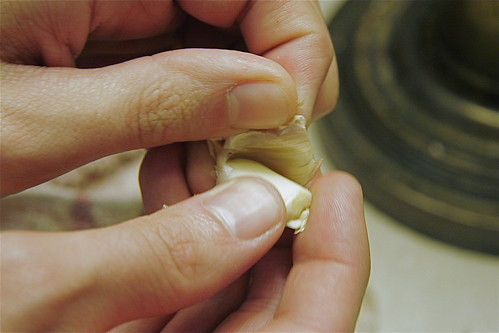
No party’s complete without it.

Traditional La Casa hand slap game.
-
Yard Sale

small version of yard sale flyer Our yard sell happened this past Saturday. Aside from a few complications and miscommunications, the sale went smoothly. It was a nice day and lots of friends stopped by. As planned, G & Ts were drunk in honor of Maria’s day of birth!
In total we pulled in between 250-300 bucks, woohoo! There’s still a lot of items left however, so we’re now having a FREE SALE. Meaning: come take whatever you want.
I had to work during the morning part of the yard sale and an anonymous photographer (named Andrew) took some nice snaps from the sale: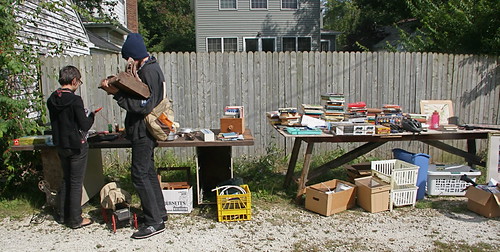


-
Sundown Towns
Last night Andrew and I went to a Unit One lecture by Sociologist James W. Loewen on Sundown Towns and racism in small town America. “Sundown Town” is a name for a town or city where whites collectively drove out and kept out black people (and also sometimes Jews, Native Americans, Latinos).
These communities are sometimes called “sundown towns” because some of them posted signs at their city limits reading, typically, “Nigger, Don’t Let The Sun Go Down On You In ___.”

The practice began in the late 19th Century, became illegal after the 1960’s and the civil rights movement, but still persisted through the 70’s, and in some cases, still persists today or until very recently.
(These archival images are taken from Professor Loewen’s slideshow on Sundown Towns.)

He’s confirmed over 400 sundown towns in Illinois alone. I used his database to check out some towns I grew up around where I’ve never once seen a black person. The question about some of these rural towns is, do they just happen to be all white, or are they all white on purpose?
Maroa, Illinois, is on his list of confirmed sundown towns (which you can search by state). He writes that the main method of exclusion in Maroa is realtors refusing to sell to blacks, and a realtor told him in 2001 that there was still an ordinance on the books making this official town policy.
The method of exclusion varies by location. Some excluded by violence, threat of violence, police or other official action, and reputation.
You can check out Loewen’s website for more information, for papers on how he conducts his research, how to confirm sundown towns, and how to help him with this project in general. He is looking for volunteers to help him conduct oral histories and research in small towns across the country.
I’m looking forward to reading up on this disturbing side of American history that deserves more attention and understanding.
-
volunteer on student farm: get tons of free veggies
I went this morning to help on the new student farm located south of campus. The farm’s manager, Zack, showed me and a group of volunteers around as we helped out harvesting.
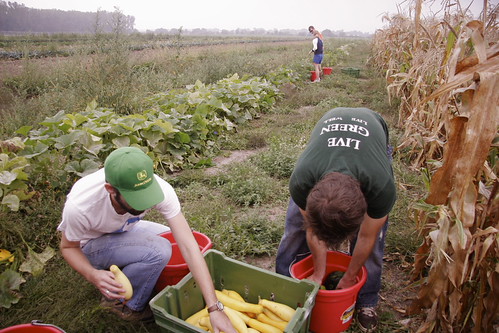
The produce from the farm is sold to University Dining Services and goes to feed kids living in the dorms. The student farm is part sponsored by the dining halls and part by the College of ACES. This is the FIRST year planting crops and they’re supplying a lot of food to the dorms.


We picked mostly squashes but some basil and parsley too.
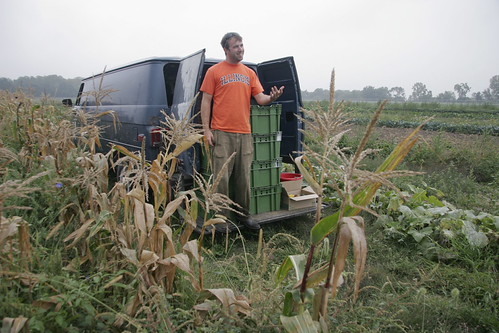
That’s Zack on the back of the van that Dining Services gave to the project.

The best part is that after a few hours of work, they let you take home as many veggies as you can carry! My roommates will be happy when they get home. -
mushroom hunting in central illinois
This past Friday we went mushroom hunting in a super-secret local spot. The key to finding mushrooms is going out a day or two after it rains. The soaked ground underneath decaying trees creates the perfect conditions for fungal growth.

In addition to a dozen or so species of fungi, we’re %90 certain we found some chanterelles, a choice edible. We cooked and tasted ’em (I didn’t try too much) and they were indeed delicious. I made a spore print, but the white spores were difficult to see on the white piece of paper that I used.

Mushrooms are so beautiful and interesting.
 Link to the rest of my mushroom photos on flickr.
 -
Losing a Queen
Honeybees are prone to swarming. A swarm is a big cloud of bees that have left the hive looking for a new home. This is a natural part of their reproductive behavior, however in a back yard environment designed to maximize honey output, swarms pose a problem.
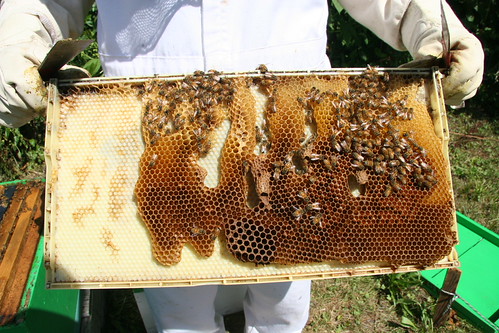
A couple weeks ago Robbie opened up both hives and noticed that in one there was no sign of a laying queen. Where there should have been cells filled with larvae at different stages of development there were instead empty cells. This indicates that either the queen died, or she took off with a swarm.

In this next photo you can see the slightly larger drone cells (where the male bees are hatched) and the very large queen cells that are perpendicular to the rest of the comb. This frame is in bad shape, and all signs indicate that bees had switched to reproductive mode.
Without a queen constantly hatching new workers, the hive would simply work itself to death and that would be the end of things. There were however many thousands of worker bees left in the hive, busy collecting what was left of the summer nectar flow. The solution to losing a queen is to simply get a new one. So Robbie contacted local bee expert, David, at Long Lane Honey Bee Farms and went to pick up a new queen. The new queen only cost about $20, and would save us the trouble of starting a new hive in the spring.
 You can see her long abdomen through the screen with the little green dot to make her easy to spot. The little cage that she came is designed to help her assimilate with the bees already in the hive. Her potent pheromones waft through the screen controlling the army of workers. The bees then chew their way through a sugar plug (black tube thing) and release her into the hive. The delay while they work to set her free insures that she won’t just fly away once released.

Robbie installed the queen cage between the two big boxes, right in the middle of the brood chamber. In a week or two we’ll open the hive back up and see if there’s any signs of egg laying. Until then, fingers crossed.
You’ll notice how the hive on the left is much taller. When Robbie noticed the absence of a queen, he moved the top honey super over. He placed newspaper between to act as a temporary barrier while the bees in there got used to their new master. Oh the intrigue of beekeeping…
-
ice cream and outdoor movies!
A few weekends ago, the members of la casa let me host a belated birthday party at the house. the party featured homemade ice cream and an outdoor movie, projected on the side of the barn.
john e, kannan, and mac brought an old-fashioned hand-crank ice maker. everyone got to contribute a little bit to making the ice cream:

we made earl grey ice cream, honey ice cream, chocolate-rum-raspberry ice cream, and avocado ice cream. nora’s boys brought sprinkles and ate a few bowls of mostly sprinkles with some avocado ice cream on top:

you can find the recipe for the earl grey ice cream here. *NOTE: i always cut the recipe in thirds. using 24 egg yolks for one recipe is just insanity.
We also stapled butcher paper to the barn and projected the egyptian movie ‘the band’s visit’, a very slow-paced comedy that i would highly recommend.

we projected a movie on the garage. (photo by Kannan) -
A Playlist
I had a radio show for four years at KTRU Houston, Rice University’s 50000 watt indy radio station. Since coming to Urbana, I hadn’t caved to the temptation of joining Radio Free Urbana (104.5 FM), a four-year-old free-form low-power community station. Until tonight, when I decided to take an hour and fill in for the Sonic Asylum show. I have no idea what the Sonic Asylum show sounds like, but I did pretty eclectically (though typically, if you know me):
“Summertime” – Allen Savedoff – Contradiction (Capstone)
“Caravan” – Allen Savedoff – Contradiction (Capstone)
“Five Short Improvisations” – Robin Goodfellow & friends – The Early Years (Experimental Musical Instruments)
“Camping in the Backyard” – Skip La Plante – La Plante (PITCH)
“Exotic Harp, Vibraphone” – Warren Burt – 18 New Fuguing Tunes for Henry Cowell (self)
“Malizi v Parizi” – Iva Bittova & Bang on a Can – Elida (Canteloupe)
“Abstain With Me” – Roy Zimmerman – Faulty Intelligence (Metaphor Records)
“Who Are Parents” – The Shaggs – Philosophy of the World (RCA Victor)
“The Dead Bird” – Dan Sedgwick – Shepherd Student Works 2006 (self)
“Burning Monk’s Waltz” – Catler Bros. – Crash Landing (FreeNotes)
“into the woods” – Astroid Power-Up! – Googleplex (self) -
hygienic bee-havior for more natural bees
Robby-Bob and I went to another bee club meeting on Sunday. It was a special event for the club. An expert was there to discuss and demonstrate ways to test bees for hygienic behavior.

The reason this is important is because beekeepers routinely use chemicals to fight off infections and pests, usually to save themselves from economic ruin. To reduce the amount of chemicals beekeepers use, an effort is underway to selectively breed bees that resist the pests. One way for bees to protect themselves is to identify and remove cells in the hive that are infected. Bees that demonstrate hygienic behavior are those that remove larvae from damaged cells. To test for this trait, they selectively freeze/kill a section of larvae with liquid nitrogen and watch to see if the dead larvae are removed by the workers.

A steel can is smushed into the comb, and liquid nitrogen is poured inside to instantly kill the larvae inside. After 24 hours, the frames are inspected.

The frame on the LEFT is from a hive that does NOT show hygienic behavior. In the frame on the RIGHT, notice how the bees removed the larvae from all the cells leaving a circle of empty comb, a sign of hygienic behavior.Many people have heard of Colony Collapse Disorder, but bees are susceptible to a range of problems and so most beekeepers rely on some sort of chemical strategy to maintain their business. Breeding hygienic bees may ultimately lead to an industry less dependent on chemical inputs, meaning more ‘natural’, or ‘organic’ honey and wax (yay!). Of course I am oversimplifying this whole process. Hygienic behavior is actually much more complicated, especially when you approach it from the genetic side.
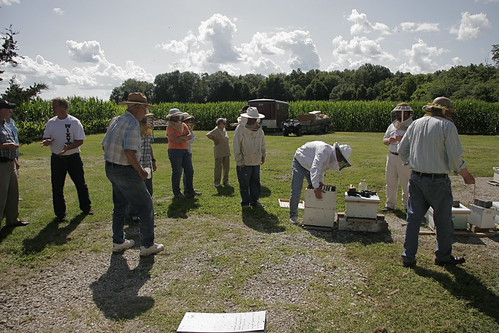
I was very lucky to be invited to the club meeting and demonstration, thanks Robby!I posted more photos of the meeting to this flickr set.
Also CEIBA wrote about the event (and used my photos!) on their website.


 La Casa Grande Colectiva