The beginning
A group of activists moved into a large seven-bedroom rooming house in Urbana and organized themselves as part of the cooperative movement of the 1970s. People have been moving in and out ever since, always under the name La Casa. It is the longest-running housing cooperative in the area.
We can’t tell you exactly what year that was, and we’d like to.
Four dates survive in four different places. A COUCH timeline written in 2003 says 1970. So does a 2004 architecture paper about the building. A COUCH press release from that same year says the house “dates to the 1960s.” The News-Gazette, writing in 1989, reported that La Casa “started in 1971.” Our own records long said 1976 — and that one, we have since learned, is the only date with nothing behind it.
So: around 1970, give or take, in a house built near the turn of the previous century. If you know better, we’d genuinely like to hear from you.
The name
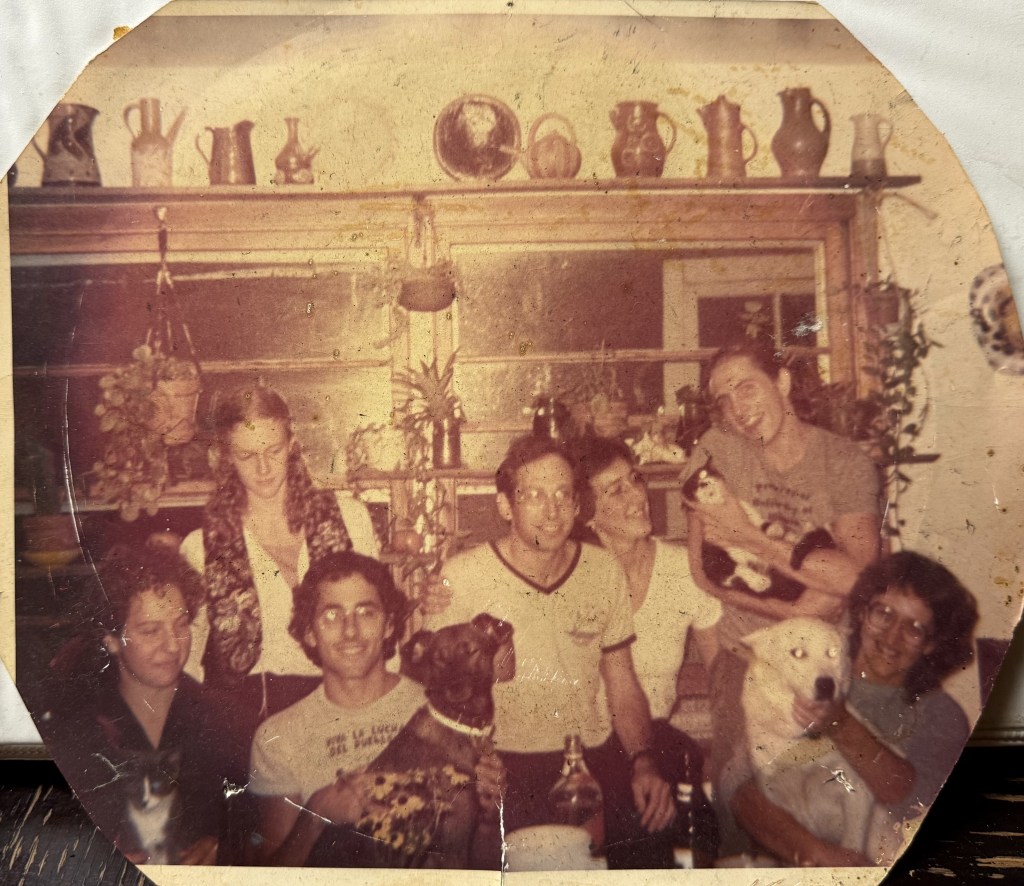
In 2011, a man named Jorge Garcia found the house blog by accident and left a comment. He’d lived here in 1978–79, and thought, with appropriate uncertainty, that he might have been the one who named the place.
I even have a memory (very possibly inaccurate) that I named the house La Casa Grande Colectiva. We lived with the twins Jimmy and Bobby R, and the United Mime Workers were always around for dinner.
That comment is the kind of thing this page exists for. There is also a neighbor, Jeff, who walks by often and said he was present in 76 when La Casa got its name.
For most of its written life the house spelled itself Collectiva, with two Ls. Somewhere along the way it lost one.
February 1989
On a Tuesday in February 1989, a News-Gazette reporter named Kirby Pringle came to dinner and wrote about it. The photograph that ran with the story shows eight people around a long table, bookshelves floor to ceiling behind them, hands reaching across for the dishes.
Six adults and one child were living here then. Debbie Doyle and her twelve-year-old daughter Julie. Steve Apotheker, who was on his way out of the director’s job at the Community Recycling Center.
I have a daughter, and for us it’s like having an extended family again. It’s just a lot of very nice people.
Debbie Doyle, 1989
The article printed the house’s bills for the month of January 16 to February 15, 1989. Rent ran $100 to $143 a person depending on the room — the same square-footage principle the house still uses. Food was $60. Utilities were $50, with the dry note “it’s a very big house.” About $270 a month, all in.
House meetings were held every Monday. New members were found by posting notices at Common Ground Food Cooperative, the McKinley Foundation and the University YMCA, and everyone who applied was interviewed. Dave Griffiths described what they were listening for:
We try to get a sense of how they live with other people, their cooking habits, what kind of food they like, if the do the dishes, their political interests.
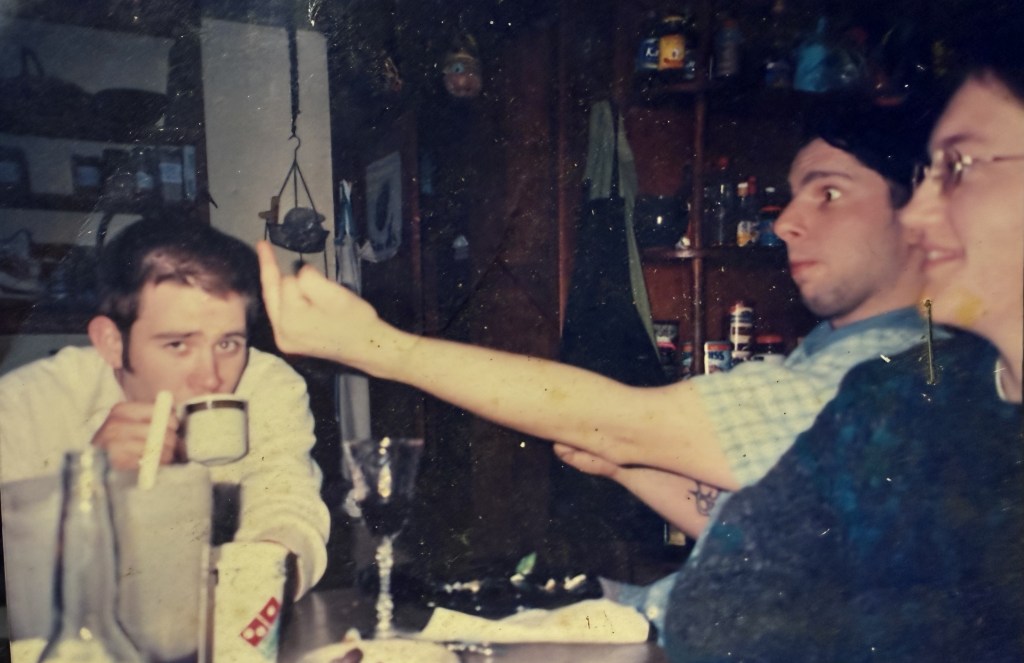
The 1980s were not kind to cooperatives. Record Service, Strawberry Fields and Art Coop all began as co-ops and abandoned the idea; the Earthworks food store folded after five years. The article noted that co-op houses tended to be “somewhat clandestine about their location,” because a house full of unrelated adults in a single-family neighborhood was usually in violation of the zoning ordinance.
La Casa came through that decade anyway. It is part of why the house is still the oldest one left.
Fred and Ametta
For about thirty years the house was rented from Fred and Ametta Rogers. Fred bought it at an estate sale and could never afterwards recall who he had bought it from. He renovated the bathrooms, and later put vinyl siding over the clapboard. In 2004 the Rogers retired and moved to Florida — which, COUCH’s annual report noted that year, “has apparently been a bit of a disappointment.”
The arithmetic matters more than it looks. If they had been the landlords for thirty years by 2004, they bought the house around 1973 — which is to say, at almost exactly the moment La Casa became a cooperative. Whoever they bought it from, they took on a coop and then kept it one for three decades.
That is most of the reason this house outlasted every other coop in town.
COUCH
In 1997, people from three Urbana coop houses — Avocado House, Green House and La Casa — got talking at the Common Ground Food Co-op and decided the town needed something larger than any one house could be on its own. They held potlucks. They studied how coop systems worked in Madison, Ann Arbor, Oberlin and Austin. They wrote bylaws, deliberately designed to allow the thing to grow.
What came out of it was COUCH — the Community of Urbana-Champaign Cooperative Housing — which incorporated as a not-for-profit in 1998 and is still running today.
La Casa was never a COUCH-owned house. It stayed independent, with its own landlord, and drifted in and out of the organisation over the years. COUCH’s 2003 annual report described La Casa as its oldest affiliated house and noted, with what reads like affection, that “La Casa participates only intermittently.”
But three houses were in the room at the beginning, and one of them was this one.
COUCH is still organising cooperative housing in Champaign-Urbana. → couch.coop
Much of what this page can say about the 1990s and 2000s comes from COUCH’s twentieth-anniversary report, researched and written by Marilena Prisco in 2023. We’re grateful for it.
The turn of the century
The 1990s are still the thinnest stretch of the record. What we have is an old list of residents kept on this site: Harlan H., who lived here from 1997 to 2001. Megan N., 1998 to 2000. Jason S., 1999 to 2001.
Harlan, we now think, is Harlan Harris — who went on to become president of COUCH in 2003, was inducted into the cooperative movement’s Hall of Fame as one of its founders, and kept the archive that made much of this page possible. If that’s you, Harlan: hello, and thank you.
2003–2015: the blog years
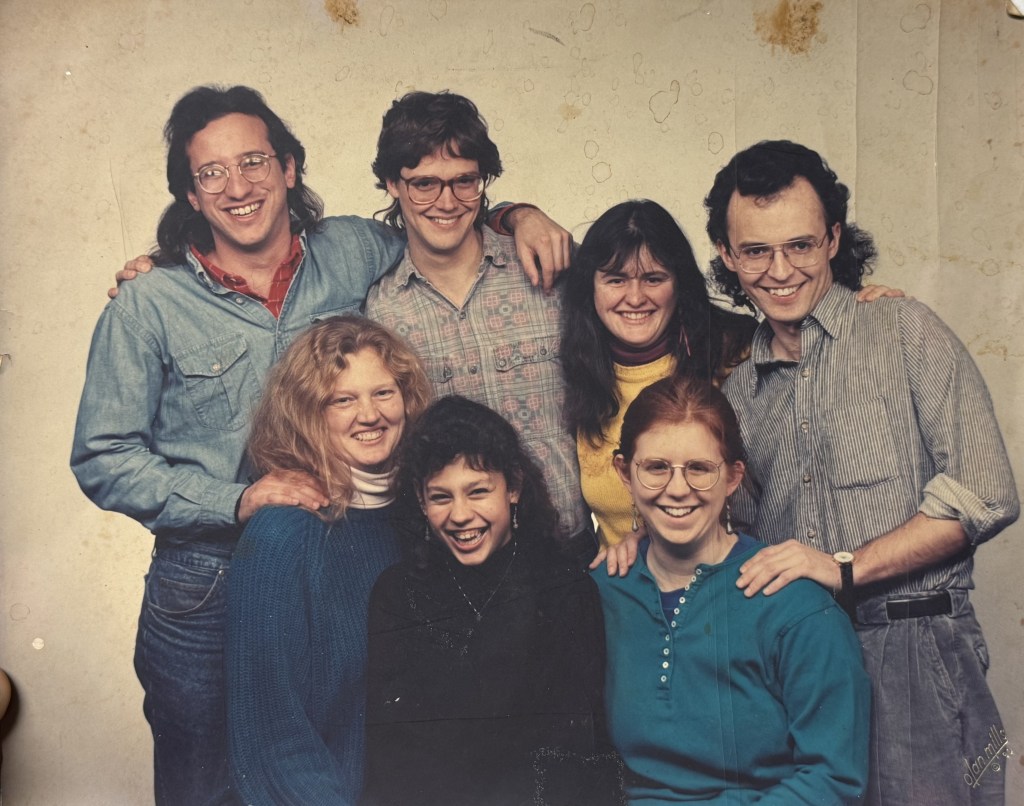
Members kept a house blog from 2003 to 2015. 193 posts documenting an unusually well-recorded stretch of the house’s life.
What was going on in those years: backyard chickens and a pair of ducks. Beekeeping. A permaculture garden with heirloom seed orders and a mushroom-growing workshop. Odd musical instruments. Bands rehearsing in the living room and leaving on tour. Potlucks big enough to make the local paper.
COUCH’s 2004 report gives a flavour of the same period from outside: beer and cider brewed, soymilk made, an orchard of fruit trees and hops planted with the Urbana Permaculture Project, a big party, a bonfire or two, and a huge tree that came down in a spring storm and had to be sawn up and carried off. That autumn more than half the house turned over at once, two couples moved in, and La Casa briefly grew from seven members to nine. The report was written by Carol Perryman and Edwin Winzeler.
The archive is still online. Browse it here.
The Memory Drawer
There is a drawer in the kitchen that has been collecting photographs since the 1970s. Nobody curated it. People moved out, left prints behind, and the drawer absorbed them.
We’ve scanned all of it — Halloween parties, garden work, enormous stockpots, a fire engine in the front yard, a bottle of home-made raspberry liqueur with its own hand-lettered label. Most of it is undated and most of the faces are unidentified.
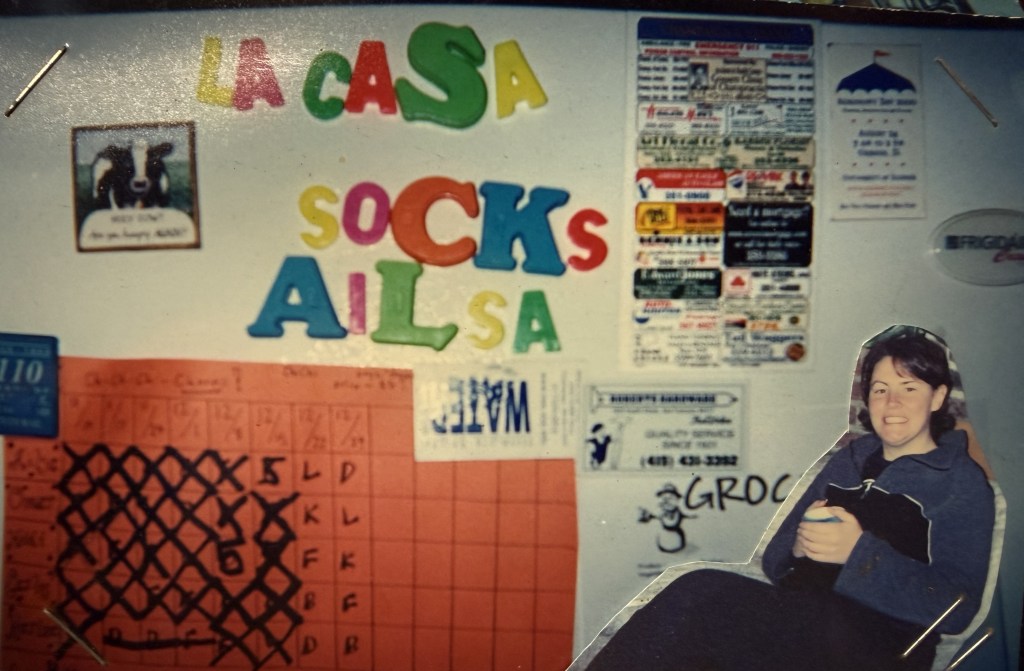
Every photograph has its own page and its own comment thread. If you recognise a face, a room, a year, or a dog, that is the place to say so.
Now
The house still runs the way it always has: consensus meetings, shared groceries, rotating roles. Rent is still calculated by the size of your room. There are still house dinners.
In 2020 the property was purchased by JP Goguen and Bitsy Weaver. JP and Bitsy had lived in the house for years before that. The intent is straightforward: keep the cooperative going as long as people want to live here.
Help us fill in the gaps
Large stretches of this history exist only in people’s memories. If you lived at La Casa — any era, any length of time — we’d like to hear from you. Photographs, documents, house rules, grocery ledgers, arguments you remember winning: all of it welcome.
The 1970s and 1980s are where we are thinnest. We would especially like to know who started this house, who the Rogers bought it from, and what year any of it actually happened.
The quickest way to help is to go through the Memory Drawer and comment on anything you recognise. Or write to us at lacasacollectiva@gmail.com.
 La Casa Grande Colectiva