
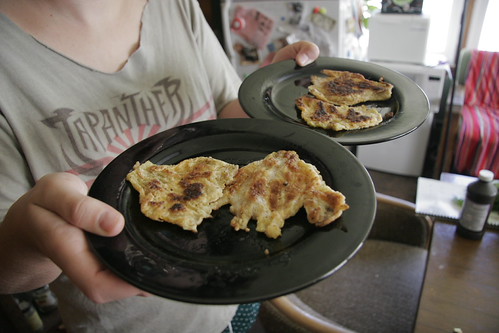
Moof! Housemate Julio here, dog-sitting Molly, a beagle that wouldn’t surprise anyone if she sprouted horns. Unattended plate of fried plantains, beware! Hungry Molly belongs to friend Christina who was out of town when this photo was taken.
Category: food
-
La Casa Real Food Olympics: Mayonnaise!
For a while now I’ve imagined a sort of La Casa Real Food Olympics: a series of foods that we in “this” “culture” usually buy already made, but which could be made from scratch, that every green La Casan would go through the experience of making from scratch just for the fun of it.
I just brainstormed 10 things that I have personally known people ’round here to make, excluding alcoholic fermentations:
- Mayonnaise
- Komboucha
- Yogurt
- Bread
- Granola
- Ginger ale
- Pesto
- Ice Cream
- Seitan
- Kimchi
I don’t know if this is the optimal order of execution, but it’s clear that making these all from scratch at least once would be a substantial accomplishment of (s)elf-reliance. Of these, I have only made mayonnaise and bread. Tonight, I teamed up with Kim (La Casa ’08 welcome back to town Kim!) to make both mayonnaise and bread again, but the bread didn’t turn out perfect, so let’s talk about the mayonnaise!
Like Kristina before me, I used the basic mayonnaise recipe from Mark Bittman’s How To Cook Everything: mix an egg, some lemon juice, some mustard, maybe some salt and pepper to taste in a food processor. Pour in a cup of olive oil in a slow stream—if you pour too fast you’ll get runny mayo! This time I used half olive, half canola oil, but it still tasted too too extra virgin for me. Still, one of the better batches I’ve made.
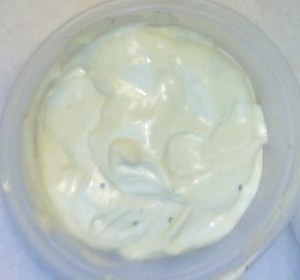
NOT a photogenic food I used the mayonnaise in Deviled Eggs, which of course involve more eggs and more mustard. They turned out great:

Delicious! -
La Casauerkraut
I think it was this article http://www.thesunmagazine.org/issues/413/countertop_culture in The Sun magazine that first caught my interest in wild fermentation. Certainly, the pallid, soggy sauerkraut of my middle American world had never once lured me. Still, my interest in home food preservation and the health benefits of raw, fermented foods made trying this irresistible, and so in I leapt. I can only say that homemade, wild fermented sauerkraut is one the most unexpected pleasures of my life now. Each batch is unique and that is part of the fun. I like to add a little garlic, a bit of carraway seed (against flatulence) and any root veggies that might be available like beets, carrots or radishes. I use the least amount of salt I can get away with which has been a bit less than the recipe and it has worked out well. Beets and purple cabbage both give the kraut a lovely pink hue. I don’t even like pink, but I have loved the colors of my kraut batches.
Anyway, Sandor Katz is the wild fermentation maven. Here’s his website, starting right off at the recipe for kraut: http://www.wildfermentation.com/resources.php?page=sauerkraut
This is the batch I made just a few days ago, dedicated to Dan Schreiber:
Cabbagecarrotconfetti 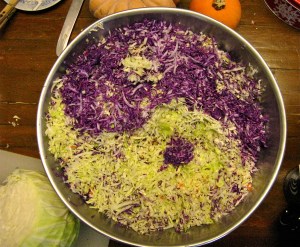
A bit of sauerkraut spirituality fun 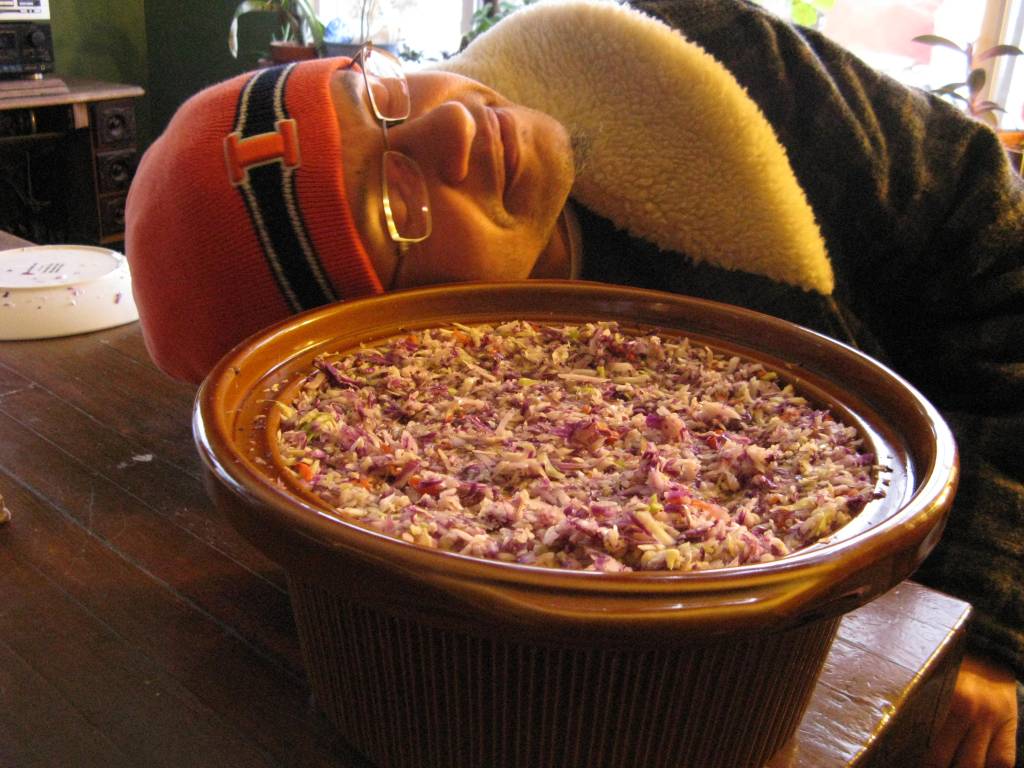
Julio giving the kraut crock some L-O-V-E I hope you make some of your own and you love it!
-
The Fall Garlic Planting and a Story About Growing Garlic
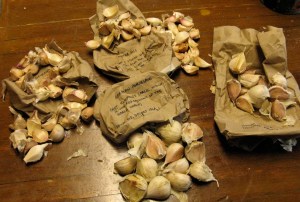
An apple-picking friend of mine from Way Back When grows some awesomely fine garlic. Her name’s Rebecca and she lives back East in Burlington, Vermont, which is where I spent the coldest winter of my life. One day the temperature with the wind chill factor was, I swear to you, 90 below zero. That’s 90. Below zero. The wind whips across the huge and frozen Lake Champlain and if you are there, you know bitter cold. Anyway…it was my great fortune this year to be a recipient of a sampling of Rebecca’s superb product. That cold but beautiful place makes for some fine, hot garlic, some of which I’m turning around and putting into our Illinois soil to, hopefully, carry on her good stuff and have lots more to devour in future times.
So, we’ve cleared out some of the tomato bed, which is petering out in this cold weather anyway. I put the green tomatoes in paper bags ala my father’s instructions. He sez they’ll ripen. We shall see. Erin and I began forking the bed, but Andrew did a lot more, then JP finished it off and worked in some compost.
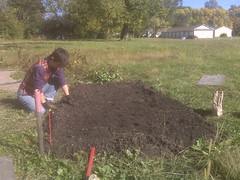 Today I planted the seed cloves from the 4 varieties Becky sent. JP helped with the first variety, Nootka Rose. The other 3 are Georgian Fire, N.Y. White and German Porcelain, the latter of which is HUGE, but NOT elephant garlic, which Rebecca said is the Red
  Delicious of the garlic world. You don’t have to be an old apple picker to know that that is tantamount to saying that elephant garlic is hardly worth eating, though, actually, La Casan Jacob would argue this point as he somehow is convinced that Red Delicious apples have some redeeming value. My heart aches for the dear boy. The German Porcelain garlic, indeed, is nice and strong, tons of flavor.
Now here’s a little story which is true:
I farmed garlic in Washington State for about a year and a half. I knew an elderly couple, the Webbers, who had formerly grown garlic organically. I thought the organic aspect was impressive as they had farmed many years before, far ahead of the current organic heyday and even far ahead of the beginning surge in the early 80’s. They were in their 90’s when I knew them back in the 90’s. Anyway, they let me and some friends of mine plant their field which was a nice field with an excellent view of Mt. Stuart.
 We did garlic and a lot of potatoes, too. One thing, though, their field had gophers. Not only did their field have gophers, but that field had more gophers than I knew could live in one field and what’s more is that these particular gophers had to taste every single garlic bulb to be absolutely sure that they didn’t like garlic. Also, the field had bindweed. It had extra strength bindweed that could bring down a rototiller in an astonishingly short amount of time, but which did not, apparently get in the way of gophers. Ever since, I can hardly believe it when I see packets of morning glory seeds for sale. I want to tell people not to ever plant it, that it comes from the devil. The DEVIL! And irrigation was, as I recall, quite tricky in that field. Al (Mr. Webber) made constant improvements to his “system”, though it never seemed become less tricky to me, and I think, quite possibly, more so. I do recall one great leap in the irrigation technology where the involvement of PVC pipes boosted our watering capabilities, but only for a day or so. Really, all those gopher holes led to one mother tunnel which emptied out not into the field at all, but, oh, down there, off the side of the hill. I thought perhaps it would at least have the benefit of washing the gophers away (or drowning the motherf*ckers), but it seemed to not impinge on them at all and what does not kill them makes them stronger. Pretty sure about that. If anything it seemed to have softened the soil up for them quite nicely. (It may have been about this time in my life that the murder of certain animals [being various rodentia] began to seem maybe not quite so abhorrent as I once thought. My dogs proved to be superior diggers, but insufficient gopher catchers. That’s a big help, as you can imagine.) Oh, and there was the wind. I wouldn’t want to neglect giving due mention to the wind which allowed for no hats, would throw dirt in your eyes, which once knocked me clean over and whose relentless blast caused me to cry and curse the wind god. (I only did that last thing once because the wind picked up noticeably when I did it.) Nonetheless, regardless and despite all we had a lot of fun and we all had garlic and spuds to last and it sure made the Webbers happy. I do not believe I would want to do it for a living, though. Not in that particular field, anyway.
Garlic chomping gopher. Say that 3 times fast. 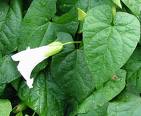
Bindweed (Morning Glory) -
Pan-Fried Jerusalem Artichokes in Sage (vegan) Butter
 The species in the la casa permaculture garden were chosen for their niche in the whole system. Helianthus tuberosus, aka jerusalem artichokes or sunchokes, produce tasty tubers
 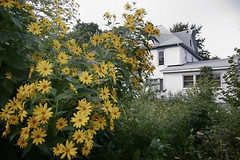 underground and beautiful clusters of yellow sunflowers above ground. The plants grow to almost 10 feet and the tubers can grow as thick as your wrist. Although most of the ones I harvested today were about as thick as your thumb.
You may be confused. They’re not artichokes, and they’re definitely not from Jerusalem, so what are they? Well, they are more like potatoes that shoot off the roots of a native sunflower. They grow vigorously and can compete with most weeds, however they don’t store as easily as potatoes and so are less commercially viable. They are a popular permaculture plant.
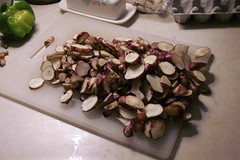
I had a craving for something fried so I found a recipe for Pan-Fried Jerusalem Artichokes in Sage Butter on epicurious. I went out just before dark and dug up a bunch of tubers.

They were very aromatic as I was digging them out and washing them. It took awhile to scrub and clean all the dirt off. From then I followed the recipe, doubling it and subbing vegan butter for regular butter.

Ingredients
- 3 tablespoons butter, divided
- 2 tablespoons olive oil
- 1 pound Jerusalem artichokes,* scrubbed, cut crosswise into 1/4-inch-thick rounds
- 3 tablespoons coarsely torn fresh sage leaves, divided
- 2 teaspoons fresh lemon juice
- 2 tablespoons chopped fresh Italian parsley
Preparation
Melt 1 tablespoon butter with olive oil in large nonstick skillet over medium-high heat. Add Jerusalem artichokes and half of sage. Sprinkle with salt and pepper. Sauté until brown and just beginning to soften, turning frequently, about 10 minutes. Using slotted spoon, transfer Jerusalem artichokes to shallow serving bowl. Add remaining 2 tablespoons butter and sage to skillet; fry until sage darkens and begins to crisp, about 30 seconds. Add lemon juice; simmer 1 minute. Pour lemon-sage butter over Jerusalem artichokes in bowl, tossing to coat. Season with salt and pepper. Sprinkle with parsley.
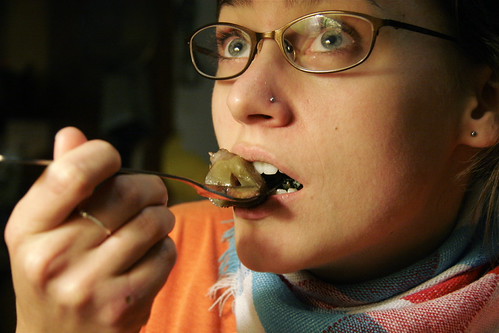
The result: well it was my first time cooking with them and I used the wrong type of pan. Some slices were cooked thoroughly til mush, others were still crunchy and undercooked. The flavor I thought was quite good and a few housemates agreed.
WIN!
Here’s some research about jerusalem artichokes I found online, zipped up.
-
roasted eggplants, baba ganoush, lunch

Oh, those deep purple beauties ripening, ripening.

A little campfire, a lot of fire-roasted eggplant.

Delectable end product.
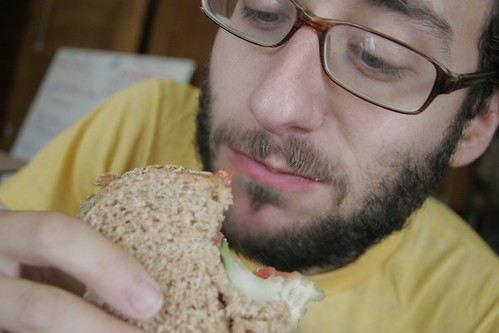
Andrew eating the hell out of a baba ganouj sandwich.
When you’re really lucky you plant some plants in just the right spot at just the right time and they say, “Man, I feel so good, I’m going to grow like mad and make lots of whatever it is I make.” We were sooo lucky here at La Casa. The eggplant plants went in the ground considerably past the prime time AND as you all know, summer was unusually cool. Eggplants like time to grow and some heat, you know, so what the hell? Not that I’m complaining. No. I am not. I’m rejoicing and not just about the mysteriously extraordinarily huge and productive plants that are our eggplant plants, but about wonderful new La Casan, Erin, who knew that you can put your eggplants by a fire to give them that extra flavor edge for better baba ganouj. But that’s not all! There’s extra flavor and then there’s someone who really knows how to work it. We at La Casa are fortunate enough to have in Erin, not just someone who can fire-roast an eggplant, but who can push that extra flavor to it’s most excellent extreme. It was so much fun today watching one after another of my fellows take their first bite and say, almost invariably, “Oh, my god!” You know, pure astonished delight.
If you want to fire-roast your eggplants just put them near your fire, almost in it. They will slowly start to shrivel and sag a bit. Keep turning them until the whole things is more or less rather shriveled. They should maintain their skin’s integrity for the most part. If they go up in flames you have gone well beyond fire-roasted.
Thanks to JP for photos and to Erin for the damned good grub. And La Casans in general for just being so great!
-
volunteer on student farm: get tons of free veggies
I went this morning to help on the new student farm located south of campus. The farm’s manager, Zack, showed me and a group of volunteers around as we helped out harvesting.
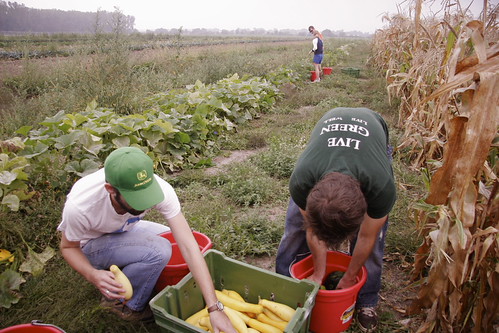
The produce from the farm is sold to University Dining Services and goes to feed kids living in the dorms. The student farm is part sponsored by the dining halls and part by the College of ACES. This is the FIRST year planting crops and they’re supplying a lot of food to the dorms.


We picked mostly squashes but some basil and parsley too.
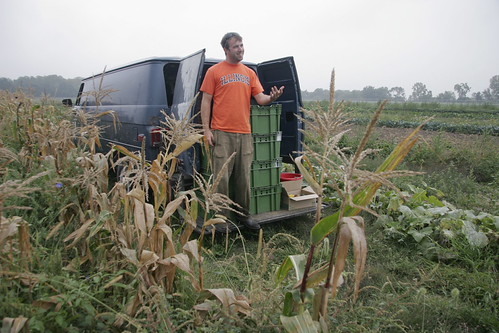
That’s Zack on the back of the van that Dining Services gave to the project.

The best part is that after a few hours of work, they let you take home as many veggies as you can carry! My roommates will be happy when they get home. -
paw paws, awesome
The paw paw genus (asimina) contain the largest edible fruit indigenous to this continent (says wikipedia). They apparently taste like a cross between a banana, a mango, and a pineapple. I’ve just begun learning about paw paws and recently was at a paw paw forest about an hour away.

The big leaves give the plant away, but the fruit are even more distinguishable.

Paw paws a very fascinating, I would recommend the wikipedia entry as a good introduction. Kentucky State University is building a great website for paw paw information and research of which there is surprisingly little. Compared to standard orchard fruits, not a lot of people are working with paw paws because they have a very short shelf life. For the backyard orchardist who doesn’t have to worry about shipping and storage, the paw paw could be an easy delicacy. Due to the fact that they’re indigenous, they are extremely pest resistant.There’s one paw paw on the Urbana Fruit Map in someone’s yard and they’re not overhanging the sidewalk (yet), so don’t take any!
Paw paws grow densely in the understory layer. Next time you take a ride down Washington St stop and take a look at the beautiful trees with the big leaves.
-
canning goodness
We canned a lot of things this past wednesday.
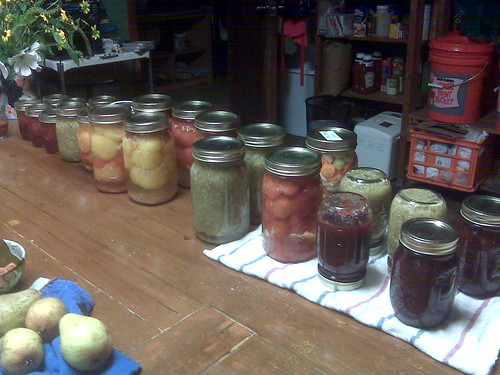
Maybe Carly can update this post with some more info!
-
mushroom hunting in central illinois
This past Friday we went mushroom hunting in a super-secret local spot. The key to finding mushrooms is going out a day or two after it rains. The soaked ground underneath decaying trees creates the perfect conditions for fungal growth.

In addition to a dozen or so species of fungi, we’re %90 certain we found some chanterelles, a choice edible. We cooked and tasted ’em (I didn’t try too much) and they were indeed delicious. I made a spore print, but the white spores were difficult to see on the white piece of paper that I used.

Mushrooms are so beautiful and interesting.
 Link to the rest of my mushroom photos on flickr.
 -
fried pumpkin blossoms
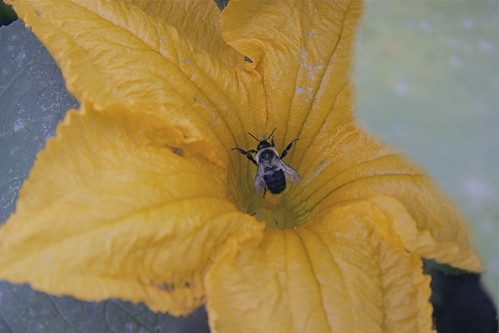
Carly made some tasty fried pumpkin blossoms and I watched and took photos.

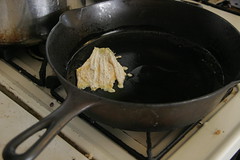
Cut the bottoms off the blossoms so you’re left with only the petals. Dip them in some beaten eggs mixed with milk (or soymilk). Then rub some bread crumbs and flour on them. Oil up a pan and throw em in. Let them fry until each side is getting a little golden. Then serve ’em to your hungry housemates.
Here’s what the blossoms look like with a bee chilling in there.
-
Hives get taller
Head-beekeeper, Robby-Bob, came by yesterday and added a shallow super to both hives.

Based on the progress that was observed in the last bee post, the hives were past due for some extra expansion room. It took a little while to source the correct size frames for the shallower top boxes, and Robby installed them while I was in class. Ideally the bees will use the new frames mostly for honey that we can later harvest. Robby decided not to use a queen excluder, so there’s the potential that the queen will get up there and lay eggs. We have enough supplies for one more box on each hive depending on how well they take to the new frames.


 La Casa Grande Colectiva