Wet and windy weather saw our expert friend, Rafter, lead a mushroom workshop on April 16th! Indoors for a PowerPoint, Q & A and snarf session; then outdoors for Shitake log inoculation and garden bed prep. Thanks to housemate JP for his effort and achievement in helping organize a delightfully illuminating event. And kudos to our many guests whose enthusiastic participation and food contributions will undoubtedly manifest in a good-Karmic harvest. Happy, happy!
Category: permaculture
-
First Duck Egg!
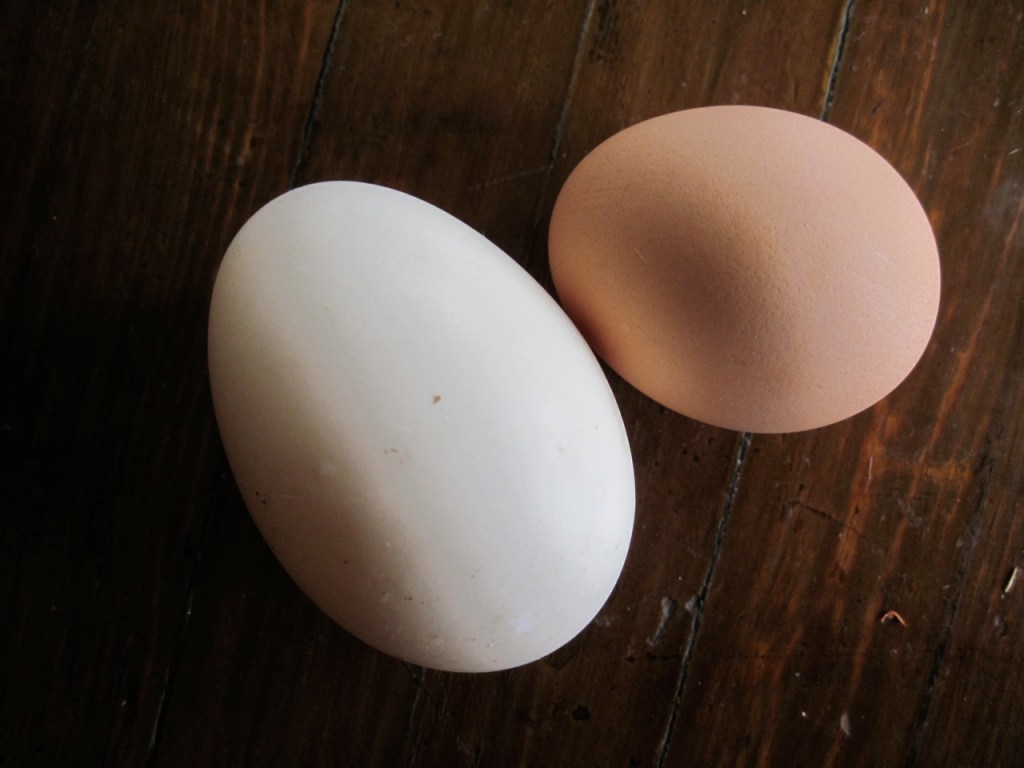
Prized duck egg (left)! 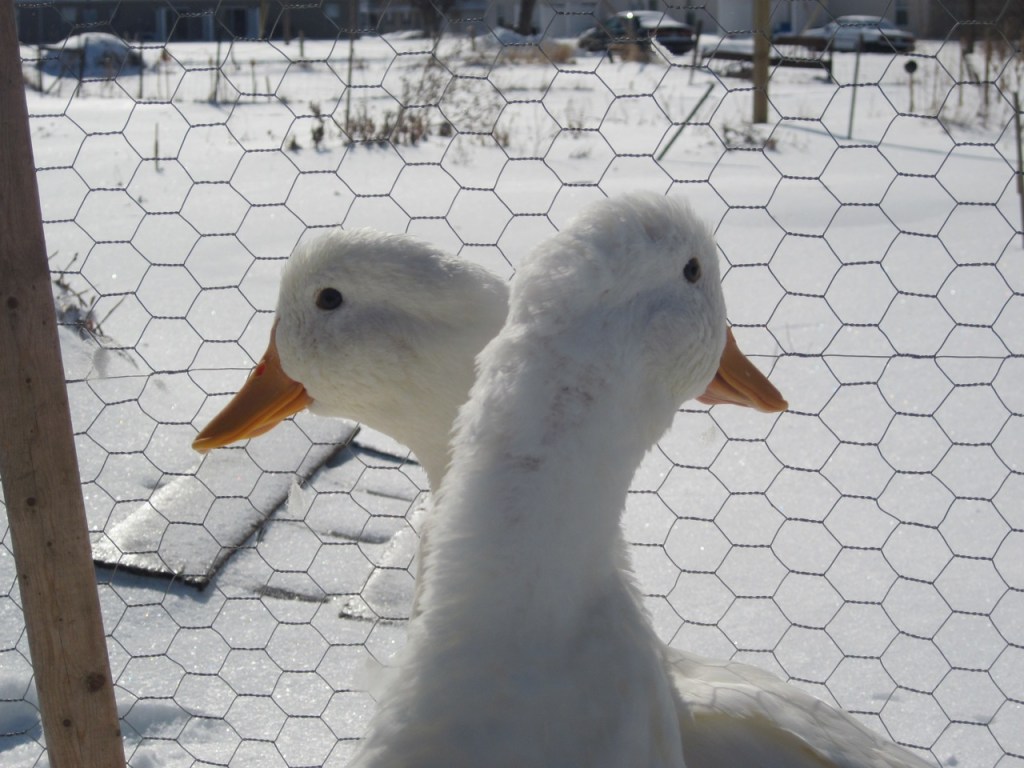
Our ducks, Mr. and Mrs. Cloud (as named by Joshy) Meet our ducks: Mr. & Mrs. Cloud. Based on what we were told when we adopted them last Fall, we didn’t expect to see a duck egg anytime soon (if ever). Well, as you can see, the layin’ has begun! This egg is amazing, with a shell that’s almost translucent, like vellum. It has been suggested that Mr. & Mrs. Cloud are especially content, now that they’re allowed to walk themselves to and from the garden puddles. Let’s hope there’ll be many more eggs to come…
-
planting pawpaw seeds
The other day I stopped by the house on Washington St that has pawpaw trees growing in the yard. A nice lady named Ruth greeted us in her driveway and we spoke for awhile about her trees. They were planted 45 years ago by her husband who saved a few seedlings from a grove that was about to be bulldozed on campus.

Happy to share her bounty of fruit, she graciously served us slices of freshly ripe pawpaw and sent us each home with a few fruits. When I told her I was interested in growing my own, she gave me a container with hundreds of seeds. I also saved all the seeds from the fruits she gave me.
Eating Ruth’s pawpaws was the first time I’d ever eaten a fully ripe one. I thought they were incredibly delicious.
Normally people plant the seeds in deep containers and transplant the seedlings after they’ve grown a bit. First, however, the seeds need to experience a period of cold lasting 90-120 days, called stratification. This is achieved by refrigerating the seeds during the winter. Of course this is a lot of work and it requires patience, a quality that I can’t always depend on myself having.
My plan is to plant all of the seeds in our shady front yard. The grass grows terribly under an old Maple tree, and pawpaws can tolerate a lot of shade. I chose to plant the seeds directly into the soil, allowing them to stratify naturally during the winter. This reduces the overall amount of work. Instead of planting a few seeds and carefully watching them, I planted a lot of seeds and allowed nature to do the rest of the work.
Using a rebar spike I stabbed the ground and dropped a seed, over and over, until over 100 were planted. The idea to plant this way came from this movie. If none of them come up, no biggie, the whole process took less than an hour. However, if some come up, then a lot will, and the chances of a few surviving are better than slim.

After I planted them I received this email back from a paw paw expert: “Maples are difficult trees to plant pawpaws under because the maple roots are so aggressive and out compete the pawpaw roots for water and nutrients. At least that is true in general if not very every situation. Pawpaws grow very often in association with tulip poplar and ash. If your soil is deep and rich, then maple is probably okay.” So I guess I have to hope our soil is “deep and rich.”
The seeds will first grow a 10 inch taproot before emerging above ground next Fall. Sometime in August 2010, I’ll be looking for tiny seedlings and hoping that somehow they’ll survive the following Winter and grow into trees.
I zipped up all my pawpaw research and you can download it here. Also, this page is loaded with info.
-
paw paws, awesome
The paw paw genus (asimina) contain the largest edible fruit indigenous to this continent (says wikipedia). They apparently taste like a cross between a banana, a mango, and a pineapple. I’ve just begun learning about paw paws and recently was at a paw paw forest about an hour away.

The big leaves give the plant away, but the fruit are even more distinguishable.

Paw paws a very fascinating, I would recommend the wikipedia entry as a good introduction. Kentucky State University is building a great website for paw paw information and research of which there is surprisingly little. Compared to standard orchard fruits, not a lot of people are working with paw paws because they have a very short shelf life. For the backyard orchardist who doesn’t have to worry about shipping and storage, the paw paw could be an easy delicacy. Due to the fact that they’re indigenous, they are extremely pest resistant.There’s one paw paw on the Urbana Fruit Map in someone’s yard and they’re not overhanging the sidewalk (yet), so don’t take any!
Paw paws grow densely in the understory layer. Next time you take a ride down Washington St stop and take a look at the beautiful trees with the big leaves.
-
Honeybees arrive
We installed two hives of honeybees today at La Casa. Fellow co-oper, Robby from across town will be using our yard (and pollen) to raise honeybees. Robby got his hive boxes from his grandfather who was a beekeeper. Robby’s been taking classes from the Central Illinois Beekeeper’s Association: CEIBA. Last night we picked up the bees from a queen breeder near Danville. They were sealed in boxes for transport in the van.
About 10,000 bees came with each queen. Five frames from a two healthy colonies, along with a two queens were put into boxes. Today we tranported the frames into the hives. Robby moved the first colony, and I moved the second. We had to wear full bee suits otherwise the bees would have stung us many times. It was quite a rush carrying the frames full of bees and being careful not to disturb them too much. We took a bunch of photos, and I’m just going to go ahead and post most of them.

Robby tried to calm the bees down with sugar water. There were hundreds flying around us as we were working.
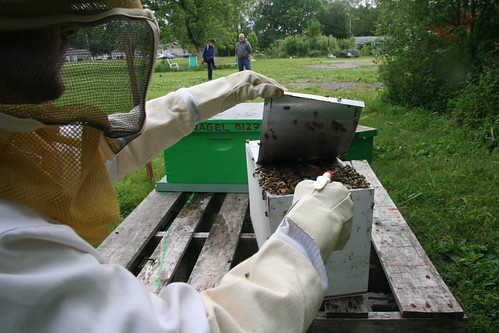
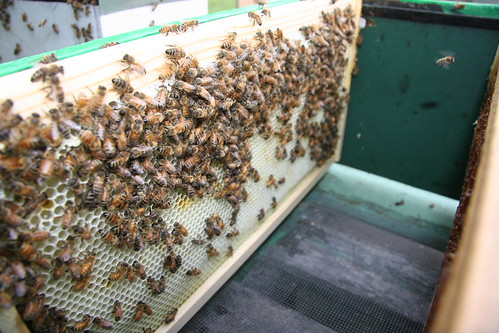
This is what frames look like installed in the hive. There are ten frames in each section of the hive. We mixed the five frames full of honey and brood (developing bees) in with 5 clean frames.
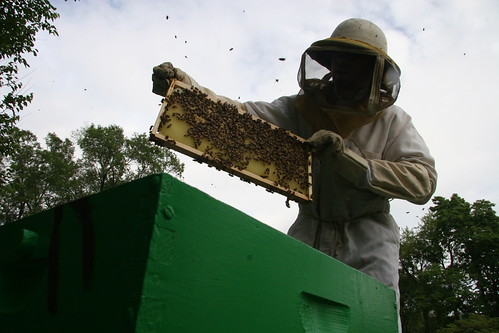

Most of the frames are installed. Just a few more to squeeze in.
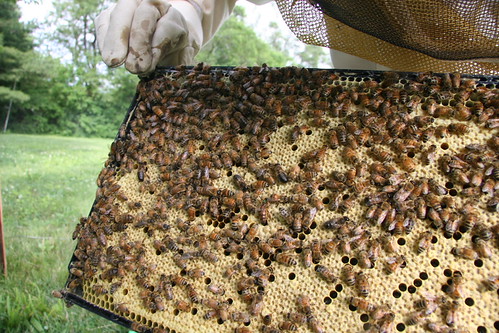
You can see the queen crawling around in this photo. There’s a little green dot on her back. Try this hi-res version if you want to see her up close. She has a longer body and smaller wings.
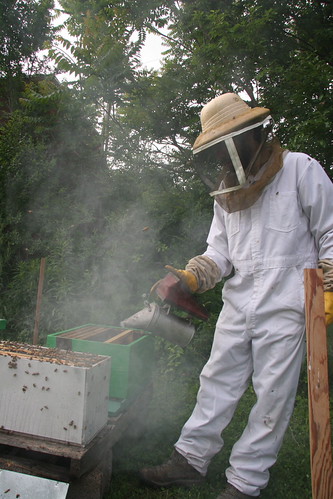
I suited up and moved the second set of frames while Robby took photos. This time we tried the smoker instead of sugar water. The smoke calms them down and confuses their communication.
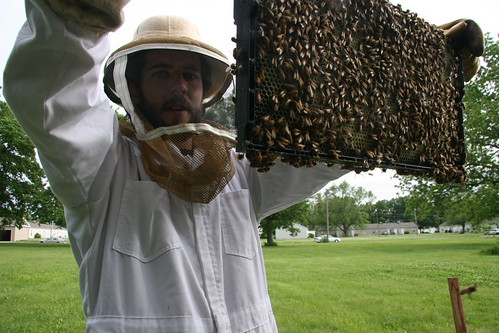
Robby snapped this nice photo.

Calming them with more smoke. Only two frames left to move.
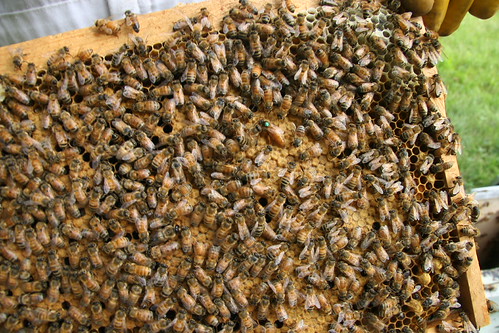
The other queen. Look for the green dot. Hi-res.

All put back together. Bees installed. The next move is to put more boxes with clean frames on top. The hives are designed to be modular, building up from the bottom box. Two big boxes at the base are where the queen builds up her colony. Then at some point smaller boxes are placed on top with a screen that lets only the workers past. Since only the worker can access the top boxes, no eggs are laid and they become full of honey. Since we’re starting this hive pretty late in the season, we might not get much honey this year. But its still a worthwhile project and if the hives survive the winter, we’ll have plenty of honey next year. -
perennial emergence
Would anyone like to trade some images for some words? How many words are these pictures worth? ~JP
I meet your five pictures with five poems. Brownie points to those who guess th constraint. ~AndR

Bamboo Shootsblasting aggressively, my bamboo oozes out,
striking hard only once: three shoots

Cascade Hops“climb! a skyhigh clamor! away, dread earth!”
(how ordinary: pursuing sun)
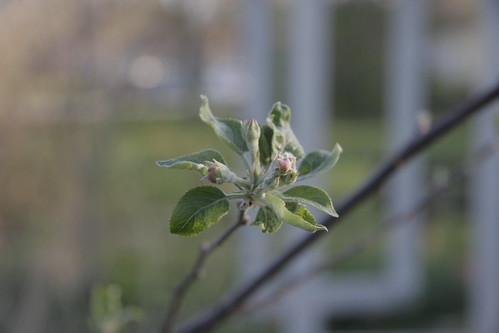
Apple bud blossomsa plump pink leafy existence
but under drunk
billowing laughter of some smiling ovary: my spectacle

Asparagusaerodynamic sunfed plant, arousing rustic “awwww’s”: give us splendor
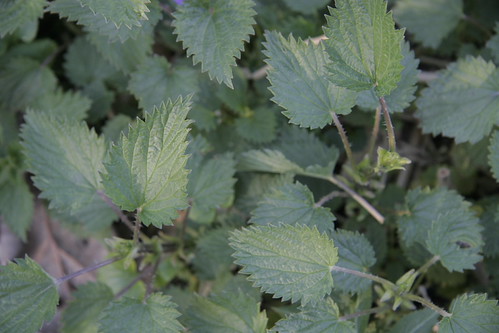
Stinging Nettlesspines touch. i never go in nighttime gowns
never ever tattle try like embers: sigh -
Grafted Golden Delicious
My friend and band-mate Sam generously gifted me this piece of M-7 rootstock with three golden delicious apple buds grafted onto it. Sam’s horticulture class at Parkland College was doing a unit on grafting and he wanted to share what he was learning with me and La Casa. We grafted on two dormant buds in Sam’s kitchen Friday afternoon and I biked home with it all smiles. I’m keeping it in the sunny room with the seed starts until its ready to move outside.

The golden delicious graft with the seedlings in the background. Three buds were grafted onto the rootstock. I did the top bud and Sam the middle. After the buds grow the green on top will be cut off. -
modeling the La Casa permaculture garden in 3D
Here’s a 3D model in that I’m in the process of building to document our permaculture garden. It includes a mock-up design for the pond that attempts to maximize the amount of perimeter. I’m still learning how to use Google Sketchup so I haven’t added too many bells and whistles.
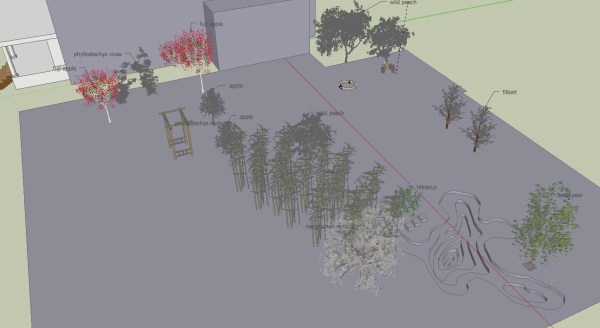
I sense an interesting utility in 3D modeling software when building permaculture designs. I’m already comfortable using photoshop but it was a conceptual leap to start working in the third dimension. Google made Sketchup very user friendly and they have online tutorials to explain each tool. Here’s a good place to start if your interested. The killer feature that google implemented is the ability to download and add models to the 3D Model Warehouse. That is where all the trees in my model came from. Other users have already started adding their own permaculture designs.
-
Bee Hives Arrive
Harvest House resident Robby Nagel brought his beehives over today. Robby inherited the hives from his grandpa who retired from beekeeping a few years ago.
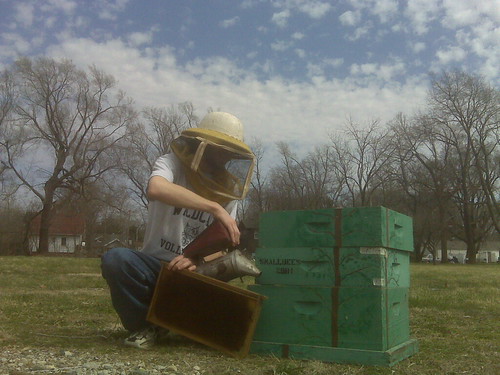
Robby has been going to beekeeping classes offered by the Central Eastern Illinois Beekeepers Association and approached us a few months ago about keeping bees in our big yard. We’re not only glad to share in the honey but the bees will function as excellent pollinators to our trees and crops. In the photo above, Robby is showing me how the different pieces of equipment work. -
weekend update, permaculturist, beds, holes, lots of talk, and eggplant parmesan
There’s a lot going around the house these days. Here’s a quick recap of the weekend.

Andrew and Ronna transplanted some of the sod that was leftover from new garden beds to a bare spot in the front yard. Sophie supervised.

Rob brought over a friend and longtime permaculture expert, Peter Bane, for a chat in the garden. It turns out the Peter grew up in Urbana and had lots of stories about home-scale food production in the area.

Gretchen brought over some eggplants and whipped up a two stellar pans of eggplant parmesan, one vegan. It was incredibly delicious.There were many hours spent outside, digging, thinking, and moving. Plans for the pond that we’re digging have taken off. Now we’re thinking about ducks, fish, and waterfalls, although lots of research needs to be done still. Garden excavations have continued, and Mac, Kannan, and JohnE have improved their beds with compost and more topsoil. Ronna has been ‘potting-up’ some of the seedlings as its not yet time to move them outside. All in all a good weekend.
-
Final dispatch from Rob as New House Members take over the Garden
(*This is now the redirect from http://www.robscott.net/lacasa/ —if you are looking for pre-2009 info on the Garden at La Casa Collectiva you can find links to earlier posts further down on this page.)
In February 2009, I met with some of the new housemates at La Casa to chat about the garden there, discuss permaculture, etc. This is when the energy really shifted around the garden, with people like Ronna, JP, and others really stepping up to make things happen in terms of annual vegetable production and whatnot. I handed off the below blank map and note about the configuration of the perrenials just before this blog was started (see next post). This content, and all the material before it, was added years after the blog was initiated.

This is a blank map that can be used to draw sketched of garden plans upon. Though it is not very clear from this map, the perennials (in particular the trees) had been planted in a horseshoe configuration, with the open end pointed south so that the sun would not be blocked by the trees. The Asian Pear on the South side was an mistake/exception to this design.
The concept of a sun trap has been used in this garden, although not strictly. The idea is that, in general, the tall perennial components of the garden are arranged in the shape of a “U” with the open part of the U facing south. In this way, the perennials serve to create a few walls around the garden, protecting it from wind, and providing some privacy, plus a nearby source of mulch (tree leaves) etc. while leaving the south side open for good light penetration from the sun. Additionally, the La Casa Garden has some warmer climate perennials planted near the house, specifically a timber bamboo and a black-cane bamboo, which are otherwise impossible to grow in Illinois – they can survive in the warm microclimate by the house. The plebian drawing above shows the suntrap wrapping around the back of the house whereas the one at La Casa passes in front of the house, so that when people look out the southern windows of the house, they see shrubs and trees just outside the window. -
Garden Flooding

One day when Eun Ah visited Urbana for the first time she found Michael and Rob staring frustratedly at the flooded annual beds and chicken area in the garden. Note the objects placed around so that the chickens could use them as islands where they could stay dry. This was a combo of sump pump water (from the house) and continuous rain that logged the soil through May and into June. Flooding mades it difficult to work on the garden.. Michael diverted the sump water to the sewer in the street after this. The swale in the garden can take some water but this was too much this year.


 La Casa Grande Colectiva