Tag: apiary

  • hygienic bee-havior for more natural bees

    Robby-Bob and I went to another bee club meeting on Sunday.  It was a special event for the club.  An expert was there to discuss and demonstrate ways to test bees for hygienic behavior.
    introducing the demonstration
    The reason this is important is because beekeepers routinely use chemicals to fight off infections and pests, usually to save themselves from economic ruin.  To reduce the amount of chemicals beekeepers use, an effort is underway to selectively breed bees that resist the pests.  One way for bees to protect themselves is to identify and remove cells in the hive that are infected.  Bees that demonstrate hygienic behavior are those that remove larvae from damaged cells.  To test for this trait, they selectively freeze/kill a section of larvae with liquid nitrogen and watch to see if the dead larvae are removed by the workers.
    demonstration- freeze kill with liquid nitrogen
    A steel can is smushed into the comb, and liquid nitrogen is poured inside to instantly kill the larvae inside.  After 24 hours, the frames are inspected.

    bees without hygienic behavior bees with hygienic behavior
    The frame on the LEFT is from a hive that does NOT show hygienic behavior. In the frame on the RIGHT, notice how the bees removed the larvae from all the cells leaving a circle of empty comb, a sign of hygienic behavior.

    Many people have heard of Colony Collapse Disorder, but bees are susceptible to a range of problems and so most beekeepers rely on some sort of chemical strategy to maintain their business.  Breeding hygienic bees may ultimately lead to an industry less dependent on chemical inputs, meaning more ‘natural’, or ‘organic’ honey and wax (yay!).  Of course I am oversimplifying this whole process.  Hygienic behavior is actually much more complicated, especially when you approach it from the genetic side.
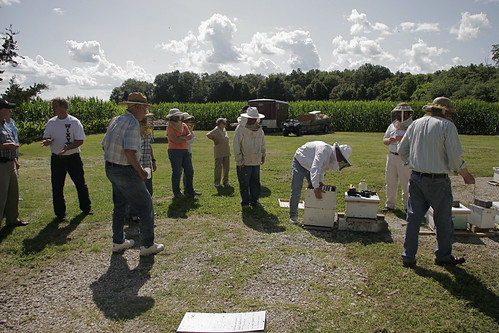
    queen removal
    I was very lucky to be invited to the club meeting and demonstration, thanks Robby!

    I posted more photos of the meeting to this flickr set.

    Also CEIBA wrote about the event (and used my photos!) on their website.

  • Hive Tour 7/12/09

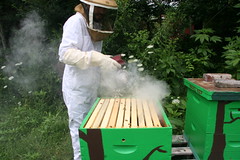
    smoking the beesMy good friends Kannan, and Mac helped me get a closer look inside out hives yesterday.  Four weeks ago I put the second deep supers on each hive.  The supers were full of bare frames, meaning the bees needed to build the comb before they could use them.  Well, after checking out the hives I can say they are doing excellently.  Lots of brood and some full frames of honey.  There were even empty brood chambers where baby bees had already emerged.  This means we probably need to add more space to allow the hive to continue to grow.

    The diagram on the left is similar to our hives, (different lid and different number of frames) but it gives you an idea of how the hives are constructed.  Its a fairly simple design.  Wooden frames are suspended inside a box, and the boxes are stacked up.  The bees then build honeycomb on both sides of each frame.  I had some handy helpers, so we were able to take clean photos of each frame.  I cropped all the photos in a similar way so you can flip through each cross section of the hive.  As you get towards the middle you’ll notice that there is less honey and more brood.  The queen lays eggs in a somewhat predictable pattern, and experienced beekeepers use that to judge the quality of the hive.

    Vodpod videos no longer available.

    full screen slide show of hive 1

    Vodpod videos no longer available.

    full screen slideshow of hive 2

  • Late Spring Bee Checkup

    Ed, a local beekeeper, came to check out our hives for a three week checkup last weekend. Robby is out of town, so he arranged to have some members of CEIBA help keep an eye on the hives. We had gotten a late start with our bees but each queen came with 5 frames of brood and honey. In just a few weeks, the bees have really established themselves and Ed determined it was time to add the second box on the hive. This will give each hive 10 fresh frames to build comb and expand the colony size.

    Capped Brood

    This frame is full of capped brood.  Brood is the general name for combs that have eggs and larvae.  The worker bees feed the developing larvae before sealing them in with a cap .  In a few weeks these bees will hatch and the process will start over again with the queen coming around and laying eggs in each comb.  In this way, the colony will double and triple in size very rapidly.

    Bee emerging

    In the center of this photo, a bee is hatching from the comb.  We watched as the bee ate away the cap.  Like eating corn on the cob, she went back and forth chewing her way out.  After she leaves, the workers will clean out the comb and get it ready for another egg.

    Honey Combs

    This is what the comb looks like when the bees decide to store honey instead of brood.  This looks like it was a fresh frame to begin with since you can still see in the lower left that the comb hasn’t been fully drawn out by the bees.  There must be a lot of nectar flowing now because even though the comb isn’t finished, the bees are already storing and capping honey.  In the upper right is capped honey.  To process the honey, the bees sit over the comb and fan their wings to evaporate off the water.  Once the honey is sufficiently concentrated they seal the comb off.  You can tell the difference between capped honey and capped brood by the color.

    I took lots of photos so we could inspect the bees in depth without keeping the hive open for too long.  Click the thumbnails to go to a flickr set of the event.

    more bee pics