Tag: bees

  • What do bees do in the winter?

    Hives on a sunny winter day
    Unless you have a beehive in your backyard, you don’t see a lot of honeybees during Winter.  In order to survive the long cold between flower blooms, the whole colony balls up inside of the hive and conserves heat by rubbing against one another.  This mass of bees starts at the bottom of the hive and moves up the center eating all the honey.  If they built up enough of a stockpile and the beekeeper didn’t take it all in the Fall, there will be enough to last till the Spring bloom.  We didn’t harvest any honey last Fall, in fact Robby added an extra box of honey for the weaker of the two colonies (note the white box).

    Another factor that helps the bees survival over the Winter is death.  The population of the hive drops dramatically from 50,000+ at the peak, all the way down to a few thousand.  This greatly reduces the rate at which the colony consumes the honey stores.

    Bottom board covered in dead bees

    Of course, with fewer workers around general hive cleaning maintenance is neglected, and the bottom board becomes a mass open grave.  The bodies pile up next to puddles of excrement almost blocking the hive entrance.

    On nice sunny Winter days some activity can be viewed around the hives. These photos were taken when the temperature was hovering around freezing, but the sun was thawing some of the accumulated snow. Bees were peaking out of the hole in the hive.

    Bees peaking through a hole

    I sat and watched with my camera, eager to see where the bees were venturing out to, and for what purpose.

    Bee crawling through the snow

    The purpose of her flight quickly became obvious.  After scurrying around along the surface of the snow for a few minutes, this bee keeled over and died.

    dead bee in the snow

    Perhaps in a selfless act, she sacrificed herself so the rest of the colony could have enough to eat and survive.  Or perhaps she was denied access to the honey stores and escaped only to find the cold white doom outside.

    A lot of what I’ve read about beekeeping suggests thinking about the entire colony as one living organism, and each bee, while performing a specific set of tasks, functions as the tissues and organs.  So, like a bear who hibernates through Winter, the hive emerges in the Spring leaner, and eager to build up and stockpile of food. While thousands of dead bees littered around the hive seems grim, it is all part of the process of seasonal regeneration.

  • Bee update from R. Nagel

    Bees bees bees


    Robert wrote an update on the beehives on his blog.  Here’s the whole thing.

    ”

    Well last weekend (November 2) the temperature was fairly warm, the sun was shining, and the wind was lazily blowing. It was a good time to check the hives and I will be periodically checking the weak hive throughout the winter. Unfortunately, due to the late season swarm that took place in late July I believe, on hive has no food. And by no food I mean the hive has no honey.

    Bees spend all summer preparing for winter. In the warm growing season they gather pollen and nectar from almost every plant within about a 2 mile radius and take it back to the hive and store it in the honey comb. By fanning their wings, they turn the nectar to honey by evaporating the water. Once the honey comb is full, it is capped with a white wax and left alone. Unless the bees decide to swarm. When the bees decide to swarm, they are dividing the colony in two and sending much of their honey stock to the new colony. This means that the honey is lost when the bees swarm.

    When the one hive swarmed, they lost not only lots of honey, but also the queen. I’m not sure what happened, but without a queen and her guiding pheromones to control the worker bees, many of them simply stayed in the hive and ate honey. So instead of gathering at least 120 pounds of honey for winter, the bees had nothing.

    SDC13808Some bees gathered on some frames discussing where the best flowers of C-U.

    So this means I have to probably once every couple weeks go to the hive and give them some sugar syrup. I can make sugar syrup by mixing two parts sugar to one part water with some heat. A problem is that the syrup could freeze and the bees might not be able to get to it. Another problem could be that the sugar syrup stays too long in the container and goes bad before its all eaten.

    Amazingly the hive stays relatively warm in winter. Although the outside temperature may drop to many degrees below zero, the core of the hive maintains a temperature of more than 90 degrees fahrenheit. The bees do this by clustering and then slowly circulating. Bees that have been on the outside of the cluster slowly move in towards the warmer middle and bees from the warm center slowly move outward. The queen, of course, is always the center of attention.

    But without any honey, the bees have no energy to produce heat and the hive may freeze and/or starve to death. This would be pretty depressing so I am going to try my best to give the bees all they need to eat.

    ”

  • Losing a Queen

    Honeybees are prone to swarming.  A swarm is a big cloud of bees that have left the hive looking for a new home.  This is a natural part of their reproductive behavior, however in a back yard environment designed to maximize honey output, swarms pose a problem.

    A couple weeks ago Robbie opened up both hives and noticed that in one there was no sign of a laying queen.  Where there should have been cells filled with larvae at different stages of development there were instead empty cells.  This indicates that either the queen died, or she took off with a swarm.
    frame with no brood

    In this next photo you can see the slightly larger drone cells (where the male bees are hatched) and the very large queen cells that are perpendicular to the rest of the comb.  This frame is in bad shape, and all signs indicate that bees had switched to reproductive mode.
    messed up comb

    Without a queen constantly hatching new workers, the hive would simply work itself to death and that would be the end of things.  There were however many thousands of worker bees left in the hive, busy collecting what was left of the summer nectar flow.  The solution to losing a queen is to simply get a new one.  So Robbie contacted local bee expert, David, at Long Lane Honey Bee Farms and went to pick up a new queen.  The new queen only cost about $20, and would save us the trouble of starting a new hive in the spring.
    queen in a carrierYou can see her long abdomen through the screen with the little green dot to make her easy to spot.  The little cage that she came is designed to help her assimilate with the bees already in the hive.  Her potent pheromones waft through the screen controlling the army of workers.  The bees then chew their way through a sugar plug (black tube thing) and release her into the hive.  The delay while they work to set her free insures that she won’t just fly away once released.
    Re-queening the hive

    Robbie installed the queen cage between the two big boxes, right in the middle of the brood chamber.  In a week or two we’ll open the hive back up and see if there’s any signs of egg laying.  Until then, fingers crossed.

    You’ll notice how the hive on the left is much taller.  When Robbie noticed the absence of a queen, he moved the top honey super over. He placed newspaper between to act as a temporary barrier while the bees in there got used to their new master.  Oh the intrigue of beekeeping…

  • hygienic bee-havior for more natural bees

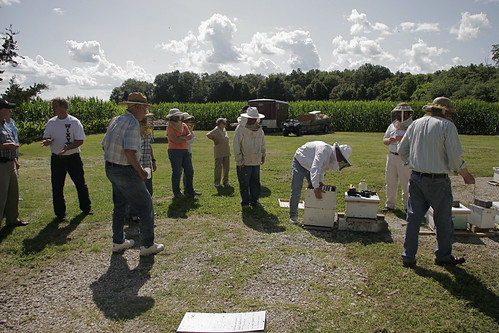
    Robby-Bob and I went to another bee club meeting on Sunday.  It was a special event for the club.  An expert was there to discuss and demonstrate ways to test bees for hygienic behavior.
    introducing the demonstration
    The reason this is important is because beekeepers routinely use chemicals to fight off infections and pests, usually to save themselves from economic ruin.  To reduce the amount of chemicals beekeepers use, an effort is underway to selectively breed bees that resist the pests.  One way for bees to protect themselves is to identify and remove cells in the hive that are infected.  Bees that demonstrate hygienic behavior are those that remove larvae from damaged cells.  To test for this trait, they selectively freeze/kill a section of larvae with liquid nitrogen and watch to see if the dead larvae are removed by the workers.
    demonstration- freeze kill with liquid nitrogen
    A steel can is smushed into the comb, and liquid nitrogen is poured inside to instantly kill the larvae inside.  After 24 hours, the frames are inspected.

    bees without hygienic behavior bees with hygienic behavior
    The frame on the LEFT is from a hive that does NOT show hygienic behavior. In the frame on the RIGHT, notice how the bees removed the larvae from all the cells leaving a circle of empty comb, a sign of hygienic behavior.

    Many people have heard of Colony Collapse Disorder, but bees are susceptible to a range of problems and so most beekeepers rely on some sort of chemical strategy to maintain their business.  Breeding hygienic bees may ultimately lead to an industry less dependent on chemical inputs, meaning more ‘natural’, or ‘organic’ honey and wax (yay!).  Of course I am oversimplifying this whole process.  Hygienic behavior is actually much more complicated, especially when you approach it from the genetic side.
    queen removal
    I was very lucky to be invited to the club meeting and demonstration, thanks Robby!

    I posted more photos of the meeting to this flickr set.

    Also CEIBA wrote about the event (and used my photos!) on their website.

  • Hives get taller

    Head-beekeeper, Robby-Bob, came by yesterday and added a shallow super to both hives.
    The gives are getting taller

    Based on the progress that was observed in the last bee post, the hives were past due for some extra expansion room.  It took a little while to source the correct size frames for the shallower top boxes, and Robby installed them while I was in class.  Ideally the bees will use the new frames mostly for honey that we can later harvest.  Robby decided not to use a queen excluder, so there’s the potential that the queen will get up there and lay eggs.  We have enough supplies for one more box on each hive depending on how well they take to the new frames.

  • Recent Polaroids, Polaroid Transfers

    I’ve been working on polaroid transfer techniques with my 125 Land Camera and expired peel-apart film. These are my first ‘roids of La Casa. I need to acquire new (to me) film!

    Maria the Markswoman

    Maria the Markswoman

    Chickens

    Chickens

    Bees

    (The transfer of the bees photo was not particularly visually interesting. Perhaps next time.)

  • Hive Tour 7/12/09

    smoking the beesMy good friends Kannan, and Mac helped me get a closer look inside out hives yesterday.  Four weeks ago I put the second deep supers on each hive.  The supers were full of bare frames, meaning the bees needed to build the comb before they could use them.  Well, after checking out the hives I can say they are doing excellently.  Lots of brood and some full frames of honey.  There were even empty brood chambers where baby bees had already emerged.  This means we probably need to add more space to allow the hive to continue to grow.

    The diagram on the left is similar to our hives, (different lid and different number of frames) but it gives you an idea of how the hives are constructed.  Its a fairly simple design.  Wooden frames are suspended inside a box, and the boxes are stacked up.  The bees then build honeycomb on both sides of each frame.  I had some handy helpers, so we were able to take clean photos of each frame.  I cropped all the photos in a similar way so you can flip through each cross section of the hive.  As you get towards the middle you’ll notice that there is less honey and more brood.  The queen lays eggs in a somewhat predictable pattern, and experienced beekeepers use that to judge the quality of the hive.

    Vodpod videos no longer available.

    full screen slide show of hive 1

    Vodpod videos no longer available.

    full screen slideshow of hive 2

  • Late Spring Bee Checkup

    Ed, a local beekeeper, came to check out our hives for a three week checkup last weekend. Robby is out of town, so he arranged to have some members of CEIBA help keep an eye on the hives. We had gotten a late start with our bees but each queen came with 5 frames of brood and honey. In just a few weeks, the bees have really established themselves and Ed determined it was time to add the second box on the hive. This will give each hive 10 fresh frames to build comb and expand the colony size.

    Capped Brood

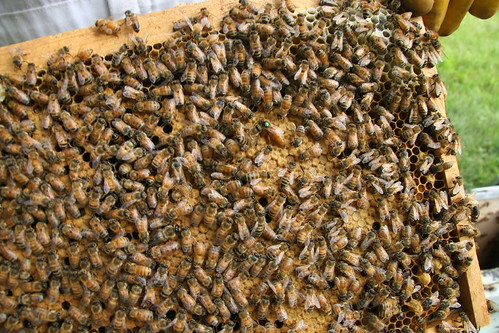
    This frame is full of capped brood.  Brood is the general name for combs that have eggs and larvae.  The worker bees feed the developing larvae before sealing them in with a cap .  In a few weeks these bees will hatch and the process will start over again with the queen coming around and laying eggs in each comb.  In this way, the colony will double and triple in size very rapidly.

    Bee emerging

    In the center of this photo, a bee is hatching from the comb.  We watched as the bee ate away the cap.  Like eating corn on the cob, she went back and forth chewing her way out.  After she leaves, the workers will clean out the comb and get it ready for another egg.

    Honey Combs

    This is what the comb looks like when the bees decide to store honey instead of brood.  This looks like it was a fresh frame to begin with since you can still see in the lower left that the comb hasn’t been fully drawn out by the bees.  There must be a lot of nectar flowing now because even though the comb isn’t finished, the bees are already storing and capping honey.  In the upper right is capped honey.  To process the honey, the bees sit over the comb and fan their wings to evaporate off the water.  Once the honey is sufficiently concentrated they seal the comb off.  You can tell the difference between capped honey and capped brood by the color.

    I took lots of photos so we could inspect the bees in depth without keeping the hive open for too long.  Click the thumbnails to go to a flickr set of the event.

    more bee pics

  • Honeybees arrive

    We installed two hives of honeybees today at La Casa.  Fellow co-oper, Robby from across town will be using our yard (and pollen) to raise honeybees.  Robby got his hive boxes from his grandfather who was a beekeeper.  Robby’s been taking classes from the Central Illinois Beekeeper’s Association: CEIBA.  Last night we picked up the bees from a queen breeder near Danville.  They were sealed in boxes for transport in the van.

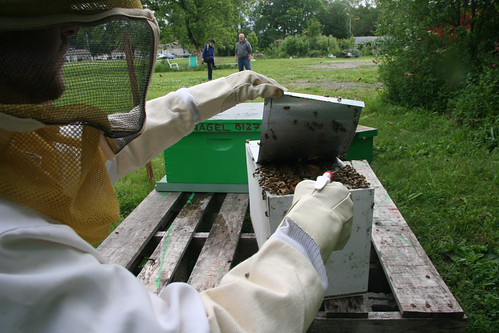
    About 10,000 bees came with each queen.  Five frames from a two healthy colonies, along with a two queens were put into boxes.  Today we tranported the frames into the hives.  Robby moved the first colony, and I moved the second.  We had to wear full bee suits otherwise the bees would have stung us many times.  It was quite a rush carrying the frames full of bees and being careful not to disturb them too much.  We took a bunch of photos, and I’m just going to go ahead and post most of them.
    opening up the transport boxes
    Robby tried to calm the bees down with sugar water. There were hundreds flying around us as we were working.
    sugar water
    frame in the hive
    This is what frames look like installed in the hive. There are ten frames in each section of the hive. We mixed the five frames full of honey and brood (developing bees) in with 5 clean frames.
    moving the frames over
    most of the frames in now
    Most of the frames are installed. Just a few more to squeeze in.
    Queen bee spotted (green dot)
    You can see the queen crawling around in this photo. There’s a little green dot on her back. Try this hi-res version if you want to see her up close. She has a longer body and smaller wings.
    smoking the second hive
    I suited up and moved the second set of frames while Robby took photos. This time we tried the smoker instead of sugar water. The smoke calms them down and confuses their communication.
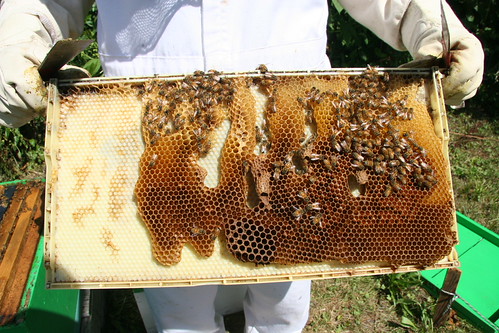
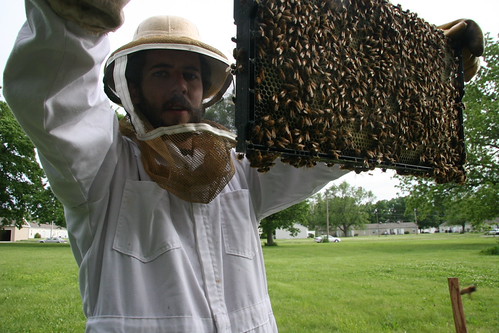
    holding up a frame full of bees
    Robby snapped this nice photo.
    more smoke to calm them down
    Calming them with more smoke. Only two frames left to move.
    Queen bee 2 (green dot)
    The other queen. Look for the green dot. Hi-res.
    bee work done, hives ready
    All put back together. Bees installed. The next move is to put more boxes with clean frames on top. The hives are designed to be modular, building up from the bottom box. Two big boxes at the base are where the queen builds up her colony. Then at some point smaller boxes are placed on top with a screen that lets only the workers past. Since only the worker can access the top boxes, no eggs are laid and they become full of honey. Since we’re starting this hive pretty late in the season, we might not get much honey this year. But its still a worthwhile project and if the hives survive the winter, we’ll have plenty of honey next year.

  • Bee Hives Arrive

    Harvest House resident Robby Nagel brought his beehives over today.  Robby inherited the hives from his grandpa who retired from beekeeping a few years ago.
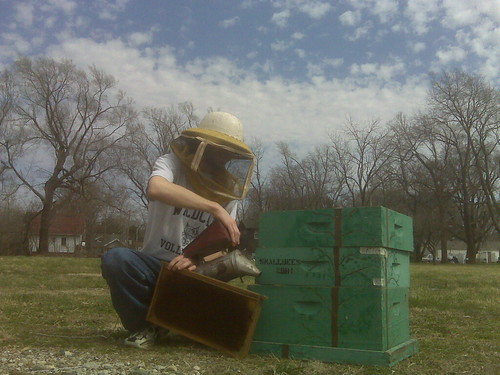
    Robby shows how the smoker works
    Robby has been going to beekeeping classes offered by the Central Eastern Illinois Beekeepers Association and approached us a few months ago about keeping bees in our big yard.  We’re not only glad to share in the honey but the bees will function as excellent pollinators to our trees and crops.  In the photo above, Robby is showing me how the different pieces of equipment work.