Housemate Jacob recently said it best: “Keep up the good bok.”
Tag: chickens
-
Hens added to the flock
After our house meeting last week we mucked out the coop to get it ready for some new birds. Maggie knows a lady outside of town with roosters and hens who agreed to sell us a few full grown layers when she heard about our recent tragedy with the pitbull. After cleaning out the coop and installing some perches made out of down limbs from the yard, a few of us went chicken shopping.

These two chickens are mixes of different breeds; on the left mainly Araucana, on the right Wyandotte. The breeder had a small operation and kept all her birds together creating eclectic mixes of colors and patterns. Before we had 4 Rhode Island Reds that were pretty much indistinguishable, which left us with no answer to the common question, “What’s this one’s name?” We made a point to pick out very different looking birds and have since begun the process of observing their behavior and choosing appropriate names.

We also got around the hanging up the feed dispenser, which seems to greatly reduce waste. More about the chickens to come. To see more photos check out my flickr stream starting here.
-
RIP, chickens
On Thursday, February 4th 2010, a loose pitbull entered our yard and killed six of our chickens.

Among the casualties were our alpha-hen, Ginger (pictured above), Stegasaurus, Lucille, and all of our Rhode Island Reds. The pitbull was picked up by animal control and the owners have been instructed to compensate us for the loss.
It’s hard to put into words the emotions that this incident created. We’ve lost chickens to predators and disease before, and we had plans to butcher several hens this Spring. The mental image that causes me the most sadness, all the hens watching in terror as the dog kills one after another of their flock-mates, is hard to push out of my head.
The flock is down to four chickens, three leghorns and an ISA Brown. We plan on getting more hens soon, stay tuned…
-
Recent Polaroids, Polaroid Transfers
I’ve been working on polaroid transfer techniques with my 125 Land Camera and expired peel-apart film. These are my first ‘roids of La Casa. I need to acquire new (to me) film!


(The transfer of the bees photo was not particularly visually interesting. Perhaps next time.)
-
“Backyard Coops Make Chicks Chic”
NPR has an article about chickens!
The comments on the article are an interesting mix of support and opposition.The article also linked to The Chicken Whisperer. He has a blog and a radio show.
“When we go to cities, a lot of times we’ll ask them, ‘Why don’t you want your citizens to lead a more self-sustaining lifestyle? Why don’t you want your citizens to save some money in this hard economic time by allowing them to raise backyard poultry?’” Schneider says. “And I’m telling you, Animal Control, I’m sure, gets way more calls from barking dogs and dogs running loose and cats than they ever have from backyard poultry.”
-
Urbana Chicken Effort – 5 Year Update
 Lately we’ve had several revelations about chicken keeping in Urbana, IL. It started when Ronna dug up this 2004 article from the New York Times while doing research on Urbana city ordinances. The article begins, “A movement is underfoot in Urbana.” Well, this is an update on Urbana chickens 5 years later.
The article titled “From City-Reared Chickens, Farm-Fresh Eggs” (10/4/2004) quotes city attorney Steve Holz (*arrested development chuckle) “There is no restriction on livestock or poultry in the city [of Urbana].” It goes on to say that “the city can take action against owners if they keep the animals in a way that hurts the health or safety of the neighborhood.” So thats it. Keeping chickens in town is %100 legit, until they become a problem.
I joined the yahoo group Urbana Chicken Effort awhile back, which I presume was the original communication tool for the “movement” that the article mentions. With 32 members signed up, the list is still used to coordinate feed and chick buying.
The other revelation occured when Heather ran into Danielle Chynoweth at the IMC. According to Danielle, our oldest chicken, Ginger, was originally owned by Molly Stentz and is estimated to be 8 years old! The 2004 NYTimes article quotes Stentz as saying, “There are so many people in my neighborhood who are doing it. It’s low-maintenance and fun.” This means that our elderly Ginger is one of the original Urbana Chicken Effort chickens, and she’s still ticking!
So, La Casa is curious to know more about the history of Urbana Chickens. How many people are keeping chickens in town these days? Do they take as many photos as us? How can we help each other and encourage more chicken cooperation? Please comment and let us know how your ladies are doing.
-
Gardening only leads to more chicken photos
Today folks were relaxing in the yard.

While Kannan and JohnE dug a fresh bed. Wherever there’s fresh dirt, the chickens gotta peck at it.


(click on the picture to see it full size!)
JohnE tried to feed the chickens.

And then he did some majestic shirtless log juggling.

-
garden progress, weekend recap
There were several changes made to the garden landscape this weekend.
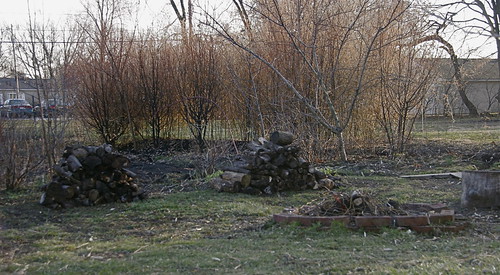
Ronna sowed a bed of peas and lettuce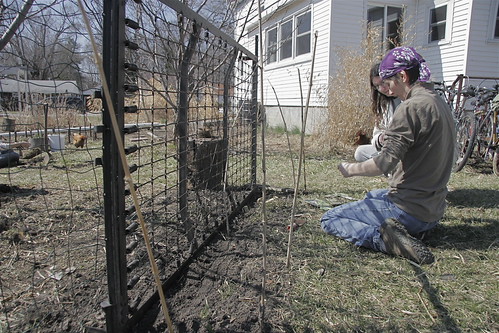
Rob, Rob, and members of the Catholic Worker House turned the old compost pile.

Mac, Kannan, and JohnE pulled up some sod to make a vegetable bed for the members of their house.

We began digging a hole at the end of the canal system that runs through the garden. We spent a lot of energy and the pond that forms will probably get really gross. We did use the topsoil to raise a few vegetable beds in order to alleviate the Sping flood that we’re expecting.

-
chicken behaviors – dust bathing
Our chickens love a good dust bath. While it looks dirty and gross, its actually an important part of their natural hygiene.

On nice sunny days the chickens will spend all afternoon showering themselves with dirt. They’ve found a few spots in the yard with suitable soil, but their favorite is over by the garage in the full sun.

The fine soil is sifted down through their feathers and helps by rubbing dry skin off their bodies. It also helps by clogging the breathing holes of lice and other parasites.
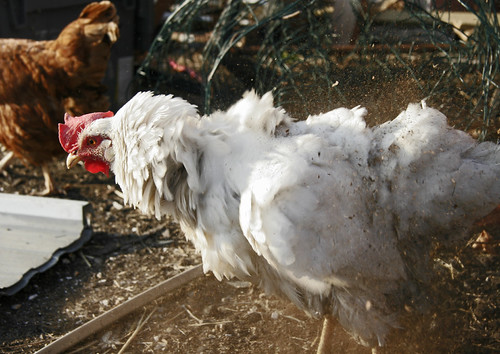
A quick shake and she’s as clean as ever.
-
Compost Dinner Time
Vodpod videos no longer available.
The chickens have been very feisty lately. Enjoying the weather and chicken dancing* away their days. Here is a little video JP took of me. Whenever you come outside the chickens tend to run up to you, expecting to be fed compost. They love it.If you want to see some more chickens running, then check out my other video here.
*what has been dubbed the chicken dance is: scratch at dirt with feet, back away, look at dirt, peck, repeat.
-
Composting at La Casa

There are two general approaches to compost: cold and hot. The cold compost method is slow, doesn’t need turning, and will happen naturally if you pile food scraps in your yard. This method is known as anaerobic digestion and its being explored by industry because it retains more energy within the system and produces usable methane. The drawbacks of cold compost are 1) smells like death when it is outside 2) doesn’t sanitize the materials and 3) takes months to occur. Hot compost on the other hand doesn’t smell, generates a lot of heat which kills harmful microbes, and breaks down fast. In a Hot Compost pile, much of the energy is released as heat by the thermophilic bacteria. To get Hot Compost, you need to balance the ingredients and turn the pile regularly. For the first time since I moved in our compost pile was steaming yesterday indicating aerobic breakdown was taking place.
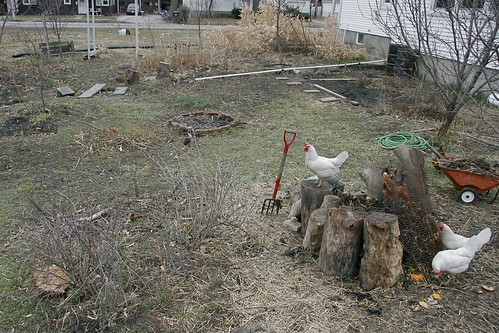
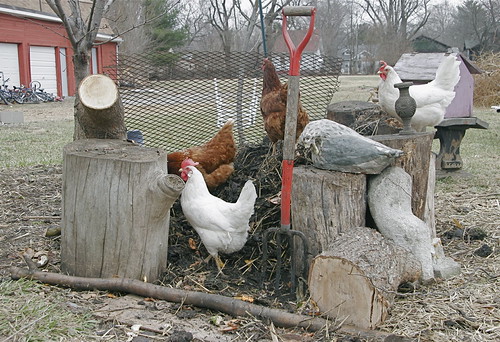
Hot Compost requires 4 inputs. Carbon, Nitrogen, Oxygen and Water. The Nitrogen comes mostly from the food scraps and is the main input. We add Carbon in the form of straw and yard trimmings. Balancing the C:N ratio is the biggest trick to getting a good pile going. I’ve recently begun adding chicken poop from the coop which should add a lot of Nitrogen to the mix. Getting Oxygen into the center of the pile requires turning the pile. Turning the pile is bane of the composter’s existence, but it’s needed to get air to the aerobic micro-organisms doing all the real work.

Hot compost will let off lots of steam.

Keeping our chickens in mind, we separate out coffee grounds and eggshells from the main compost pile.
links:
Comparison of anaerobic and aerobic digestion wikipedia
Composting wikipedia
Composting for the Homeowner Illinois Extension
Tips on Composting http://www.composters.comAlong with fuel efficiency, water conservation, and reduction in meat consumption, home composting is one of the most environmentally beneficial activities of modern society. Yard and food wastes make up approximately 30% of the waste stream in the US. – http://www.composters.com
 La Casa Grande Colectiva