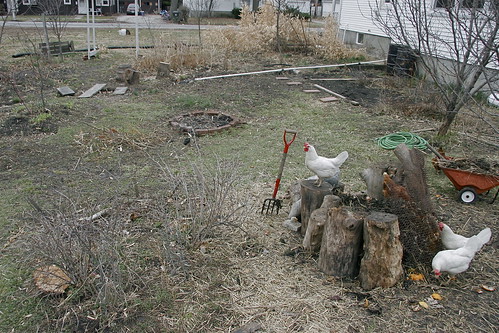
I recently attended a hot composting workshop in our neighborhood put on by a local artist who has been doing a lot of organizing this summer in preparation for a community dinner this weekend. Inspired to put into action the knowledge that was generously shared with me, I woke up this morning and decided to build a hot compost pile. We had all the necessary ingredients and tools already on hand, so I was able to get right to work.
 First I went through the garden pulling out lots of weeds. The weeds would be the nitrogen rich materials needed for the pile. We have lots of weeds growing, so there was indeed an abundance. Thse plants bring nutrients up from deep below the soil, so in a way, the weeds are helping!
 I had already cleaned out the chicken coop bedding which contained straw (carbon) and manure (more nitrogen). The next step was to shred the weeds with a lawnmower. This increases the surface area of the materials and speeds up the reaction. We got the mower for free from a friend, woohoo!
The last step was to build the pile. The goal is to create a mass 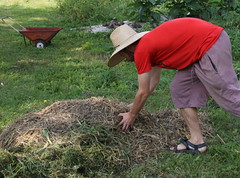 of alternating carbon and nitrogen layers. In between the layers you add water and some dirt or old compost (this primes the pile with all the needed microbes). That’s it: carbon, nitrogen, dirt, water, over and over, until you have a pile that’s about 3 x 3 x 3 feet. The finished pile didn’t make it quite tall enough, so I’m keeping my fingers crossed. I finished off the pile with a ring of chicken wire.
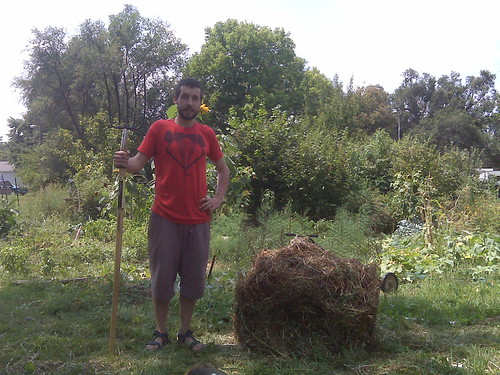
Thanks Gretchen for taking the photos!
Tag: compost
-
Compost Dinner Time
Vodpod videos no longer available.
The chickens have been very feisty lately. Enjoying the weather and chicken dancing* away their days. Here is a little video JP took of me. Whenever you come outside the chickens tend to run up to you, expecting to be fed compost. They love it.If you want to see some more chickens running, then check out my other video here.
*what has been dubbed the chicken dance is: scratch at dirt with feet, back away, look at dirt, peck, repeat.
-
Composting at La Casa

There are two general approaches to compost: cold and hot. The cold compost method is slow, doesn’t need turning, and will happen naturally if you pile food scraps in your yard. This method is known as anaerobic digestion and its being explored by industry because it retains more energy within the system and produces usable methane. The drawbacks of cold compost are 1) smells like death when it is outside 2) doesn’t sanitize the materials and 3) takes months to occur. Hot compost on the other hand doesn’t smell, generates a lot of heat which kills harmful microbes, and breaks down fast. In a Hot Compost pile, much of the energy is released as heat by the thermophilic bacteria. To get Hot Compost, you need to balance the ingredients and turn the pile regularly. For the first time since I moved in our compost pile was steaming yesterday indicating aerobic breakdown was taking place.
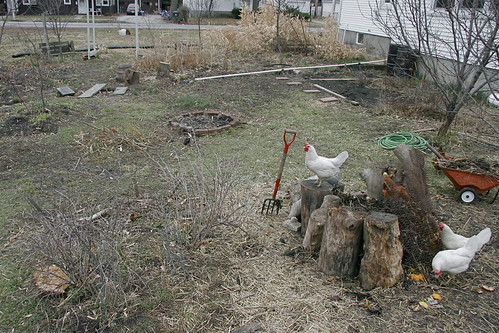
Hot Compost requires 4 inputs. Carbon, Nitrogen, Oxygen and Water. The Nitrogen comes mostly from the food scraps and is the main input. We add Carbon in the form of straw and yard trimmings. Balancing the C:N ratio is the biggest trick to getting a good pile going. I’ve recently begun adding chicken poop from the coop which should add a lot of Nitrogen to the mix. Getting Oxygen into the center of the pile requires turning the pile. Turning the pile is bane of the composter’s existence, but it’s needed to get air to the aerobic micro-organisms doing all the real work.

Hot compost will let off lots of steam.

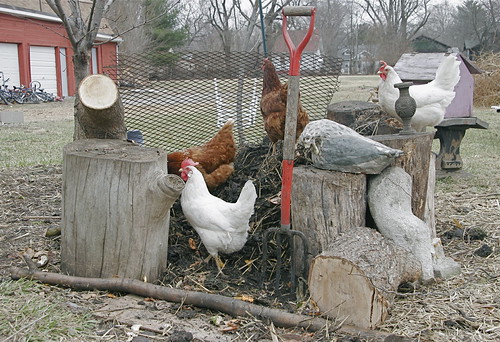
Keeping our chickens in mind, we separate out coffee grounds and eggshells from the main compost pile.
links:
Comparison of anaerobic and aerobic digestion wikipedia
Composting wikipedia
Composting for the Homeowner Illinois Extension
Tips on Composting http://www.composters.comAlong with fuel efficiency, water conservation, and reduction in meat consumption, home composting is one of the most environmentally beneficial activities of modern society. Yard and food wastes make up approximately 30% of the waste stream in the US. – http://www.composters.com