
Robby-Bob and I went to another bee club meeting on Sunday. It was a special event for the club. An expert was there to discuss and demonstrate ways to test bees for hygienic behavior.

The reason this is important is because beekeepers routinely use chemicals to fight off infections and pests, usually to save themselves from economic ruin. To reduce the amount of chemicals beekeepers use, an effort is underway to selectively breed bees that resist the pests. One way for bees to protect themselves is to identify and remove cells in the hive that are infected. Bees that demonstrate hygienic behavior are those that remove larvae from damaged cells. To test for this trait, they selectively freeze/kill a section of larvae with liquid nitrogen and watch to see if the dead larvae are removed by the workers.

A steel can is smushed into the comb, and liquid nitrogen is poured inside to instantly kill the larvae inside. After 24 hours, the frames are inspected.


The frame on the LEFT is from a hive that does NOT show hygienic behavior. In the frame on the RIGHT, notice how the bees removed the larvae from all the cells leaving a circle of empty comb, a sign of hygienic behavior.
Many people have heard of Colony Collapse Disorder, but bees are susceptible to a range of problems and so most beekeepers rely on some sort of chemical strategy to maintain their business. Breeding hygienic bees may ultimately lead to an industry less dependent on chemical inputs, meaning more ‘natural’, or ‘organic’ honey and wax (yay!). Of course I am oversimplifying this whole process. Hygienic behavior is actually much more complicated, especially when you approach it from the genetic side.
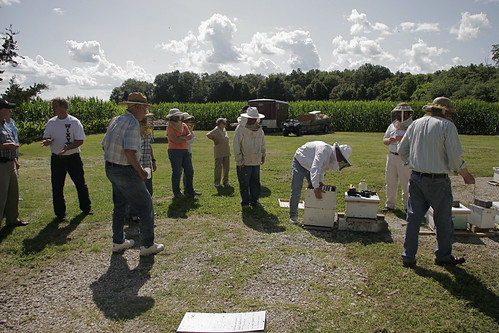
I was very lucky to be invited to the club meeting and demonstration, thanks Robby!
I posted more photos of the meeting to this flickr set.
Also CEIBA wrote about the event (and used my photos!) on their website.


