Tag: garden

  • modeling the La Casa permaculture garden in 3D

    Here’s a 3D model in that I’m in the process of building to document our permaculture garden. It includes a mock-up design for the pond that attempts to maximize the amount of perimeter. I’m still learning how to use Google Sketchup so I haven’t added too many bells and whistles.
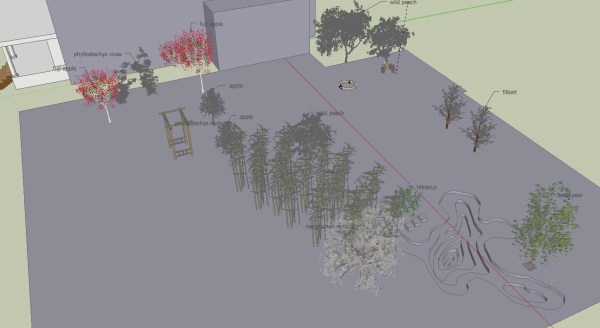
    Garden Model

    I sense an interesting utility in 3D modeling software when building permaculture designs.  I’m already comfortable using photoshop but it was a conceptual leap to start working in the third dimension. Google made Sketchup very user friendly and they have online tutorials to explain each tool. Here’s a good place to start if your interested. The killer feature that google implemented is the ability to download and add models to the 3D Model Warehouse. That is where all the trees in my model came from. Other users have already started adding their own permaculture designs.

  • weekend update, permaculturist, beds, holes, lots of talk, and eggplant parmesan

    There’s a lot going around the house these days. Here’s a quick recap of the weekend.
    Transplanting sod to the front yard
    Andrew and Ronna transplanted some of the sod that was leftover from new garden beds to a bare spot in the front yard. Sophie supervised.
    Rob and Peter chat in the garden
    Rob brought over a friend and longtime permaculture expert, Peter Bane, for a chat in the garden. It turns out the Peter grew up in Urbana and had lots of stories about home-scale food production in the area.
    Gretchen and eggplant parmesian
    Gretchen brought over some eggplants and whipped up a two stellar pans of eggplant parmesan, one vegan. It was incredibly delicious.

    There were many hours spent outside, digging, thinking, and moving.  Plans for the pond that we’re digging have taken off.  Now we’re thinking about ducks, fish, and waterfalls, although lots of research needs to be done still.  Garden excavations have continued, and Mac, Kannan, and JohnE have improved their beds with compost and more topsoil.  Ronna has been ‘potting-up’ some of the seedlings as its not yet time to move them outside.  All in all a good weekend.

  • plantingplantingwateringwatering

    go superfood!
    go superfood!

    More beds are being dug for our lightly ambitious garden. As of today actual seeds that have been placed in the soil of the garden itself are: sugar pod peas (yummm!), about 5 different lettuces, carrots (scarlet nantes, danvers), chard (5 color silverbeet, ruby red), purple radishes, yarrow, moonflowers, persian cress, yellow mangel beets AND chia. yes, chia of chia pet fame. But talk about an underutilization of a plant. The seeds of this good old indigenous plant are what could be considered a superfood. Here are a couple of links so that if you want to know more you can:

    Chia For Health

    Chia Seed – The Ancient Food of the Future

    p.s. Someone mentioned that Seeds of Change is now owned by the Mars candy company, which is too bad, but at least we got our seed packets via the time-honored art of dumpster diving.

  • Gardening only leads to more chicken photos

    Today folks were relaxing in the yard.
    Relaxing on the Yard
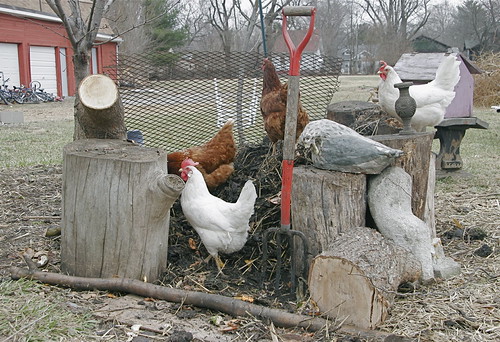
    While Kannan and JohnE dug a fresh bed. Wherever there’s fresh dirt, the chickens gotta peck at it.
    Chickens invade the new bed
    Noms!
    (click on the picture to see it full size!)
    JohnE tried to feed the chickens.
    Worms
    And then he did some majestic shirtless log juggling.
    Shirtless Log Juggling

  • garden progress, weekend recap

    There were several changes made to the garden landscape this weekend.
    _MG_6877.JPG
    Ronna sowed a bed of peas and lettuceRonna works on the pea and lettuce bed.
    Rob, Rob, and members of the Catholic Worker House turned the old compost pile.
    talking about compost
    Mac, Kannan, and JohnE pulled up some sod to make a vegetable bed for the members of their house.
    chicken inspects fresh bed
    We began digging a hole at the end of the canal system that runs through the garden.  We spent a lot of energy and the pond that forms will probably get really gross.  We did use the topsoil to raise a few vegetable beds in order to alleviate the Sping flood that we’re expecting.
    THE HOLE

  • Spring Comes Early in the Garden

    Last Friday was a beautiful day. After a day at work I came home to find housemates and friends working in the garden.
    garden_work1

    gardenwork2

    Drew, Rob and JP clearing out bamboo to make room for fresh beds.

    webdsc_4746b

    The chickens were out pecking for worms and enjoying the nice weather.

    webdsc_4699b

    Sophie was really excited about the chickens.

    webdsc_4682b

    The bamboo was burned.

    webdsc_4675b

    And the resulting fire was strangely beautiful.
    webdsc_4751b
    Just another day at La Casa.

  • Composting at La Casa

    There are two general approaches to compost: cold and hot.  The cold compost method is slow, doesn’t need turning, and will happen naturally if you pile food scraps in your yard.  This method is known as anaerobic digestion and its being explored by industry because it retains more energy within the system and produces usable methane.  The drawbacks of cold compost are 1) smells like death when it is outside 2) doesn’t sanitize the materials and 3) takes months to occur.  Hot compost on the other hand doesn’t smell, generates a lot of heat which kills harmful microbes, and breaks down fast.  In a Hot Compost pile, much of the energy is released as heat by the thermophilic bacteria.  To get Hot Compost, you need to balance the ingredients and turn the pile regularly.  For the first time since I moved in our compost pile was steaming yesterday indicating aerobic breakdown was taking place.


    Hot Compost requires 4 inputs. Carbon, Nitrogen, Oxygen and Water. The Nitrogen comes mostly from the food scraps and is the main input. We add Carbon in the form of straw and yard trimmings. Balancing the C:N ratio is the biggest trick to getting a good pile going. I’ve recently begun adding chicken poop from the coop which should add a lot of Nitrogen to the mix. Getting Oxygen into the center of the pile requires turning the pile. Turning the pile is bane of the composter’s existence, but it’s needed to get air to the aerobic micro-organisms doing all the real work.

    Hot compost will let off lots of steam.

    Keeping our chickens in mind, we separate out coffee grounds and eggshells from the main compost pile.

    links:
    Comparison of anaerobic and aerobic digestion wikipedia
    Composting wikipedia
    Composting for the Homeowner Illinois Extension
    Tips on Composting http://www.composters.com

    Along with fuel efficiency, water conservation, and reduction in meat consumption, home composting is one of the most environmentally beneficial activities of modern society. Yard and food wastes make up approximately 30% of the waste stream in the US. – http://www.composters.com