Year: 2009

  • roasted eggplants, baba ganoush, lunch

    eggplants looking delicious

    Oh, those deep purple beauties ripening, ripening.

    Roasting eggplants by the bonfire

    A little campfire, a lot of fire-roasted eggplant.

    tastiest lunch

    Delectable end product.

    _MG_0972.JPG

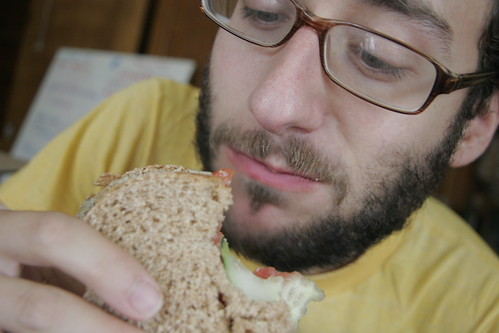
    Andrew eating the hell out of a baba ganouj sandwich.

    When you’re really lucky you plant some plants in just the right spot at just the right time and they say, “Man, I feel so good, I’m going to grow like mad and make lots of whatever it is I make.” We were sooo lucky here at La Casa. The eggplant plants went in the ground considerably past the prime time AND as you all know, summer was unusually cool. Eggplants like time to grow and some heat, you know, so what the hell? Not that I’m complaining. No. I am not. I’m rejoicing and not just about the mysteriously extraordinarily huge and productive plants that are our eggplant plants, but about wonderful new La Casan, Erin, who knew that you can put your eggplants by a fire to give them that extra flavor edge for better baba ganouj. But that’s not all! There’s extra flavor and then there’s someone who really knows how to work it. We at La Casa are fortunate enough to have in Erin, not just someone who can fire-roast an eggplant, but who can push that extra flavor to it’s most excellent extreme. It was so much fun today watching one after another of my fellows take their first bite and say, almost invariably, “Oh, my god!” You know, pure astonished delight.

    If you want to fire-roast your eggplants just put them near your fire, almost in it. They will slowly start to shrivel and sag a bit. Keep turning them until the whole things is more or less rather shriveled. They should maintain their skin’s integrity for the most part. If they go up in flames you have gone well beyond fire-roasted.

    Thanks to JP for photos and to Erin for the damned good grub. And La Casans in general for just being so great!
  • volunteer on student farm: get tons of free veggies

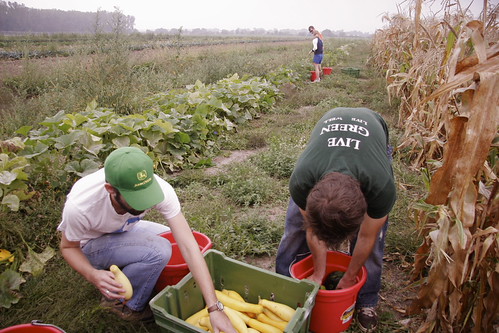
    I went this morning to help on the new student farm located south of campus. The farm’s manager, Zack, showed me and a group of volunteers around as we helped out harvesting.
    packing squash
    The produce from the farm is sold to University Dining Services and goes to feed kids living in the dorms. The student farm is part sponsored by the dining halls and part by the College of ACES.  This is the FIRST year planting crops and they’re supplying a lot of food to the dorms.
    squash

    basil harvest
    We picked mostly squashes but some basil and parsley too.
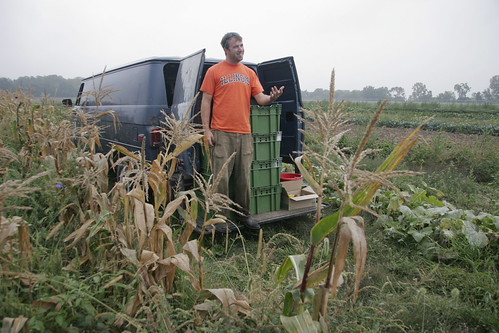
    zack on the van
    That’s Zack on the back of the van that Dining Services gave to the project.
    take away from volunteering at the student farm
    The best part is that after a few hours of work, they let you take home as many veggies as you can carry! My roommates will be happy when they get home.
  • paw paws, awesome

    The paw paw genus (asimina) contain the largest edible fruit indigenous to this continent (says wikipedia).  They apparently taste like a cross between a banana, a mango, and a pineapple. I’ve just begun learning about paw paws and recently was at a paw paw forest about an hour away.
    Paw paw forest
    The big leaves give the plant away, but the fruit are even more distinguishable.
    Paw paw fruit
    Paw paws a very fascinating, I would recommend the wikipedia entry as a good introduction. Kentucky State University is building a great website for paw paw information and research of which there is surprisingly little. Compared to standard orchard fruits, not a lot of people are working with paw paws because they have a very short shelf life. For the backyard orchardist who doesn’t have to worry about shipping and storage, the paw paw could be an easy delicacy. Due to the fact that they’re indigenous, they are extremely pest resistant.

    There’s one paw paw on the Urbana Fruit Map in someone’s yard and they’re not overhanging the sidewalk (yet), so don’t take any!

    Paw paws grow densely in the understory layer. Next time you take a ride down Washington St stop and take a look at the beautiful trees with the big leaves.

  • late summer hive check – mystery queen

    Robbie and I opened up the hives a few weekends ago to take an inventory of the healthy hive and see how much brood the new queen has produced in the weaker hive.  Sadly, we didn’t see a lot of honey in the honey supers (the shallower frames on top).  We figured this was some what to be expected since our hive was just getting built up when most of the plants were producing nectar.  It was a timing issue, and we were late getting our hives started.
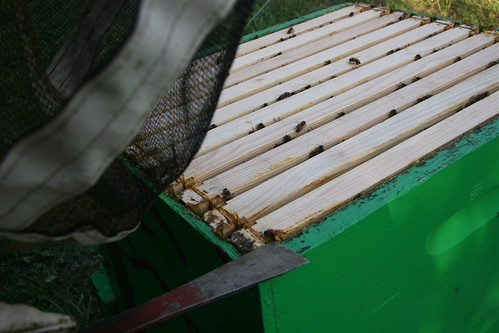
    some honey, not a lot
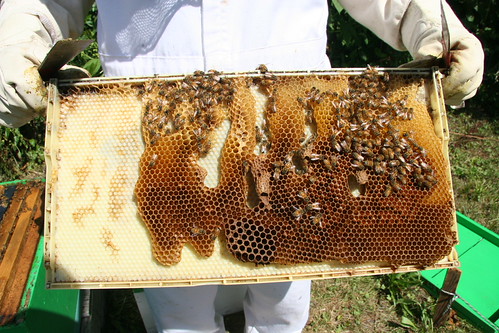
    You can see that there is some capped honey in the middle, but the bees have barely drawn out the wax comb towards the edges of the frame.

    In the hive that recently had been re-queened, there was a clear sign that the new queen had been successfully introduced. You can see in the photo below that some of the cells have a dark yellow cap on them. That’s called ‘capped brood’, and in a few weeks fully developed bees will eat their way out and begin working right away.
    capped brood
    The brighter orange cells are pollen stores.

    When we first opened up the second hive we immediately noticed something strange. Right in the corner of the hive that we pried open with the hive tool, there was an unmarked queen hiding out.
    mystery queen hanging out in the corner of the hive
    There she is about as far away from the nucleus of the hive as possible.
    mystery queen
    You can see her elongated abdomen and short wings. We were hoping to find signs of the introduced queen and maybe spot her, and oddly the first bee we see after opening the hive is another queen. I suspect that before the first queen swarmed, the bees had already started feeding royal jelly to create a new queen. By the time she hatched we had stuck a new queen in, who has now taken over the colony.

    If you spend a moment to think about it, a very interesting tale of courtly coups could be extracted from this. Is the native born queen entitled to the crown? Who is this imposter queen who has stolen the throne and banished the rightful heir to the far reaches of the queendom? Did we screw up the natural order of things by adding a new queen when the bees were busy rearing a new one?

    We scratched our heads (through the veils), set the mystery queen aside, and continued looking for signs of the introduced queen. When we were finished and putting the frames back in we found the unmarked queen very close to where she was before.
    close-up of mysterious queen
    It seems as though she still had a few workers attending to her.

  • quarter life crisis?

    IMG_3639

    IMG_3516

    The point at which the party devolves a tad is the best time for pictures.  After everyone has had a few drinks and perhaps becomes both sillier & more shining/relaxed.

    Strange crossroads, which came first?, and yes that is a bathroom picture.

    Good food, great drinks with home-made tomato juice, wonderful folks sharing, laughter, gettin’ down wit some rap, general all ’round fantabulous night.

    IMG_3685

    IMG_3566

    IMG_3695

    IMG_3648

    IMG_3555

    IMG_3669

    IMG_3638

  • My pre-existing condition was no health care access

    (Rob wrote this song in the direction of the health care debate. It is the product of less than 24 hours of work.)

    Jacob, “MC Utterbot” and udderbot
    Andrew, “Professor Heathwaite” and 23-tone electric
    Rob, “Hello” and drums

    Lyrics:

    I need a lever, cause yo, I’ve got a fever
    Need some accessibility to the health care facility
    What’s the public option when the option ain’t publicized
    I’m still waiting in line you better recognize
    your health is mine, to deny it’s a crime
    50 million in urgency so check the emergency… **CRASH**

    All the other wealthy industrialized countries have universal health care systems — that means, every citizen has access to health care. Except in the United States. Yo! MC Utterbot, I think they need some contents to make some sense out of this nonsense…

    The clock ticks… I’m talkin’ ’bout one-in-six
    Only hard to understand with insurance in hand
    When y’read they propaganda, s’hard to understand-a
    They take our activism and they call it socialism
    Or portray the U.K. as a place with no x-rays
    where you wait in line for days but it’s worse here I dare say…

    Excuse me sir, we only assist robots in this emergency room — WILL SOMEONE TURN OFF THAT CAR ALARM. What’s that? You are a robot. Oh. I’m sorry but your insurance doesn’t cover that procedure. Please see the secretary down the hall and fill out more paperwork…

    My pre-existing condition was no health care access
    I had to treat myself based on my best guess
    While corporations are playing me like a game of chess
    Still I’ve got to say, nevertheless
    I want health care parity and solidarity
    A social contract yo this ain’t no frickin charity
    The blue dogs know they’re gonna have to go
    and when I get to the do’ I wanna hear something just like

    Hello…
    Hello…
    Hello…
    Hello…
    Hello…
    Hello…
    Hello…
    Hello…
    Hello…
    Hello…

  • canning goodness

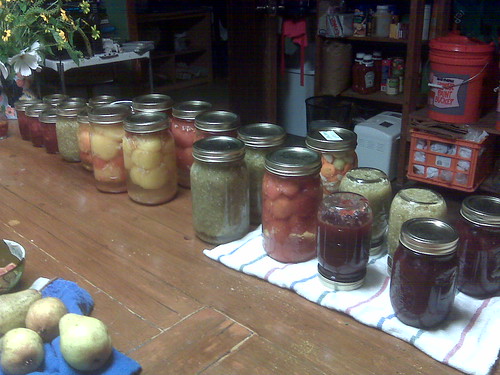
    We canned a lot of things this past wednesday.
    Canned goods: salsa verde, peach raspberry jam, spiced plum jam, pasta sauce, pickled what-not, whole tomatoes with basil and garlic

    Maybe Carly can update this post with some more info!

  • mushroom hunting in central illinois

    This past Friday we went mushroom hunting in a super-secret local spot.  The key to finding mushrooms is going out a day or two after it rains.  The soaked ground underneath decaying trees creates the perfect conditions for fungal growth.
    _MG_0394.JPG
    In addition to a dozen or so species of fungi, we’re %90 certain we found some chanterelles, a choice edible.  We cooked and tasted ’em (I didn’t try too much) and they were indeed delicious.  I made a spore print, but the white spores were difficult to see on the white piece of paper that I used.
    _MG_0390.JPG

    Mushrooms are so beautiful and interesting.

    _MG_0415.JPGLink to the rest of my mushroom photos on flickr.

  • Losing a Queen

    Honeybees are prone to swarming.  A swarm is a big cloud of bees that have left the hive looking for a new home.  This is a natural part of their reproductive behavior, however in a back yard environment designed to maximize honey output, swarms pose a problem.

    A couple weeks ago Robbie opened up both hives and noticed that in one there was no sign of a laying queen.  Where there should have been cells filled with larvae at different stages of development there were instead empty cells.  This indicates that either the queen died, or she took off with a swarm.
    frame with no brood

    In this next photo you can see the slightly larger drone cells (where the male bees are hatched) and the very large queen cells that are perpendicular to the rest of the comb.  This frame is in bad shape, and all signs indicate that bees had switched to reproductive mode.
    messed up comb

    Without a queen constantly hatching new workers, the hive would simply work itself to death and that would be the end of things.  There were however many thousands of worker bees left in the hive, busy collecting what was left of the summer nectar flow.  The solution to losing a queen is to simply get a new one.  So Robbie contacted local bee expert, David, at Long Lane Honey Bee Farms and went to pick up a new queen.  The new queen only cost about $20, and would save us the trouble of starting a new hive in the spring.
    queen in a carrierYou can see her long abdomen through the screen with the little green dot to make her easy to spot.  The little cage that she came is designed to help her assimilate with the bees already in the hive.  Her potent pheromones waft through the screen controlling the army of workers.  The bees then chew their way through a sugar plug (black tube thing) and release her into the hive.  The delay while they work to set her free insures that she won’t just fly away once released.
    Re-queening the hive

    Robbie installed the queen cage between the two big boxes, right in the middle of the brood chamber.  In a week or two we’ll open the hive back up and see if there’s any signs of egg laying.  Until then, fingers crossed.

    You’ll notice how the hive on the left is much taller.  When Robbie noticed the absence of a queen, he moved the top honey super over. He placed newspaper between to act as a temporary barrier while the bees in there got used to their new master.  Oh the intrigue of beekeeping…

  • UPDATE: mural at the independent media center

    Below is the mural from about a month ago.  The mural is a project by local artist Chris Hampson.

    Mural progress at the independant media center Mural progress at the independant media center

    Chris decided to divide the mural into “picture frames” for people to fill in. (2 weeks ago)
    Mural changed Mural changed

    There was painting party which I was unfortunately out of town for.  Below is the mural after the party.

    Mural after painting workshop Mural after painting workshop

    It seems that the mural is an evolving collaborative project that is meant to engage as many people as possible.  Today I found this excellent panoramic photo-stitch of the mural on Daniel Schreiber’s blog about local art happenings (and chocolate). Super cool.

  • fried pumpkin blossoms

    Carly made some tasty fried pumpkin blossoms and I watched and took photos.
    fried pumpkin blossom prep frying up the blossom

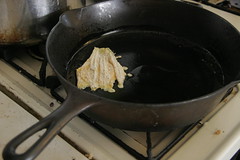
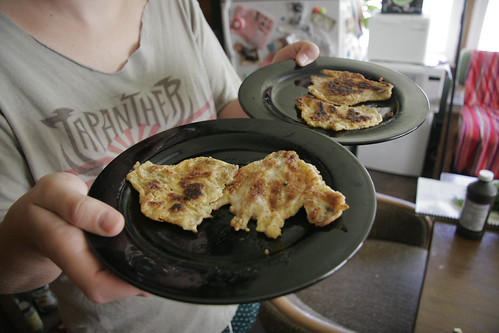
    Cut the bottoms off the blossoms so you’re left with only the petals. Dip them in some beaten eggs mixed with milk (or soymilk). Then rub some bread crumbs and flour on them.  Oil up a pan and throw em in. Let them fry until each side is getting a little golden. Then serve ’em to your hungry housemates.
    finished fried pumpkin blossom

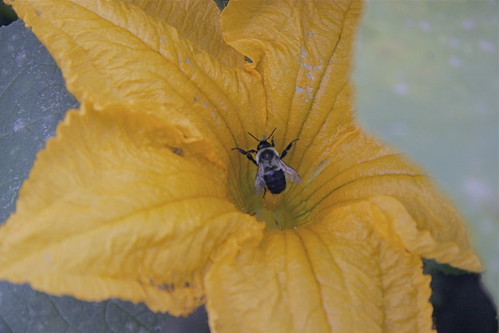
    Here’s what the blossoms look like with a bee chilling in there.
    pumpkin blossoms with bee

  • building a legit hot compost pile

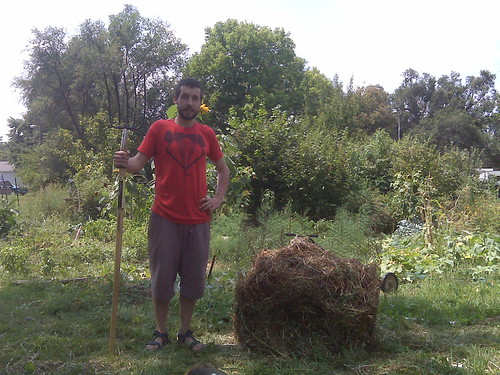
    I recently attended a hot composting workshop in our neighborhood put on by a local artist who has been doing a lot of organizing this summer in preparation for a community dinner this weekend.  Inspired to put into action the knowledge that was generously shared with me, I woke up this morning and decided to build a hot compost pile.  We had all the necessary ingredients and tools already on hand, so I was able to get right to work.
    picking weeds for the compostFirst I went through the garden pulling out lots of weeds.  The weeds would be the nitrogen rich materials needed for the pile.  We have lots of weeds growing, so there was indeed an abundance.  Thse plants bring nutrients up from deep below the soil, so in a way, the weeds are helping!
    mowing up the weedsI had already cleaned out the chicken coop bedding which contained straw (carbon) and manure (more nitrogen).  The next step was to shred the weeds with a lawnmower.  This increases the surface area of the materials and speeds up the reaction.  We got the mower for free from a friend, woohoo!
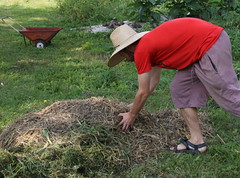
    The last step was to build the pile.  The goal is to create a mass building up the layers of carbon and nitrogenof alternating carbon and nitrogen layers.  In between the layers you add water and some dirt or old compost (this primes the pile with all the needed microbes).  That’s it: carbon, nitrogen, dirt, water, over and over, until you have a pile that’s about 3 x 3 x 3 feet.  The finished pile didn’t make it quite tall enough, so I’m keeping my fingers crossed. I finished off the pile with a ring of chicken wire.
    Pile done
    Thanks Gretchen for taking the photos!