Year: 2009

  • ODDMUSIC grand(e) opening

    ODDMUSIC grand(e) openingCOME see the Independent Media Center’s new Oddmusic Instrumentarium, first steps toward a compositional co-op & library of acoustic oddities.

    DO BRING an instrument (saucepan, egg-shaker, flügelhorn, udderbot…) for listening with. Some instruments provided.

    Featuring new works, new premises:

    – a tour of one-of-a-kind and locally-invented instruments housed at Oddmusic
    – Jacob presents a new performance on udderbot
    – Andrew debuts a 22-tone acoustic guitar
    – FALSE STATEMENT BULLETIN 04 Live Edition
    – A workshop in singing/playing/listening OVERTONES

    FRIDAY, AUG. 14

    8PM

    URBANA-CHAMPAIGN INDEPENDENT MEDIA CENTER

    202 S BROADWAY, URBANA

  • ice cream and outdoor movies!

    A few weekends ago, the members of la casa let me host a belated birthday party at the house.  the party featured homemade ice cream and an outdoor movie, projected on the side of the barn.

    john e, kannan, and mac brought an old-fashioned hand-crank ice maker. everyone got to contribute a little bit to making the ice cream:
    Juby churning ice cream

    we made earl grey ice cream, honey ice cream, chocolate-rum-raspberry ice cream, and avocado ice cream. nora’s boys brought sprinkles and ate a few bowls of mostly sprinkles with some avocado ice cream on top:
    cado ice cream so good

    you can find the recipe for the earl grey ice cream here.  *NOTE: i always cut the recipe in thirds. using 24 egg yolks for one recipe is just insanity.

    We also stapled butcher paper to the barn and projected the egyptian movie ‘the band’s visit’, a very slow-paced comedy that i would highly recommend.

    we projected a movie on the garage.
    we projected a movie on the garage. (photo by Kannan)
  • La Casa gets faster internet!!!!!!!

    REJOICE! OH LORD! Oh My Gods! Thank you, new wires!
    Picture 7
    When you watch YouTube, the video just…plays.

  • 6 Tips for Lead Safe Gardening on Vimeo

    My friend John E produced this video on soil testing using our yard. Ronna is in there digging soil. Too bad they didn’t actually do the test. Good info none-the-less!

    Vodpod videos no longer available.

  • A Playlist

    I had a radio show for four years at KTRU Houston, Rice University’s 50000 watt indy radio station. Since coming to Urbana, I hadn’t caved to the temptation of joining Radio Free Urbana (104.5 FM), a four-year-old free-form low-power community station. Until tonight, when I decided to take an hour and fill in for the Sonic Asylum show. I have no idea what the Sonic Asylum show sounds like, but I did pretty eclectically (though typically, if you know me):

    “Summertime” – Allen Savedoff – Contradiction (Capstone)
    “Caravan” – Allen Savedoff – Contradiction (Capstone)
    “Five Short Improvisations” – Robin Goodfellow & friends – The Early Years (Experimental Musical Instruments)
    “Camping in the Backyard” – Skip La Plante – La Plante (PITCH)
    “Exotic Harp, Vibraphone” – Warren Burt – 18 New Fuguing Tunes for Henry Cowell (self)
    “Malizi v Parizi” – Iva Bittova & Bang on a Can – Elida (Canteloupe)
    “Abstain With Me” – Roy Zimmerman – Faulty Intelligence (Metaphor Records)
    “Who Are Parents” – The Shaggs – Philosophy of the World (RCA Victor)
    “The Dead Bird” – Dan Sedgwick – Shepherd Student Works 2006 (self)
    “Burning Monk’s Waltz” – Catler Bros. – Crash Landing (FreeNotes)
    “into the woods” – Astroid Power-Up! – Googleplex (self)

  • identifying the plants in the yard

    We recently had a house guest, Aaron, who works for the Chicago Park District maintaining parks and natural areas. He walked around the yard identifying everything he could. There were several prairie species, and lots of invasive weeds. We learned that the big pink flowers that the carpenter bees love is called Joe Pie Weed.
    Joe Pie Weed and carpenter bee
    We also found the beautiful orange flowers of butterfly milkweed.
    Butterfly milkweed (native) topview

    There were a couple plants the Aaron couldn’t recognize.  I found the flickr photo pool called ID Please, where you upload photos of plants and animals you can’t identify and the people who troll that group ID them for you.  I was able to identify this mallow plant and some comfrey that way.

    Scroll through the slideshow to see some of the identified species.

    Vodpod videos no longer available.

  • hygienic bee-havior for more natural bees

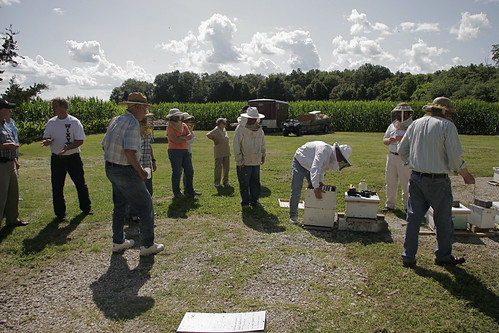
    Robby-Bob and I went to another bee club meeting on Sunday.  It was a special event for the club.  An expert was there to discuss and demonstrate ways to test bees for hygienic behavior.
    introducing the demonstration
    The reason this is important is because beekeepers routinely use chemicals to fight off infections and pests, usually to save themselves from economic ruin.  To reduce the amount of chemicals beekeepers use, an effort is underway to selectively breed bees that resist the pests.  One way for bees to protect themselves is to identify and remove cells in the hive that are infected.  Bees that demonstrate hygienic behavior are those that remove larvae from damaged cells.  To test for this trait, they selectively freeze/kill a section of larvae with liquid nitrogen and watch to see if the dead larvae are removed by the workers.
    demonstration- freeze kill with liquid nitrogen
    A steel can is smushed into the comb, and liquid nitrogen is poured inside to instantly kill the larvae inside.  After 24 hours, the frames are inspected.

    bees without hygienic behavior bees with hygienic behavior
    The frame on the LEFT is from a hive that does NOT show hygienic behavior. In the frame on the RIGHT, notice how the bees removed the larvae from all the cells leaving a circle of empty comb, a sign of hygienic behavior.

    Many people have heard of Colony Collapse Disorder, but bees are susceptible to a range of problems and so most beekeepers rely on some sort of chemical strategy to maintain their business.  Breeding hygienic bees may ultimately lead to an industry less dependent on chemical inputs, meaning more ‘natural’, or ‘organic’ honey and wax (yay!).  Of course I am oversimplifying this whole process.  Hygienic behavior is actually much more complicated, especially when you approach it from the genetic side.
    queen removal
    I was very lucky to be invited to the club meeting and demonstration, thanks Robby!

    I posted more photos of the meeting to this flickr set.

    Also CEIBA wrote about the event (and used my photos!) on their website.
  • Hives get taller

    Head-beekeeper, Robby-Bob, came by yesterday and added a shallow super to both hives.
    The gives are getting taller

    Based on the progress that was observed in the last bee post, the hives were past due for some extra expansion room.  It took a little while to source the correct size frames for the shallower top boxes, and Robby installed them while I was in class.  Ideally the bees will use the new frames mostly for honey that we can later harvest.  Robby decided not to use a queen excluder, so there’s the potential that the queen will get up there and lay eggs.  We have enough supplies for one more box on each hive depending on how well they take to the new frames.

  • Recent Polaroids, Polaroid Transfers

    I’ve been working on polaroid transfer techniques with my 125 Land Camera and expired peel-apart film. These are my first ‘roids of La Casa. I need to acquire new (to me) film!

    Maria the Markswoman

    Maria the Markswoman

    Chickens

    Chickens

    Bees

    (The transfer of the bees photo was not particularly visually interesting. Perhaps next time.)

  • mas fotografias del jardin

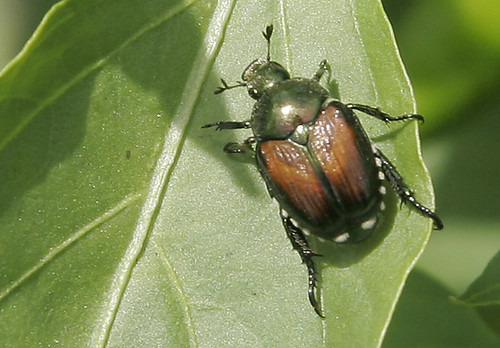
    These beetles did a serious number on our red raspberries this season.
    Annoying beetle
    Found some lemon cukes ready to pick, yum.
    lemon cukes
    More super happy sunflowers.
    more happy sunflowers
    A cabbage from a mac, john e, and kannan’s plot.
    cabbage
    Leaf bug laying eggs on the barn. (photo by mac)
    Leaf bug laying eggs on the barn

  • Hive Tour 7/12/09

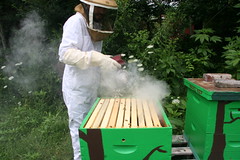
    smoking the beesMy good friends Kannan, and Mac helped me get a closer look inside out hives yesterday.  Four weeks ago I put the second deep supers on each hive.  The supers were full of bare frames, meaning the bees needed to build the comb before they could use them.  Well, after checking out the hives I can say they are doing excellently.  Lots of brood and some full frames of honey.  There were even empty brood chambers where baby bees had already emerged.  This means we probably need to add more space to allow the hive to continue to grow.

    The diagram on the left is similar to our hives, (different lid and different number of frames) but it gives you an idea of how the hives are constructed.  Its a fairly simple design.  Wooden frames are suspended inside a box, and the boxes are stacked up.  The bees then build honeycomb on both sides of each frame.  I had some handy helpers, so we were able to take clean photos of each frame.  I cropped all the photos in a similar way so you can flip through each cross section of the hive.  As you get towards the middle you’ll notice that there is less honey and more brood.  The queen lays eggs in a somewhat predictable pattern, and experienced beekeepers use that to judge the quality of the hive.

    Vodpod videos no longer available.

    full screen slide show of hive 1

    Vodpod videos no longer available.

    full screen slideshow of hive 2