Category: garden

  • Hives get taller

    Head-beekeeper, Robby-Bob, came by yesterday and added a shallow super to both hives.
    The gives are getting taller

    Based on the progress that was observed in the last bee post, the hives were past due for some extra expansion room.  It took a little while to source the correct size frames for the shallower top boxes, and Robby installed them while I was in class.  Ideally the bees will use the new frames mostly for honey that we can later harvest.  Robby decided not to use a queen excluder, so there’s the potential that the queen will get up there and lay eggs.  We have enough supplies for one more box on each hive depending on how well they take to the new frames.

  • mas fotografias del jardin

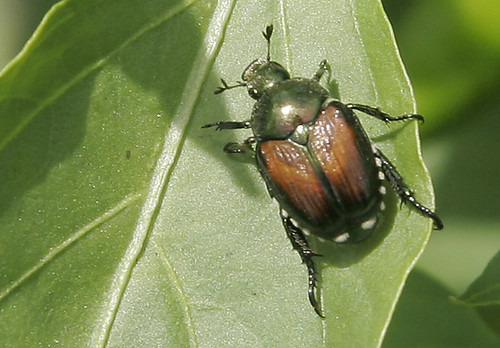
    These beetles did a serious number on our red raspberries this season.
    Annoying beetle
    Found some lemon cukes ready to pick, yum.
    lemon cukes
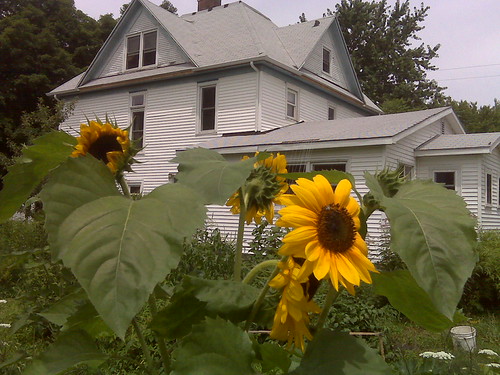
    More super happy sunflowers.
    more happy sunflowers
    A cabbage from a mac, john e, and kannan’s plot.
    cabbage
    Leaf bug laying eggs on the barn. (photo by mac)
    Leaf bug laying eggs on the barn

  • Hive Tour 7/12/09

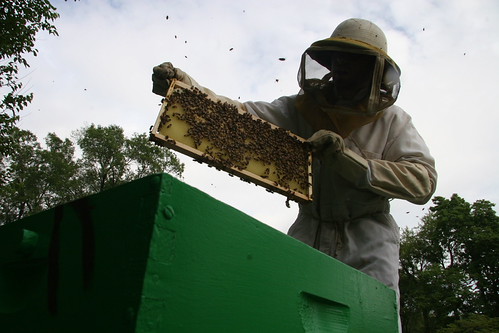
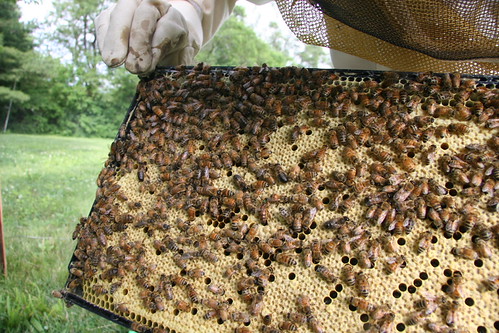
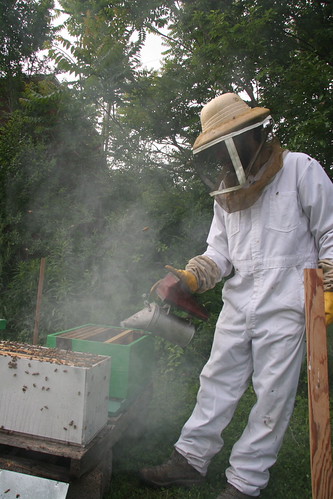
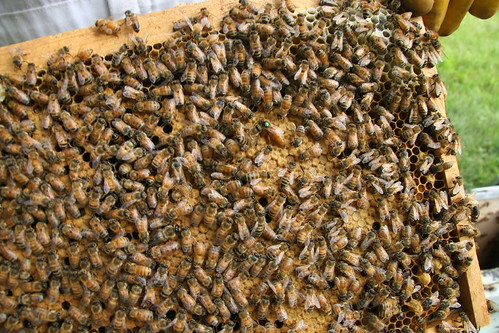
    smoking the beesMy good friends Kannan, and Mac helped me get a closer look inside out hives yesterday.  Four weeks ago I put the second deep supers on each hive.  The supers were full of bare frames, meaning the bees needed to build the comb before they could use them.  Well, after checking out the hives I can say they are doing excellently.  Lots of brood and some full frames of honey.  There were even empty brood chambers where baby bees had already emerged.  This means we probably need to add more space to allow the hive to continue to grow.

    The diagram on the left is similar to our hives, (different lid and different number of frames) but it gives you an idea of how the hives are constructed.  Its a fairly simple design.  Wooden frames are suspended inside a box, and the boxes are stacked up.  The bees then build honeycomb on both sides of each frame.  I had some handy helpers, so we were able to take clean photos of each frame.  I cropped all the photos in a similar way so you can flip through each cross section of the hive.  As you get towards the middle you’ll notice that there is less honey and more brood.  The queen lays eggs in a somewhat predictable pattern, and experienced beekeepers use that to judge the quality of the hive.

    Vodpod videos no longer available.

    full screen slide show of hive 1

    Vodpod videos no longer available.

    full screen slideshow of hive 2

  • volunteer sunflowers

    La Casa and sunflowers
    If you walked around the La Casa garden, you’d probably wonder why we planted so many sunflowers. Well, we didn’t actually plant a single one. At least no one did this year. They are all volunteers.

  • long time no post

    Sorry for the long delay in posts.

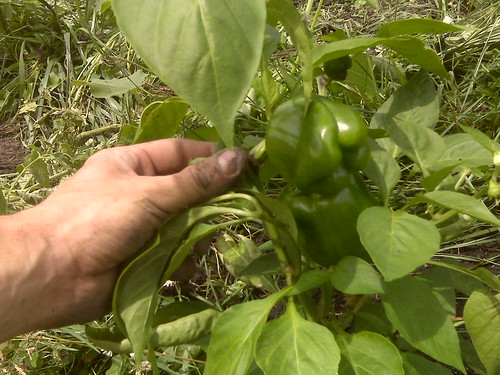
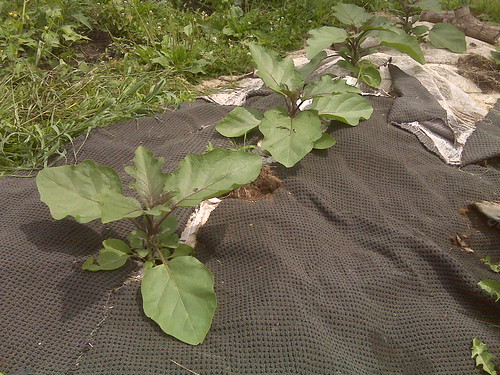
    Here’s some quick photos from our garden shot with my cell phone: hibiscus bloom, bell peppers, eggplants, tomatoes.
    Hibiscus in bloom
    Some cute peppers
    Eggplants are happy in the experimental bed
    Lots of tomatOes coming in

  • Snow Peas

    snap peas

    Planted by Ronna.

    ronna_picking

    And picked by Ronna. (View from the roof)

  • Red Currants

    redcurrants1
    From the garden!

    I have too many great memories of eating red currants off bushes in Poland as a little girl. The polish are obsessed with red and black currants. It’s definately a flavor (of jam or juices), much like Americans have grape and cherry. I haven’t come across any red currants while in the states and I was overjoyed when I found these growing in the garden.

  • praying mantis pods

    praying mantis pod

    A bunch of praying mantis pods were recovered from the burn pile yesterday.  The pods were attached to last year’s bamboo growth and were cutout when the grove was thinned.  Ronna found them in the brush pile and saved them because she thinks they’re beautiful.  They’re now nicely displayed on our kitchen table as an interesting conversation piece.

    praying mantis pods

    We got to talking about them and wondered if there were still mantis babies inside.  This caused Don and I to search for information online about praying mantis lifecycles.  We found this short video on youtube:

  • Honeybees arrive

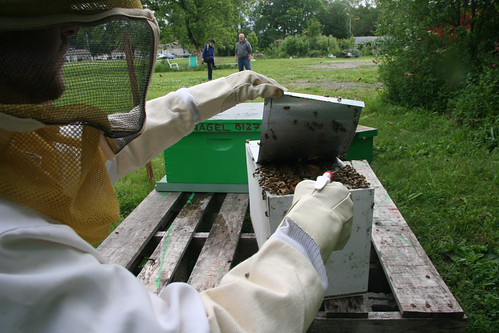
    We installed two hives of honeybees today at La Casa.  Fellow co-oper, Robby from across town will be using our yard (and pollen) to raise honeybees.  Robby got his hive boxes from his grandfather who was a beekeeper.  Robby’s been taking classes from the Central Illinois Beekeeper’s Association: CEIBA.  Last night we picked up the bees from a queen breeder near Danville.  They were sealed in boxes for transport in the van.

    About 10,000 bees came with each queen.  Five frames from a two healthy colonies, along with a two queens were put into boxes.  Today we tranported the frames into the hives.  Robby moved the first colony, and I moved the second.  We had to wear full bee suits otherwise the bees would have stung us many times.  It was quite a rush carrying the frames full of bees and being careful not to disturb them too much.  We took a bunch of photos, and I’m just going to go ahead and post most of them.
    opening up the transport boxes
    Robby tried to calm the bees down with sugar water. There were hundreds flying around us as we were working.
    sugar water
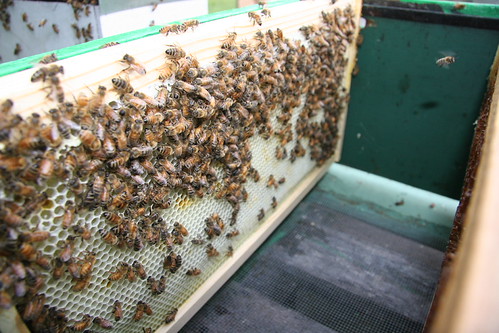
    frame in the hive
    This is what frames look like installed in the hive. There are ten frames in each section of the hive. We mixed the five frames full of honey and brood (developing bees) in with 5 clean frames.
    moving the frames over
    most of the frames in now
    Most of the frames are installed. Just a few more to squeeze in.
    Queen bee spotted (green dot)
    You can see the queen crawling around in this photo. There’s a little green dot on her back. Try this hi-res version if you want to see her up close. She has a longer body and smaller wings.
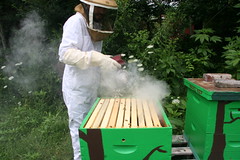
    smoking the second hive
    I suited up and moved the second set of frames while Robby took photos. This time we tried the smoker instead of sugar water. The smoke calms them down and confuses their communication.
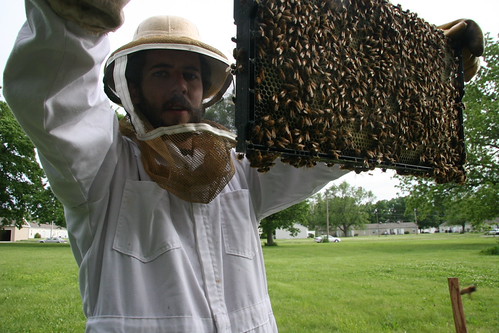
    holding up a frame full of bees
    Robby snapped this nice photo.
    more smoke to calm them down
    Calming them with more smoke. Only two frames left to move.
    Queen bee 2 (green dot)
    The other queen. Look for the green dot. Hi-res.
    bee work done, hives ready
    All put back together. Bees installed. The next move is to put more boxes with clean frames on top. The hives are designed to be modular, building up from the bottom box. Two big boxes at the base are where the queen builds up her colony. Then at some point smaller boxes are placed on top with a screen that lets only the workers past. Since only the worker can access the top boxes, no eggs are laid and they become full of honey. Since we’re starting this hive pretty late in the season, we might not get much honey this year. But its still a worthwhile project and if the hives survive the winter, we’ll have plenty of honey next year.

  • Radishes from the Garden!

    radishes
    Grown right in our garden. They taste great. Real radishes have a great spicy taste to them. (they are similar to horseradish, after all)

  • after the flood

    We got soaked yesterday and most of the garden is now underwater. yikes.
    Water logged garden
    from some news article… “In Illinois, a range of windy storms dumped as much as 3 inches of rain within 50 minutes. National Weather Service meteorologist Ed Shimon called the accumulation “unbelievable,” comparing it to heavy rainfall in the tropics.”

    today – dry
    tomorrow – more rain

    let’s hope this dries up soon.

    update: went out and snapped some photos with my “good” camera.  click thumbs below to see ’em.

    floodthumbs