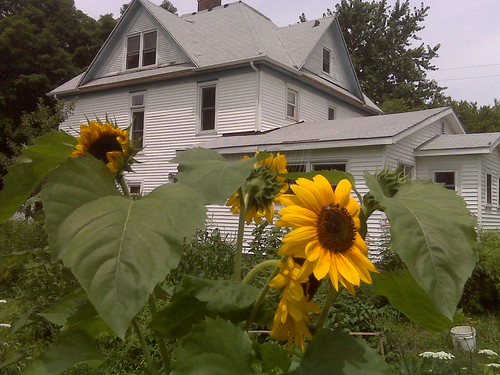
I’ve been working on polaroid transfer techniques with my 125 Land Camera and expired peel-apart film. These are my first ‘roids of La Casa. I need to acquire new (to me) film!
(The transfer of the bees photo was not particularly visually interesting. Perhaps next time.)
If you walked around the La Casa garden, you’d probably wonder why we planted so many sunflowers. Well, we didn’t actually plant a single one. At least no one did this year. They are all volunteers.
I am cat sitting Olive until August 1st. She is a feisty, skiddish gal who likes to be petted lightly.
She mostly hangs out in my room, and enjoys sleeping with me or darting around the second floor.
Goes to Olive!
It was a close tie with this year’s runner up, Sophie, who in the last moments of the competition threw up a foamy, buttery grassy mess on the dining room couch. Those around her made various “eww” and “you’re gross” noises, thereby knocking her down in the rankings. Sophie ate 1.5 sticks of butter earlier in the day and ate grass to help ease her digestion.
Great Job to both contestants!
1. Sophie
2. Hey!
3. Sophie Sophie Sophie Sophie Sophie
4. Pxxssff!
5. Sooo…
6. Anyways
7. Oh My God!
8. Fail
9. SuuuUURE SUuure
10. There is [insert food item] in [place] if anybody needs some
11. Just like
12. Deenor
13. Varied tones of clucking from numerous emotional stages
14. Whining, so much whining
15. BARROOOO
16. Mmmh Mmmmh Mmmh
If you ever wander the streets of downtown Champaign, with just the right kind of aimlessness, you may suddenly find yourself in a tiny forest, which opens up onto a tiny prairie, complete with wetland, glacial till, and authentic hobo markings. This is the Pocket Prairie, which Dave Monk (a.k.a. The Prairie Monk) takes care of and uses as a demonstration of the ecosystem.
Dave came here from Australia decades ago to study the prairie ecosystem, only to find that it was rapidly being swallowed up by farming and development. Today, less than 0.1 percent of original prairie remains. Dave stresses that the sheer genetic variety found only on the prairie may very well contain future cures for cancers, as well as plants with the potential to be good biofuels. The research will take years, as it does, and of course it is up to all of us to ensure the prairie is still around when we need it.
From neverending battles with landscaping racketeers and those who hire them, came the slogan “Grow it, don’t mow it!” This spirit is reflected across Urbana, which has more un-traditional and wild-growing lawns than I have seen anywhere else.
At any rate, I helped Dave produce a virtual tour slideshow of the “Pocket Prairie” in the springtime, and here it is (original post):
This is the second day of the second year of the Blues, Brews, and BBQ festival in Urbana. Big names coming tonight, and it’s free this year. Too bad it’s the same evening as the West African dance/drum circle/potluck/bonfire at La Casa. I must catch some of both.
This recording was made today under the auspices of “Sound Explorers”…
“Sound Explorers” is an idea I had for a student club back at Rice; the group would take trips to local places of particular sonic interest. One way of learning more about your locality could be by making a map identifying these places of aural uniqueness.
At any rate yesterday I found myself wanting to try out the IMC production room’s Zoom H2 recorder, & I found a blues festival at my front door. The wandering took me to a Freebird kazoo-along, a porta-potty, and a small tree.
Ed, a local beekeeper, came to check out our hives for a three week checkup last weekend. Robby is out of town, so he arranged to have some members of CEIBA help keep an eye on the hives. We had gotten a late start with our bees but each queen came with 5 frames of brood and honey. In just a few weeks, the bees have really established themselves and Ed determined it was time to add the second box on the hive. This will give each hive 10 fresh frames to build comb and expand the colony size.
This frame is full of capped brood. Brood is the general name for combs that have eggs and larvae. The worker bees feed the developing larvae before sealing them in with a cap . In a few weeks these bees will hatch and the process will start over again with the queen coming around and laying eggs in each comb. In this way, the colony will double and triple in size very rapidly.
In the center of this photo, a bee is hatching from the comb. We watched as the bee ate away the cap. Like eating corn on the cob, she went back and forth chewing her way out. After she leaves, the workers will clean out the comb and get it ready for another egg.
This is what the comb looks like when the bees decide to store honey instead of brood. This looks like it was a fresh frame to begin with since you can still see in the lower left that the comb hasn’t been fully drawn out by the bees. There must be a lot of nectar flowing now because even though the comb isn’t finished, the bees are already storing and capping honey. In the upper right is capped honey. To process the honey, the bees sit over the comb and fan their wings to evaporate off the water. Once the honey is sufficiently concentrated they seal the comb off. You can tell the difference between capped honey and capped brood by the color.
I took lots of photos so we could inspect the bees in depth without keeping the hive open for too long. Click the thumbnails to go to a flickr set of the event.
Sophie came to my room today looking for adoration and I gave it to her. I begged her to let me record her beauty via my camera. She played hard to get at first, showing me for just a moment the many pointy teeth in her mouth, but then relented and gave me everything I could ask for:




 La Casa Grande Colectiva