Wet and windy weather saw our expert friend, Rafter, lead a mushroom workshop on April 16th! Indoors for a PowerPoint, Q & A and snarf session; then outdoors for Shitake log inoculation and garden bed prep. Thanks to housemate JP for his effort and achievement in helping organize a delightfully illuminating event. And kudos to our many guests whose enthusiastic participation and food contributions will undoubtedly manifest in a good-Karmic harvest. Happy, happy!
Category: projects
-
La Casauerkraut
I think it was this article http://www.thesunmagazine.org/issues/413/countertop_culture in The Sun magazine that first caught my interest in wild fermentation. Certainly, the pallid, soggy sauerkraut of my middle American world had never once lured me. Still, my interest in home food preservation and the health benefits of raw, fermented foods made trying this irresistible, and so in I leapt. I can only say that homemade, wild fermented sauerkraut is one the most unexpected pleasures of my life now. Each batch is unique and that is part of the fun. I like to add a little garlic, a bit of carraway seed (against flatulence) and any root veggies that might be available like beets, carrots or radishes. I use the least amount of salt I can get away with which has been a bit less than the recipe and it has worked out well. Beets and purple cabbage both give the kraut a lovely pink hue. I don’t even like pink, but I have loved the colors of my kraut batches.
Anyway, Sandor Katz is the wild fermentation maven. Here’s his website, starting right off at the recipe for kraut: http://www.wildfermentation.com/resources.php?page=sauerkraut
This is the batch I made just a few days ago, dedicated to Dan Schreiber:
Cabbagecarrotconfetti 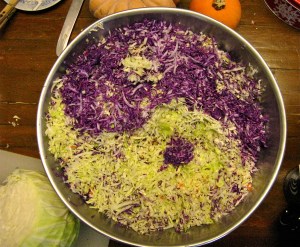
A bit of sauerkraut spirituality fun 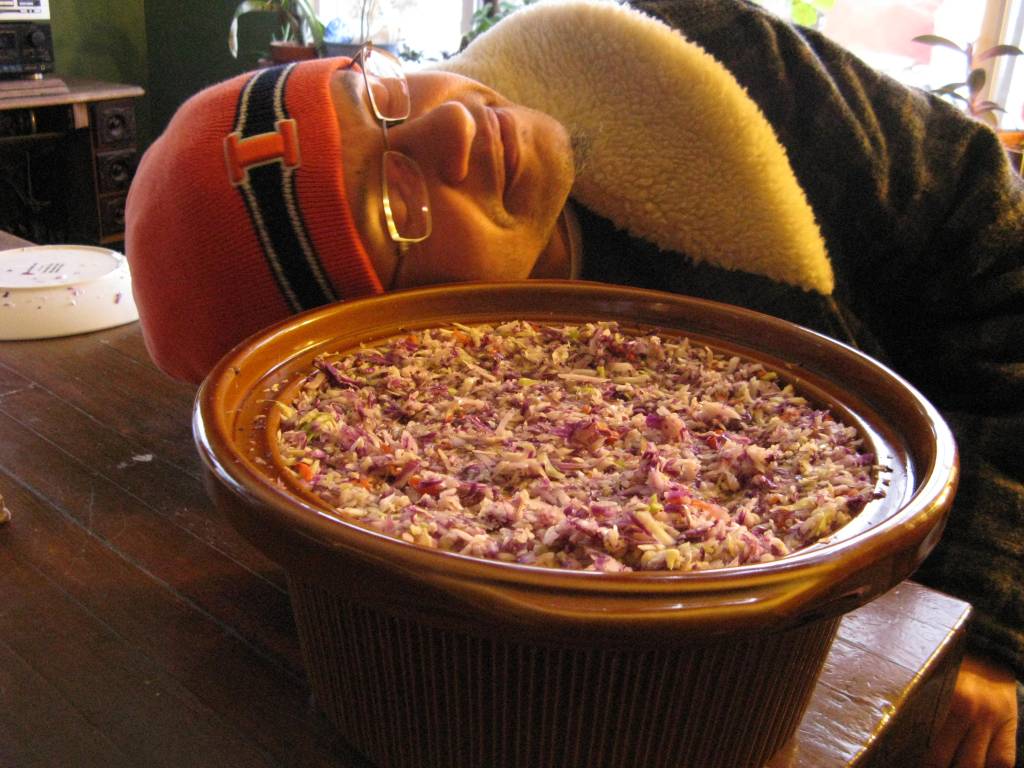
Julio giving the kraut crock some L-O-V-E I hope you make some of your own and you love it!
-
Bee update from R. Nagel

Robert wrote an update on the beehives on his blog. Here’s the whole thing.
”
Well last weekend (November 2) the temperature was fairly warm, the sun was shining, and the wind was lazily blowing. It was a good time to check the hives and I will be periodically checking the weak hive throughout the winter. Unfortunately, due to the late season swarm that took place in late July I believe, on hive has no food. And by no food I mean the hive has no honey.
Bees spend all summer preparing for winter. In the warm growing season they gather pollen and nectar from almost every plant within about a 2 mile radius and take it back to the hive and store it in the honey comb. By fanning their wings, they turn the nectar to honey by evaporating the water. Once the honey comb is full, it is capped with a white wax and left alone. Unless the bees decide to swarm. When the bees decide to swarm, they are dividing the colony in two and sending much of their honey stock to the new colony. This means that the honey is lost when the bees swarm.
When the one hive swarmed, they lost not only lots of honey, but also the queen. I’m not sure what happened, but without a queen and her guiding pheromones to control the worker bees, many of them simply stayed in the hive and ate honey. So instead of gathering at least 120 pounds of honey for winter, the bees had nothing.
 Some bees gathered on some frames discussing where the best flowers of C-U.
So this means I have to probably once every couple weeks go to the hive and give them some sugar syrup. I can make sugar syrup by mixing two parts sugar to one part water with some heat. A problem is that the syrup could freeze and the bees might not be able to get to it. Another problem could be that the sugar syrup stays too long in the container and goes bad before its all eaten.
Amazingly the hive stays relatively warm in winter. Although the outside temperature may drop to many degrees below zero, the core of the hive maintains a temperature of more than 90 degrees fahrenheit. The bees do this by clustering and then slowly circulating. Bees that have been on the outside of the cluster slowly move in towards the warmer middle and bees from the warm center slowly move outward. The queen, of course, is always the center of attention.
But without any honey, the bees have no energy to produce heat and the hive may freeze and/or starve to death. This would be pretty depressing so I am going to try my best to give the bees all they need to eat.
”
-
planting pawpaw seeds
The other day I stopped by the house on Washington St that has pawpaw trees growing in the yard. A nice lady named Ruth greeted us in her driveway and we spoke for awhile about her trees. They were planted 45 years ago by her husband who saved a few seedlings from a grove that was about to be bulldozed on campus.

Happy to share her bounty of fruit, she graciously served us slices of freshly ripe pawpaw and sent us each home with a few fruits. When I told her I was interested in growing my own, she gave me a container with hundreds of seeds. I also saved all the seeds from the fruits she gave me.
Eating Ruth’s pawpaws was the first time I’d ever eaten a fully ripe one. I thought they were incredibly delicious.
Normally people plant the seeds in deep containers and transplant the seedlings after they’ve grown a bit. First, however, the seeds need to experience a period of cold lasting 90-120 days, called stratification. This is achieved by refrigerating the seeds during the winter. Of course this is a lot of work and it requires patience, a quality that I can’t always depend on myself having.
My plan is to plant all of the seeds in our shady front yard. The grass grows terribly under an old Maple tree, and pawpaws can tolerate a lot of shade. I chose to plant the seeds directly into the soil, allowing them to stratify naturally during the winter. This reduces the overall amount of work. Instead of planting a few seeds and carefully watching them, I planted a lot of seeds and allowed nature to do the rest of the work.
Using a rebar spike I stabbed the ground and dropped a seed, over and over, until over 100 were planted. The idea to plant this way came from this movie. If none of them come up, no biggie, the whole process took less than an hour. However, if some come up, then a lot will, and the chances of a few surviving are better than slim.

After I planted them I received this email back from a paw paw expert: “Maples are difficult trees to plant pawpaws under because the maple roots are so aggressive and out compete the pawpaw roots for water and nutrients. At least that is true in general if not very every situation. Pawpaws grow very often in association with tulip poplar and ash. If your soil is deep and rich, then maple is probably okay.” So I guess I have to hope our soil is “deep and rich.”
The seeds will first grow a 10 inch taproot before emerging above ground next Fall. Sometime in August 2010, I’ll be looking for tiny seedlings and hoping that somehow they’ll survive the following Winter and grow into trees.
I zipped up all my pawpaw research and you can download it here. Also, this page is loaded with info.
-
ODDMUSIC II
As many of you know, Jacob and Andrew have a project going at the IMC called Oddmusic Urbana-Champaign:
Oddmusic U-C is building a library of unusual and usual musical instruments at the UC-IMC and facilitates events to connect experimental composition, microtonality, & instrument-building with non-sectarian radical social change. We insist upon “music” as a type of “odd,” desirable when it avoids the same old society telling itself what it already knows.

Andrew in Oddmusic II, the day after the big move. Last month, we had a grand(e) opening, and this month an opportunity has come up to relocate our collection to a brand new space that’s cheaper, more commodious, brighter, and by at least one guest’s account, friendlier! Last Sunday, with help from our friends Mary Ann(e), Don, Snow Leopard, and Mary Margaret, we successfully moved into our great new space. We’re continuing to host office hours every Sunday evening from 7pm to 9:30, so feel free to come by this weekend and see what we’re about. We’re now in the basement of the Independent Media Center (at Elm and Broadway in Urbana), room 21A, just down the hall from the Bike Project.
For more, see our blog and (or) sign up to be on the Oddmusic listserv.
-
Sundown Towns
Last night Andrew and I went to a Unit One lecture by Sociologist James W. Loewen on Sundown Towns and racism in small town America. “Sundown Town” is a name for a town or city where whites collectively drove out and kept out black people (and also sometimes Jews, Native Americans, Latinos).
These communities are sometimes called “sundown towns” because some of them posted signs at their city limits reading, typically, “Nigger, Don’t Let The Sun Go Down On You In ___.”

The practice began in the late 19th Century, became illegal after the 1960’s and the civil rights movement, but still persisted through the 70’s, and in some cases, still persists today or until very recently.
(These archival images are taken from Professor Loewen’s slideshow on Sundown Towns.)

He’s confirmed over 400 sundown towns in Illinois alone. I used his database to check out some towns I grew up around where I’ve never once seen a black person. The question about some of these rural towns is, do they just happen to be all white, or are they all white on purpose?
Maroa, Illinois, is on his list of confirmed sundown towns (which you can search by state). He writes that the main method of exclusion in Maroa is realtors refusing to sell to blacks, and a realtor told him in 2001 that there was still an ordinance on the books making this official town policy.
The method of exclusion varies by location. Some excluded by violence, threat of violence, police or other official action, and reputation.
You can check out Loewen’s website for more information, for papers on how he conducts his research, how to confirm sundown towns, and how to help him with this project in general. He is looking for volunteers to help him conduct oral histories and research in small towns across the country.
I’m looking forward to reading up on this disturbing side of American history that deserves more attention and understanding.
-
paw paws, awesome
The paw paw genus (asimina) contain the largest edible fruit indigenous to this continent (says wikipedia). They apparently taste like a cross between a banana, a mango, and a pineapple. I’ve just begun learning about paw paws and recently was at a paw paw forest about an hour away.

The big leaves give the plant away, but the fruit are even more distinguishable.

Paw paws a very fascinating, I would recommend the wikipedia entry as a good introduction. Kentucky State University is building a great website for paw paw information and research of which there is surprisingly little. Compared to standard orchard fruits, not a lot of people are working with paw paws because they have a very short shelf life. For the backyard orchardist who doesn’t have to worry about shipping and storage, the paw paw could be an easy delicacy. Due to the fact that they’re indigenous, they are extremely pest resistant.There’s one paw paw on the Urbana Fruit Map in someone’s yard and they’re not overhanging the sidewalk (yet), so don’t take any!
Paw paws grow densely in the understory layer. Next time you take a ride down Washington St stop and take a look at the beautiful trees with the big leaves.
-
late summer hive check – mystery queen
Robbie and I opened up the hives a few weekends ago to take an inventory of the healthy hive and see how much brood the new queen has produced in the weaker hive. Sadly, we didn’t see a lot of honey in the honey supers (the shallower frames on top). We figured this was some what to be expected since our hive was just getting built up when most of the plants were producing nectar. It was a timing issue, and we were late getting our hives started.

You can see that there is some capped honey in the middle, but the bees have barely drawn out the wax comb towards the edges of the frame.In the hive that recently had been re-queened, there was a clear sign that the new queen had been successfully introduced. You can see in the photo below that some of the cells have a dark yellow cap on them. That’s called ‘capped brood’, and in a few weeks fully developed bees will eat their way out and begin working right away.

The brighter orange cells are pollen stores.When we first opened up the second hive we immediately noticed something strange. Right in the corner of the hive that we pried open with the hive tool, there was an unmarked queen hiding out.
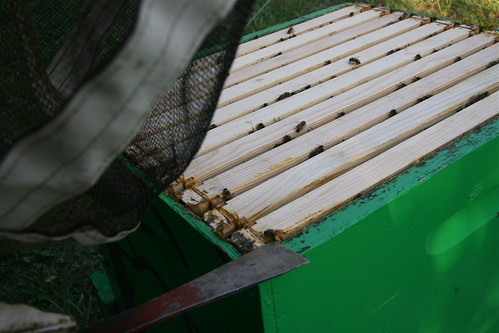
There she is about as far away from the nucleus of the hive as possible.

You can see her elongated abdomen and short wings. We were hoping to find signs of the introduced queen and maybe spot her, and oddly the first bee we see after opening the hive is another queen. I suspect that before the first queen swarmed, the bees had already started feeding royal jelly to create a new queen. By the time she hatched we had stuck a new queen in, who has now taken over the colony.If you spend a moment to think about it, a very interesting tale of courtly coups could be extracted from this. Is the native born queen entitled to the crown? Who is this imposter queen who has stolen the throne and banished the rightful heir to the far reaches of the queendom? Did we screw up the natural order of things by adding a new queen when the bees were busy rearing a new one?
We scratched our heads (through the veils), set the mystery queen aside, and continued looking for signs of the introduced queen. When we were finished and putting the frames back in we found the unmarked queen very close to where she was before.

It seems as though she still had a few workers attending to her. -
My pre-existing condition was no health care access
(Rob wrote this song in the direction of the health care debate. It is the product of less than 24 hours of work.)
Jacob, “MC Utterbot” and udderbot
Andrew, “Professor Heathwaite” and 23-tone electric
Rob, “Hello” and drumsLyrics:
I need a lever, cause yo, I’ve got a fever
Need some accessibility to the health care facility
What’s the public option when the option ain’t publicized
I’m still waiting in line you better recognize
your health is mine, to deny it’s a crime
50 million in urgency so check the emergency… **CRASH**All the other wealthy industrialized countries have universal health care systems — that means, every citizen has access to health care. Except in the United States. Yo! MC Utterbot, I think they need some contents to make some sense out of this nonsense…
The clock ticks… I’m talkin’ ’bout one-in-six
Only hard to understand with insurance in hand
When y’read they propaganda, s’hard to understand-a
They take our activism and they call it socialism
Or portray the U.K. as a place with no x-rays
where you wait in line for days but it’s worse here I dare say…Excuse me sir, we only assist robots in this emergency room — WILL SOMEONE TURN OFF THAT CAR ALARM. What’s that? You are a robot. Oh. I’m sorry but your insurance doesn’t cover that procedure. Please see the secretary down the hall and fill out more paperwork…
My pre-existing condition was no health care access
I had to treat myself based on my best guess
While corporations are playing me like a game of chess
Still I’ve got to say, nevertheless
I want health care parity and solidarity
A social contract yo this ain’t no frickin charity
The blue dogs know they’re gonna have to go
and when I get to the do’ I wanna hear something just likeHello…
Hello…
Hello…
Hello…
Hello…
Hello…
Hello…
Hello…
Hello…
Hello… -
Losing a Queen
Honeybees are prone to swarming. A swarm is a big cloud of bees that have left the hive looking for a new home. This is a natural part of their reproductive behavior, however in a back yard environment designed to maximize honey output, swarms pose a problem.
A couple weeks ago Robbie opened up both hives and noticed that in one there was no sign of a laying queen. Where there should have been cells filled with larvae at different stages of development there were instead empty cells. This indicates that either the queen died, or she took off with a swarm.

In this next photo you can see the slightly larger drone cells (where the male bees are hatched) and the very large queen cells that are perpendicular to the rest of the comb. This frame is in bad shape, and all signs indicate that bees had switched to reproductive mode.
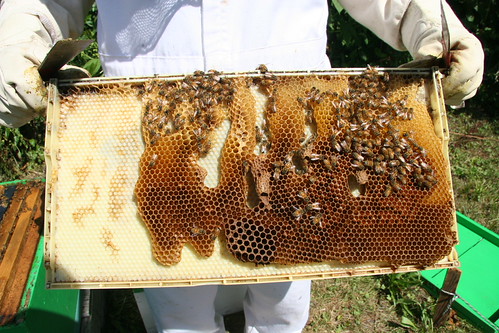
Without a queen constantly hatching new workers, the hive would simply work itself to death and that would be the end of things. There were however many thousands of worker bees left in the hive, busy collecting what was left of the summer nectar flow. The solution to losing a queen is to simply get a new one. So Robbie contacted local bee expert, David, at Long Lane Honey Bee Farms and went to pick up a new queen. The new queen only cost about $20, and would save us the trouble of starting a new hive in the spring.
 You can see her long abdomen through the screen with the little green dot to make her easy to spot. The little cage that she came is designed to help her assimilate with the bees already in the hive. Her potent pheromones waft through the screen controlling the army of workers. The bees then chew their way through a sugar plug (black tube thing) and release her into the hive. The delay while they work to set her free insures that she won’t just fly away once released.

Robbie installed the queen cage between the two big boxes, right in the middle of the brood chamber. In a week or two we’ll open the hive back up and see if there’s any signs of egg laying. Until then, fingers crossed.
You’ll notice how the hive on the left is much taller. When Robbie noticed the absence of a queen, he moved the top honey super over. He placed newspaper between to act as a temporary barrier while the bees in there got used to their new master. Oh the intrigue of beekeeping…
-
UPDATE: mural at the independent media center
Below is the mural from about a month ago. The mural is a project by local artist Chris Hampson.


Chris decided to divide the mural into “picture frames” for people to fill in. (2 weeks ago)


There was painting party which I was unfortunately out of town for. Below is the mural after the party.


It seems that the mural is an evolving collaborative project that is meant to engage as many people as possible. Today I found this excellent panoramic photo-stitch of the mural on Daniel Schreiber’s blog about local art happenings (and chocolate). Super cool.


 La Casa Grande Colectiva