I recently attended a hot composting workshop in our neighborhood put on by a local artist who has been doing a lot of organizing this summer in preparation for a community dinner this weekend. Inspired to put into action the knowledge that was generously shared with me, I woke up this morning and decided to build a hot compost pile. We had all the necessary ingredients and tools already on hand, so I was able to get right to work.
 First I went through the garden pulling out lots of weeds. The weeds would be the nitrogen rich materials needed for the pile. We have lots of weeds growing, so there was indeed an abundance. Thse plants bring nutrients up from deep below the soil, so in a way, the weeds are helping!
 I had already cleaned out the chicken coop bedding which contained straw (carbon) and manure (more nitrogen). The next step was to shred the weeds with a lawnmower. This increases the surface area of the materials and speeds up the reaction. We got the mower for free from a friend, woohoo!
The last step was to build the pile. The goal is to create a mass 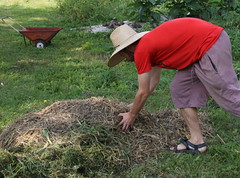 of alternating carbon and nitrogen layers. In between the layers you add water and some dirt or old compost (this primes the pile with all the needed microbes). That’s it: carbon, nitrogen, dirt, water, over and over, until you have a pile that’s about 3 x 3 x 3 feet. The finished pile didn’t make it quite tall enough, so I’m keeping my fingers crossed. I finished off the pile with a ring of chicken wire.
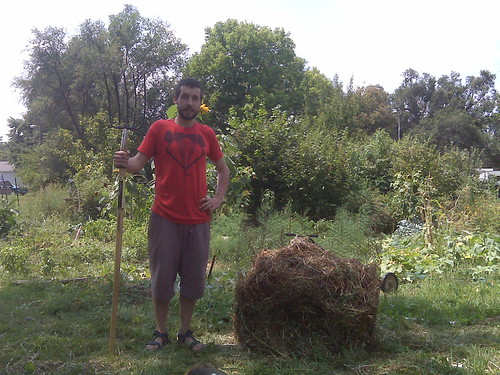
Thanks Gretchen for taking the photos!
Category: projects
-
6 Tips for Lead Safe Gardening on Vimeo
My friend John E produced this video on soil testing using our yard. Ronna is in there digging soil. Too bad they didn’t actually do the test. Good info none-the-less!
Vodpod videos no longer available.
more about "6 Tips for Lead Safe Gardening on Vimeo", posted with vodpod -
Hives get taller
Head-beekeeper, Robby-Bob, came by yesterday and added a shallow super to both hives.

Based on the progress that was observed in the last bee post, the hives were past due for some extra expansion room. It took a little while to source the correct size frames for the shallower top boxes, and Robby installed them while I was in class. Ideally the bees will use the new frames mostly for honey that we can later harvest. Robby decided not to use a queen excluder, so there’s the potential that the queen will get up there and lay eggs. We have enough supplies for one more box on each hive depending on how well they take to the new frames.
-
Recent Polaroids, Polaroid Transfers
I’ve been working on polaroid transfer techniques with my 125 Land Camera and expired peel-apart film. These are my first ‘roids of La Casa. I need to acquire new (to me) film!


(The transfer of the bees photo was not particularly visually interesting. Perhaps next time.)
-
Hive Tour 7/12/09

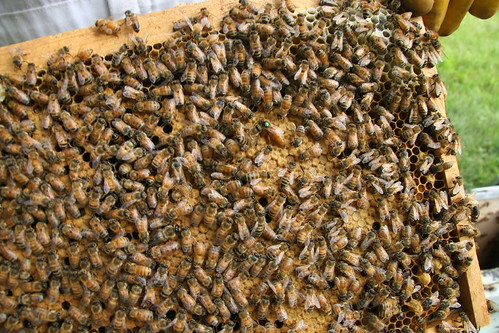
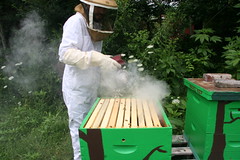 My good friends Kannan, and Mac helped me get a closer look inside out hives yesterday. Four weeks ago I put the second deep supers on each hive. The supers were full of bare frames, meaning the bees needed to build the comb before they could use them. Well, after checking out the hives I can say they are doing excellently. Lots of brood and some full frames of honey. There were even empty brood chambers where baby bees had already emerged. This means we probably need to add more space to allow the hive to continue to grow.
The diagram on the left is similar to our hives, (different lid and different number of frames) but it gives you an idea of how the hives are constructed. Its a fairly simple design. Wooden frames are suspended inside a box, and the boxes are stacked up. The bees then build honeycomb on both sides of each frame. I had some handy helpers, so we were able to take clean photos of each frame. I cropped all the photos in a similar way so you can flip through each cross section of the hive. As you get towards the middle you’ll notice that there is less honey and more brood. The queen lays eggs in a somewhat predictable pattern, and experienced beekeepers use that to judge the quality of the hive.
Vodpod videos no longer available. Vodpod videos no longer available. -
long time no post
Sorry for the long delay in posts.
Here’s some quick photos from our garden shot with my cell phone: hibiscus bloom, bell peppers, eggplants, tomatoes.

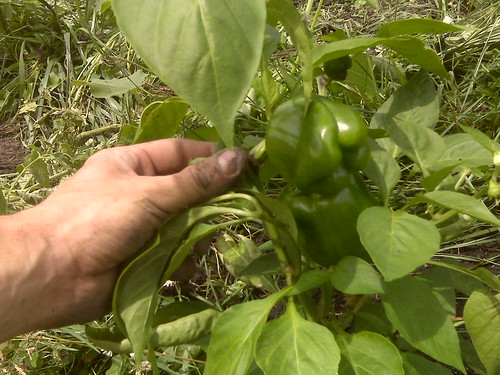
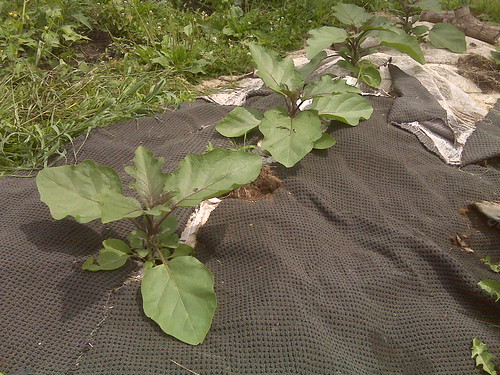

-
Late Spring Bee Checkup
Ed, a local beekeeper, came to check out our hives for a three week checkup last weekend. Robby is out of town, so he arranged to have some members of CEIBA help keep an eye on the hives. We had gotten a late start with our bees but each queen came with 5 frames of brood and honey. In just a few weeks, the bees have really established themselves and Ed determined it was time to add the second box on the hive. This will give each hive 10 fresh frames to build comb and expand the colony size.

This frame is full of capped brood. Brood is the general name for combs that have eggs and larvae. The worker bees feed the developing larvae before sealing them in with a cap . In a few weeks these bees will hatch and the process will start over again with the queen coming around and laying eggs in each comb. In this way, the colony will double and triple in size very rapidly.

In the center of this photo, a bee is hatching from the comb. We watched as the bee ate away the cap. Like eating corn on the cob, she went back and forth chewing her way out. After she leaves, the workers will clean out the comb and get it ready for another egg.

This is what the comb looks like when the bees decide to store honey instead of brood. This looks like it was a fresh frame to begin with since you can still see in the lower left that the comb hasn’t been fully drawn out by the bees. There must be a lot of nectar flowing now because even though the comb isn’t finished, the bees are already storing and capping honey. In the upper right is capped honey. To process the honey, the bees sit over the comb and fan their wings to evaporate off the water. Once the honey is sufficiently concentrated they seal the comb off. You can tell the difference between capped honey and capped brood by the color.
I took lots of photos so we could inspect the bees in depth without keeping the hive open for too long. Click the thumbnails to go to a flickr set of the event.

-
ODDMUSIC Urbana-Champaign: an invitation
Some of you have already heard about the weirdwonderfulness going on at the Independent Media Center these days. Jacob & Andrew have started renting a space & lovingly devoting it to ODDMUSIC. We are presently collecting musical oddities (such as microtonal midi controllers with hundreds of buttons, defretted guitars, and musical saws) to make available for public use. We envision, among many things, an instrument library, developing right here in Urbana.

Oddmusic experimenters playing on prototypes of the Tonal Plexus. I mention this now because a.) we just started a fancy new blog, & b.) we are hosting office hours every Sunday night this week from 7pm to whenever. Folks have come by to play on our strange instruments, talk oddmusic, & scheme for future musical provocations.
Do consider yourself invited! We plan to be there next Sunday (& times in between, of course, at odd hours), so please stop by & see what the heck. Oddmusic is located on the second floor of the IMC. We’ll leave the back door open for you – not the Bike Co-op door, but the next one over on the left. Walk up the stairs & follow the wafting tunes.
-
Honeybees arrive
We installed two hives of honeybees today at La Casa. Fellow co-oper, Robby from across town will be using our yard (and pollen) to raise honeybees. Robby got his hive boxes from his grandfather who was a beekeeper. Robby’s been taking classes from the Central Illinois Beekeeper’s Association: CEIBA. Last night we picked up the bees from a queen breeder near Danville. They were sealed in boxes for transport in the van.
About 10,000 bees came with each queen. Five frames from a two healthy colonies, along with a two queens were put into boxes. Today we tranported the frames into the hives. Robby moved the first colony, and I moved the second. We had to wear full bee suits otherwise the bees would have stung us many times. It was quite a rush carrying the frames full of bees and being careful not to disturb them too much. We took a bunch of photos, and I’m just going to go ahead and post most of them.

Robby tried to calm the bees down with sugar water. There were hundreds flying around us as we were working.
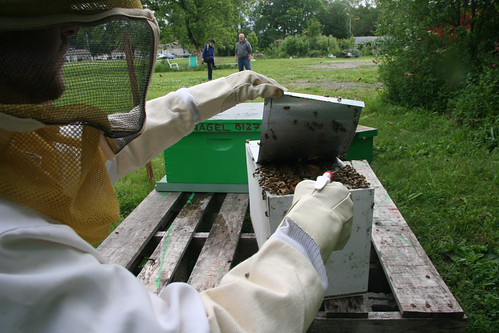
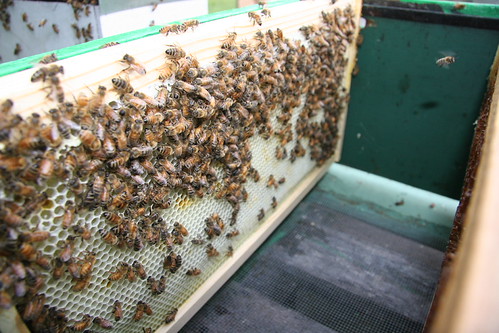
This is what frames look like installed in the hive. There are ten frames in each section of the hive. We mixed the five frames full of honey and brood (developing bees) in with 5 clean frames.
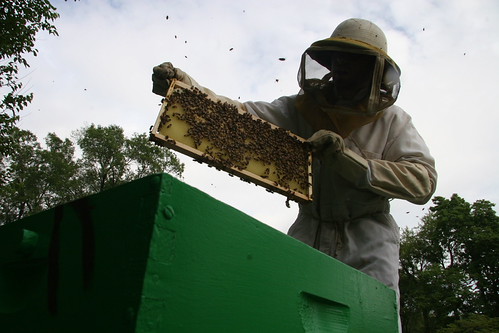

Most of the frames are installed. Just a few more to squeeze in.
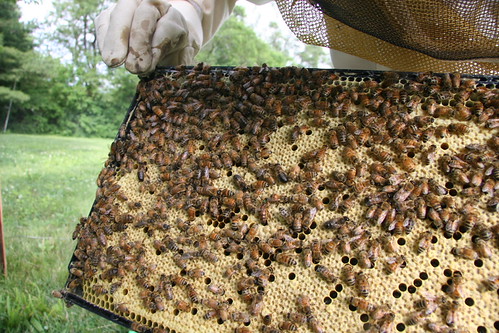
You can see the queen crawling around in this photo. There’s a little green dot on her back. Try this hi-res version if you want to see her up close. She has a longer body and smaller wings.
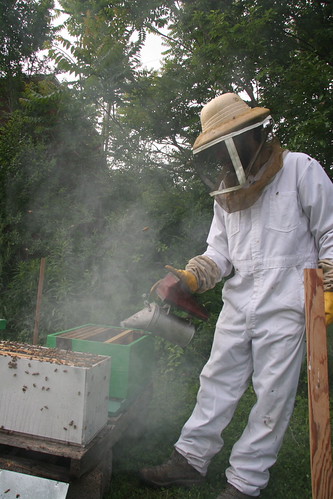
I suited up and moved the second set of frames while Robby took photos. This time we tried the smoker instead of sugar water. The smoke calms them down and confuses their communication.
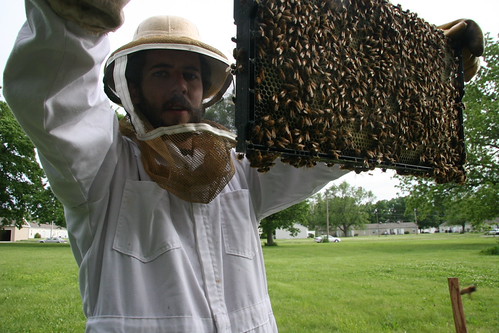
Robby snapped this nice photo.

Calming them with more smoke. Only two frames left to move.
The other queen. Look for the green dot. Hi-res.

All put back together. Bees installed. The next move is to put more boxes with clean frames on top. The hives are designed to be modular, building up from the bottom box. Two big boxes at the base are where the queen builds up her colony. Then at some point smaller boxes are placed on top with a screen that lets only the workers past. Since only the worker can access the top boxes, no eggs are laid and they become full of honey. Since we’re starting this hive pretty late in the season, we might not get much honey this year. But its still a worthwhile project and if the hives survive the winter, we’ll have plenty of honey next year. -
house concert – This Must Be The Place
Last Wednesday, May 13, we put on House Concert VII (seventh in “recent memory”), the final act of which was all of us La Casans covering the Talking Heads, This Must Be The Place. Heather got the whole thing on her point-and-shoot; thanks Heather!
More videos from Heather’s youtube:
A New Inspired Poem, by Snow Leopard.
This is the Title of the Story, read by Michael Phelps.
Hoprock, by Jacob Barton.
5 songs of fish (but in this instance, four), by Nodal Nim. -
Archery Range in the Yard
Cody, a friend of La Casa, has set up an archery range in the backyard. It’s realllly fun.


This is the target, several bales of straw.

And this is Cody’s beautiful puppy, Payton.


