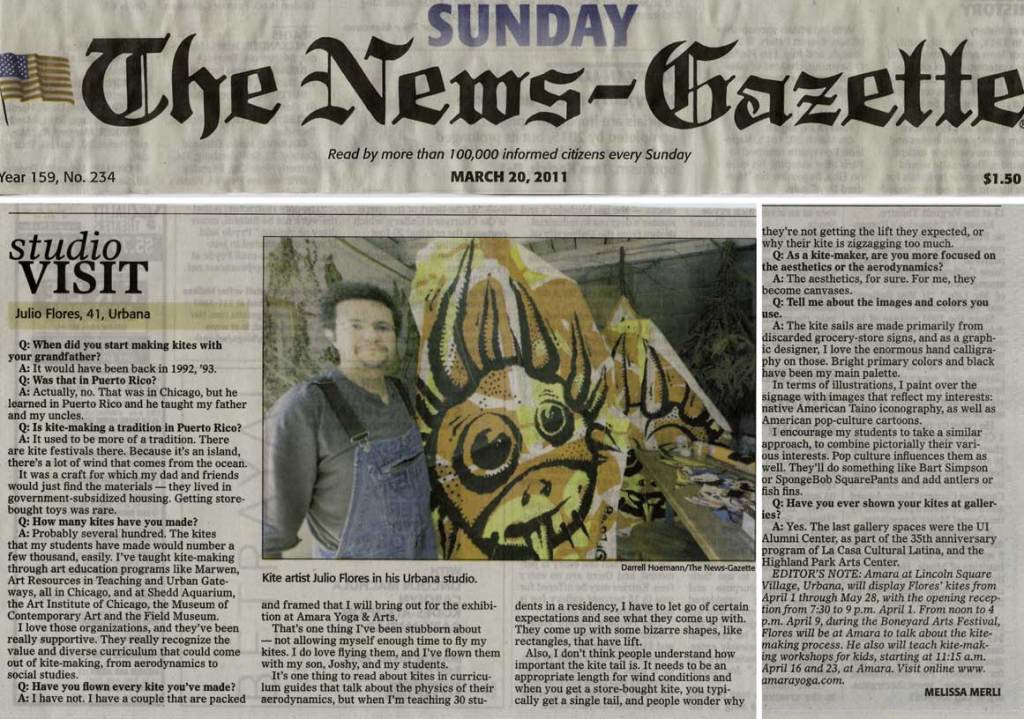
Much thanks to local reporter and friend, Melissa Merli!
Category: stories
-
What do bees do in the winter?

Unless you have a beehive in your backyard, you don’t see a lot of honeybees during Winter. In order to survive the long cold between flower blooms, the whole colony balls up inside of the hive and conserves heat by rubbing against one another. This mass of bees starts at the bottom of the hive and moves up the center eating all the honey. If they built up enough of a stockpile and the beekeeper didn’t take it all in the Fall, there will be enough to last till the Spring bloom. We didn’t harvest any honey last Fall, in fact Robby added an extra box of honey for the weaker of the two colonies (note the white box).Another factor that helps the bees survival over the Winter is death. The population of the hive drops dramatically from 50,000+ at the peak, all the way down to a few thousand. This greatly reduces the rate at which the colony consumes the honey stores.

Of course, with fewer workers around general hive cleaning maintenance is neglected, and the bottom board becomes a mass open grave. The bodies pile up next to puddles of excrement almost blocking the hive entrance.
On nice sunny Winter days some activity can be viewed around the hives. These photos were taken when the temperature was hovering around freezing, but the sun was thawing some of the accumulated snow. Bees were peaking out of the hole in the hive.

I sat and watched with my camera, eager to see where the bees were venturing out to, and for what purpose.

The purpose of her flight quickly became obvious. After scurrying around along the surface of the snow for a few minutes, this bee keeled over and died.

Perhaps in a selfless act, she sacrificed herself so the rest of the colony could have enough to eat and survive. Or perhaps she was denied access to the honey stores and escaped only to find the cold white doom outside.
A lot of what I’ve read about beekeeping suggests thinking about the entire colony as one living organism, and each bee, while performing a specific set of tasks, functions as the tissues and organs. So, like a bear who hibernates through Winter, the hive emerges in the Spring leaner, and eager to build up and stockpile of food. While thousands of dead bees littered around the hive seems grim, it is all part of the process of seasonal regeneration.
-
RIP, chickens
On Thursday, February 4th 2010, a loose pitbull entered our yard and killed six of our chickens.

Among the casualties were our alpha-hen, Ginger (pictured above), Stegasaurus, Lucille, and all of our Rhode Island Reds. The pitbull was picked up by animal control and the owners have been instructed to compensate us for the loss.
It’s hard to put into words the emotions that this incident created. We’ve lost chickens to predators and disease before, and we had plans to butcher several hens this Spring. The mental image that causes me the most sadness, all the hens watching in terror as the dog kills one after another of their flock-mates, is hard to push out of my head.
The flock is down to four chickens, three leghorns and an ISA Brown. We plan on getting more hens soon, stay tuned…
-
Bee update from R. Nagel

Robert wrote an update on the beehives on his blog. Here’s the whole thing.
”
Well last weekend (November 2) the temperature was fairly warm, the sun was shining, and the wind was lazily blowing. It was a good time to check the hives and I will be periodically checking the weak hive throughout the winter. Unfortunately, due to the late season swarm that took place in late July I believe, on hive has no food. And by no food I mean the hive has no honey.
Bees spend all summer preparing for winter. In the warm growing season they gather pollen and nectar from almost every plant within about a 2 mile radius and take it back to the hive and store it in the honey comb. By fanning their wings, they turn the nectar to honey by evaporating the water. Once the honey comb is full, it is capped with a white wax and left alone. Unless the bees decide to swarm. When the bees decide to swarm, they are dividing the colony in two and sending much of their honey stock to the new colony. This means that the honey is lost when the bees swarm.
When the one hive swarmed, they lost not only lots of honey, but also the queen. I’m not sure what happened, but without a queen and her guiding pheromones to control the worker bees, many of them simply stayed in the hive and ate honey. So instead of gathering at least 120 pounds of honey for winter, the bees had nothing.
 Some bees gathered on some frames discussing where the best flowers of C-U.
So this means I have to probably once every couple weeks go to the hive and give them some sugar syrup. I can make sugar syrup by mixing two parts sugar to one part water with some heat. A problem is that the syrup could freeze and the bees might not be able to get to it. Another problem could be that the sugar syrup stays too long in the container and goes bad before its all eaten.
Amazingly the hive stays relatively warm in winter. Although the outside temperature may drop to many degrees below zero, the core of the hive maintains a temperature of more than 90 degrees fahrenheit. The bees do this by clustering and then slowly circulating. Bees that have been on the outside of the cluster slowly move in towards the warmer middle and bees from the warm center slowly move outward. The queen, of course, is always the center of attention.
But without any honey, the bees have no energy to produce heat and the hive may freeze and/or starve to death. This would be pretty depressing so I am going to try my best to give the bees all they need to eat.
”
-
cArLy’S bIrThDaY << open thread
Carly’s birthday & party happened here on October 27th. These pictures bespeak a fraction of the unfolding mirth. Add pictures; comment!
 (the Jackalope)

a pictoral timeline of Carly’s birth mythology.

Surfing the certainty gradient…
or
being cute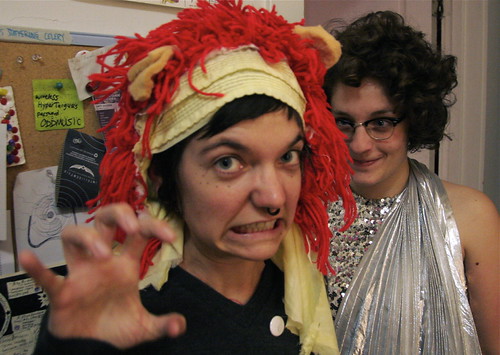
cute like a red-head bear/cat mop thing: Putting the “costume” in costume party.

What was I thinking?… or maybe what weren’t you thinking?
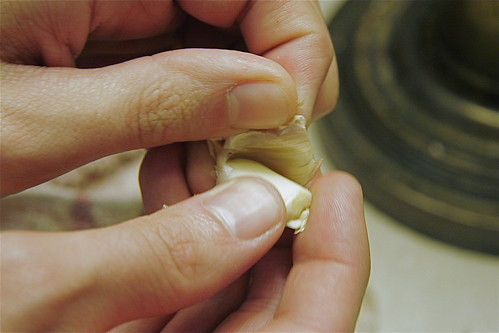
No party’s complete without it.

Traditional La Casa hand slap game.
-
The Fall Garlic Planting and a Story About Growing Garlic
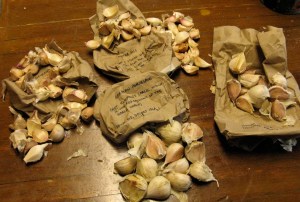
An apple-picking friend of mine from Way Back When grows some awesomely fine garlic. Her name’s Rebecca and she lives back East in Burlington, Vermont, which is where I spent the coldest winter of my life. One day the temperature with the wind chill factor was, I swear to you, 90 below zero. That’s 90. Below zero. The wind whips across the huge and frozen Lake Champlain and if you are there, you know bitter cold. Anyway…it was my great fortune this year to be a recipient of a sampling of Rebecca’s superb product. That cold but beautiful place makes for some fine, hot garlic, some of which I’m turning around and putting into our Illinois soil to, hopefully, carry on her good stuff and have lots more to devour in future times.
So, we’ve cleared out some of the tomato bed, which is petering out in this cold weather anyway. I put the green tomatoes in paper bags ala my father’s instructions. He sez they’ll ripen. We shall see. Erin and I began forking the bed, but Andrew did a lot more, then JP finished it off and worked in some compost.
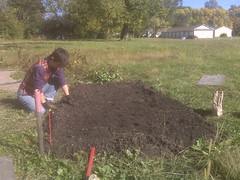 Today I planted the seed cloves from the 4 varieties Becky sent. JP helped with the first variety, Nootka Rose. The other 3 are Georgian Fire, N.Y. White and German Porcelain, the latter of which is HUGE, but NOT elephant garlic, which Rebecca said is the Red
  Delicious of the garlic world. You don’t have to be an old apple picker to know that that is tantamount to saying that elephant garlic is hardly worth eating, though, actually, La Casan Jacob would argue this point as he somehow is convinced that Red Delicious apples have some redeeming value. My heart aches for the dear boy. The German Porcelain garlic, indeed, is nice and strong, tons of flavor.
Now here’s a little story which is true:
I farmed garlic in Washington State for about a year and a half. I knew an elderly couple, the Webbers, who had formerly grown garlic organically. I thought the organic aspect was impressive as they had farmed many years before, far ahead of the current organic heyday and even far ahead of the beginning surge in the early 80’s. They were in their 90’s when I knew them back in the 90’s. Anyway, they let me and some friends of mine plant their field which was a nice field with an excellent view of Mt. Stuart.
 We did garlic and a lot of potatoes, too. One thing, though, their field had gophers. Not only did their field have gophers, but that field had more gophers than I knew could live in one field and what’s more is that these particular gophers had to taste every single garlic bulb to be absolutely sure that they didn’t like garlic. Also, the field had bindweed. It had extra strength bindweed that could bring down a rototiller in an astonishingly short amount of time, but which did not, apparently get in the way of gophers. Ever since, I can hardly believe it when I see packets of morning glory seeds for sale. I want to tell people not to ever plant it, that it comes from the devil. The DEVIL! And irrigation was, as I recall, quite tricky in that field. Al (Mr. Webber) made constant improvements to his “system”, though it never seemed become less tricky to me, and I think, quite possibly, more so. I do recall one great leap in the irrigation technology where the involvement of PVC pipes boosted our watering capabilities, but only for a day or so. Really, all those gopher holes led to one mother tunnel which emptied out not into the field at all, but, oh, down there, off the side of the hill. I thought perhaps it would at least have the benefit of washing the gophers away (or drowning the motherf*ckers), but it seemed to not impinge on them at all and what does not kill them makes them stronger. Pretty sure about that. If anything it seemed to have softened the soil up for them quite nicely. (It may have been about this time in my life that the murder of certain animals [being various rodentia] began to seem maybe not quite so abhorrent as I once thought. My dogs proved to be superior diggers, but insufficient gopher catchers. That’s a big help, as you can imagine.) Oh, and there was the wind. I wouldn’t want to neglect giving due mention to the wind which allowed for no hats, would throw dirt in your eyes, which once knocked me clean over and whose relentless blast caused me to cry and curse the wind god. (I only did that last thing once because the wind picked up noticeably when I did it.) Nonetheless, regardless and despite all we had a lot of fun and we all had garlic and spuds to last and it sure made the Webbers happy. I do not believe I would want to do it for a living, though. Not in that particular field, anyway.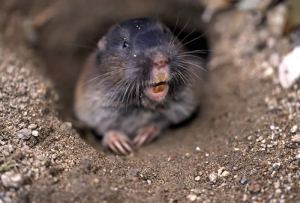
Garlic chomping gopher. Say that 3 times fast. 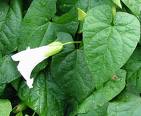
Bindweed (Morning Glory) -
Sundown Towns
Last night Andrew and I went to a Unit One lecture by Sociologist James W. Loewen on Sundown Towns and racism in small town America. “Sundown Town” is a name for a town or city where whites collectively drove out and kept out black people (and also sometimes Jews, Native Americans, Latinos).
These communities are sometimes called “sundown towns” because some of them posted signs at their city limits reading, typically, “Nigger, Don’t Let The Sun Go Down On You In ___.”

The practice began in the late 19th Century, became illegal after the 1960’s and the civil rights movement, but still persisted through the 70’s, and in some cases, still persists today or until very recently.
(These archival images are taken from Professor Loewen’s slideshow on Sundown Towns.)

He’s confirmed over 400 sundown towns in Illinois alone. I used his database to check out some towns I grew up around where I’ve never once seen a black person. The question about some of these rural towns is, do they just happen to be all white, or are they all white on purpose?
Maroa, Illinois, is on his list of confirmed sundown towns (which you can search by state). He writes that the main method of exclusion in Maroa is realtors refusing to sell to blacks, and a realtor told him in 2001 that there was still an ordinance on the books making this official town policy.
The method of exclusion varies by location. Some excluded by violence, threat of violence, police or other official action, and reputation.
You can check out Loewen’s website for more information, for papers on how he conducts his research, how to confirm sundown towns, and how to help him with this project in general. He is looking for volunteers to help him conduct oral histories and research in small towns across the country.
I’m looking forward to reading up on this disturbing side of American history that deserves more attention and understanding.
-
roasted eggplants, baba ganoush, lunch

Oh, those deep purple beauties ripening, ripening.

A little campfire, a lot of fire-roasted eggplant.

Delectable end product.
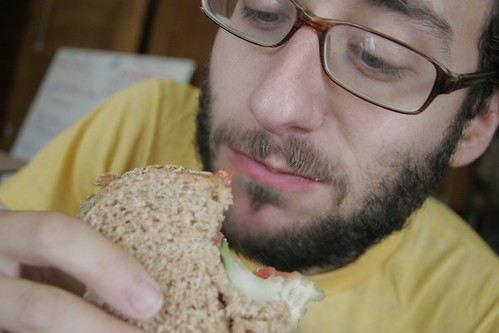
Andrew eating the hell out of a baba ganouj sandwich.
When you’re really lucky you plant some plants in just the right spot at just the right time and they say, “Man, I feel so good, I’m going to grow like mad and make lots of whatever it is I make.” We were sooo lucky here at La Casa. The eggplant plants went in the ground considerably past the prime time AND as you all know, summer was unusually cool. Eggplants like time to grow and some heat, you know, so what the hell? Not that I’m complaining. No. I am not. I’m rejoicing and not just about the mysteriously extraordinarily huge and productive plants that are our eggplant plants, but about wonderful new La Casan, Erin, who knew that you can put your eggplants by a fire to give them that extra flavor edge for better baba ganouj. But that’s not all! There’s extra flavor and then there’s someone who really knows how to work it. We at La Casa are fortunate enough to have in Erin, not just someone who can fire-roast an eggplant, but who can push that extra flavor to it’s most excellent extreme. It was so much fun today watching one after another of my fellows take their first bite and say, almost invariably, “Oh, my god!” You know, pure astonished delight.
If you want to fire-roast your eggplants just put them near your fire, almost in it. They will slowly start to shrivel and sag a bit. Keep turning them until the whole things is more or less rather shriveled. They should maintain their skin’s integrity for the most part. If they go up in flames you have gone well beyond fire-roasted.
Thanks to JP for photos and to Erin for the damned good grub. And La Casans in general for just being so great!
-
volunteer on student farm: get tons of free veggies
I went this morning to help on the new student farm located south of campus. The farm’s manager, Zack, showed me and a group of volunteers around as we helped out harvesting.
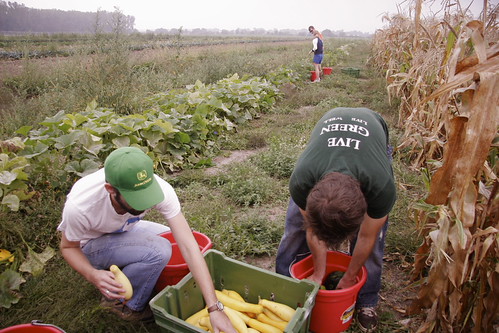
The produce from the farm is sold to University Dining Services and goes to feed kids living in the dorms. The student farm is part sponsored by the dining halls and part by the College of ACES. This is the FIRST year planting crops and they’re supplying a lot of food to the dorms.


We picked mostly squashes but some basil and parsley too.
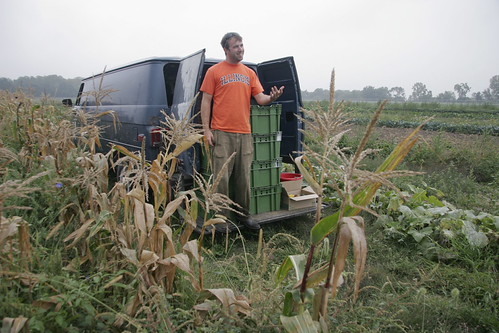
That’s Zack on the back of the van that Dining Services gave to the project.

The best part is that after a few hours of work, they let you take home as many veggies as you can carry! My roommates will be happy when they get home. -
paw paws, awesome
The paw paw genus (asimina) contain the largest edible fruit indigenous to this continent (says wikipedia). They apparently taste like a cross between a banana, a mango, and a pineapple. I’ve just begun learning about paw paws and recently was at a paw paw forest about an hour away.

The big leaves give the plant away, but the fruit are even more distinguishable.

Paw paws a very fascinating, I would recommend the wikipedia entry as a good introduction. Kentucky State University is building a great website for paw paw information and research of which there is surprisingly little. Compared to standard orchard fruits, not a lot of people are working with paw paws because they have a very short shelf life. For the backyard orchardist who doesn’t have to worry about shipping and storage, the paw paw could be an easy delicacy. Due to the fact that they’re indigenous, they are extremely pest resistant.There’s one paw paw on the Urbana Fruit Map in someone’s yard and they’re not overhanging the sidewalk (yet), so don’t take any!
Paw paws grow densely in the understory layer. Next time you take a ride down Washington St stop and take a look at the beautiful trees with the big leaves.
-
late summer hive check – mystery queen
Robbie and I opened up the hives a few weekends ago to take an inventory of the healthy hive and see how much brood the new queen has produced in the weaker hive. Sadly, we didn’t see a lot of honey in the honey supers (the shallower frames on top). We figured this was some what to be expected since our hive was just getting built up when most of the plants were producing nectar. It was a timing issue, and we were late getting our hives started.

You can see that there is some capped honey in the middle, but the bees have barely drawn out the wax comb towards the edges of the frame.In the hive that recently had been re-queened, there was a clear sign that the new queen had been successfully introduced. You can see in the photo below that some of the cells have a dark yellow cap on them. That’s called ‘capped brood’, and in a few weeks fully developed bees will eat their way out and begin working right away.

The brighter orange cells are pollen stores.When we first opened up the second hive we immediately noticed something strange. Right in the corner of the hive that we pried open with the hive tool, there was an unmarked queen hiding out.
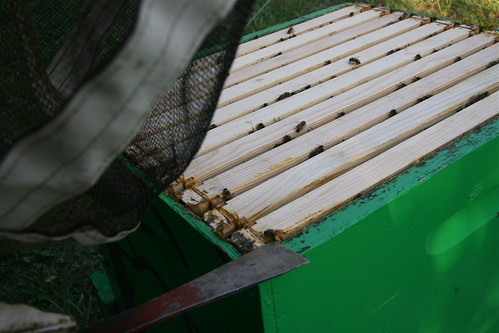
There she is about as far away from the nucleus of the hive as possible.

You can see her elongated abdomen and short wings. We were hoping to find signs of the introduced queen and maybe spot her, and oddly the first bee we see after opening the hive is another queen. I suspect that before the first queen swarmed, the bees had already started feeding royal jelly to create a new queen. By the time she hatched we had stuck a new queen in, who has now taken over the colony.If you spend a moment to think about it, a very interesting tale of courtly coups could be extracted from this. Is the native born queen entitled to the crown? Who is this imposter queen who has stolen the throne and banished the rightful heir to the far reaches of the queendom? Did we screw up the natural order of things by adding a new queen when the bees were busy rearing a new one?
We scratched our heads (through the veils), set the mystery queen aside, and continued looking for signs of the introduced queen. When we were finished and putting the frames back in we found the unmarked queen very close to where she was before.

It seems as though she still had a few workers attending to her.


 La Casa Grande Colectiva