
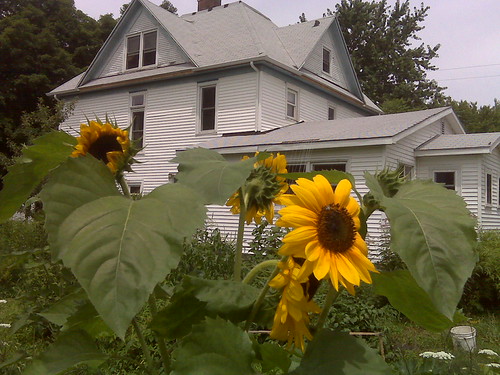
If you walked around the La Casa garden, you’d probably wonder why we planted so many sunflowers. Well, we didn’t actually plant a single one. At least no one did this year. They are all volunteers.
Author: JP
-
volunteer sunflowers
-
long time no post
Sorry for the long delay in posts.
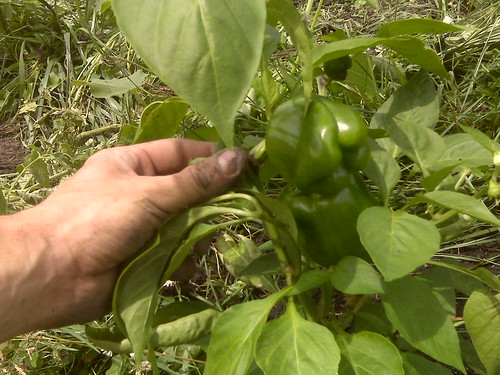
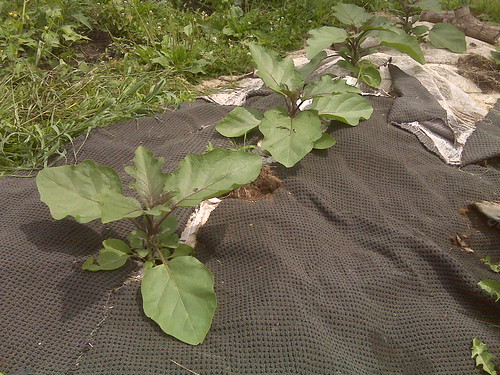
Here’s some quick photos from our garden shot with my cell phone: hibiscus bloom, bell peppers, eggplants, tomatoes.


-
Black Raspberry and Currant Jams

Carly whipped up some delicious jams with the abundant berries from our garden. I helped a little. -
Dome Encounter
I went on a class trip to East St Louis this weekend, and lo and behold, we visited a dome.
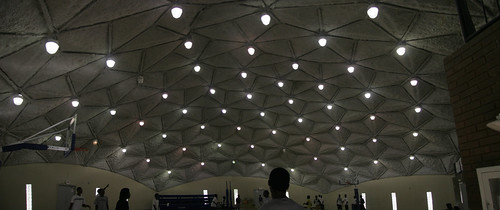
The Dome housed the gym of the Mary Brown Community Center, which was a big stop on our two day tour of the different community centers, libraries, and churches where community engagement is taking place. I was very much in awe of this dome (which didn’t seem geodesic since there weren’t just triangles, but I could be wrong). I made the spliced panorama above (hastily) while two games of pickup basketball were being played.
As a blogged about before, Domes are notorious for being difficult to maintain. I was curious about this beautiful structure so I decided to cast a net (aka Google Search) and see what info about the Mary Brown CC was out on the web.

click the image to see the search results page I tried a few different search strings and eventually came across the Search Timeline for “mary brown community center”. The Timeline feature is cool, but its utility is limited. As you can see, the search results only go back as far as 1988, when Jackie Joyner Kersey began getting press about her desire to rehab the Community Center where she first began running track. The timeline displays results from the Google News database, which seems to have a limited scope. I’m sure if I went and did a similar search through old microfilm and other non-digital archives, I would come up with a much broader picture of the history of the Community Center and the Dome. Of course, I would probably never actually do that, and I was able to learn much about the Center by rifling through the results. I couldn’t find the year the Dome was built but I did learn that the Dome was rehabbed in 2004 after years of delays (and a scandal?). One thing I don’t like about this Timeline feature is that many of the News stories need to be purchased in order to view the fulltext, boo. I guess newspapers need to make money somehow.
-
Late Spring Bee Checkup
Ed, a local beekeeper, came to check out our hives for a three week checkup last weekend. Robby is out of town, so he arranged to have some members of CEIBA help keep an eye on the hives. We had gotten a late start with our bees but each queen came with 5 frames of brood and honey. In just a few weeks, the bees have really established themselves and Ed determined it was time to add the second box on the hive. This will give each hive 10 fresh frames to build comb and expand the colony size.

This frame is full of capped brood. Brood is the general name for combs that have eggs and larvae. The worker bees feed the developing larvae before sealing them in with a cap . In a few weeks these bees will hatch and the process will start over again with the queen coming around and laying eggs in each comb. In this way, the colony will double and triple in size very rapidly.

In the center of this photo, a bee is hatching from the comb. We watched as the bee ate away the cap. Like eating corn on the cob, she went back and forth chewing her way out. After she leaves, the workers will clean out the comb and get it ready for another egg.

This is what the comb looks like when the bees decide to store honey instead of brood. This looks like it was a fresh frame to begin with since you can still see in the lower left that the comb hasn’t been fully drawn out by the bees. There must be a lot of nectar flowing now because even though the comb isn’t finished, the bees are already storing and capping honey. In the upper right is capped honey. To process the honey, the bees sit over the comb and fan their wings to evaporate off the water. Once the honey is sufficiently concentrated they seal the comb off. You can tell the difference between capped honey and capped brood by the color.
I took lots of photos so we could inspect the bees in depth without keeping the hive open for too long. Click the thumbnails to go to a flickr set of the event.

-
praying mantis pods

A bunch of praying mantis pods were recovered from the burn pile yesterday. The pods were attached to last year’s bamboo growth and were cutout when the grove was thinned. Ronna found them in the brush pile and saved them because she thinks they’re beautiful. They’re now nicely displayed on our kitchen table as an interesting conversation piece.

We got to talking about them and wondered if there were still mantis babies inside. This caused Don and I to search for information online about praying mantis lifecycles. We found this short video on youtube:
-
Honeybees arrive
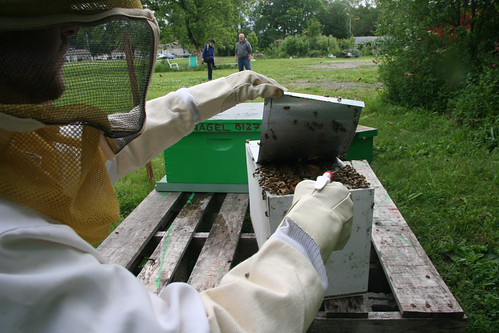
We installed two hives of honeybees today at La Casa. Fellow co-oper, Robby from across town will be using our yard (and pollen) to raise honeybees. Robby got his hive boxes from his grandfather who was a beekeeper. Robby’s been taking classes from the Central Illinois Beekeeper’s Association: CEIBA. Last night we picked up the bees from a queen breeder near Danville. They were sealed in boxes for transport in the van.
About 10,000 bees came with each queen. Five frames from a two healthy colonies, along with a two queens were put into boxes. Today we tranported the frames into the hives. Robby moved the first colony, and I moved the second. We had to wear full bee suits otherwise the bees would have stung us many times. It was quite a rush carrying the frames full of bees and being careful not to disturb them too much. We took a bunch of photos, and I’m just going to go ahead and post most of them.

Robby tried to calm the bees down with sugar water. There were hundreds flying around us as we were working.
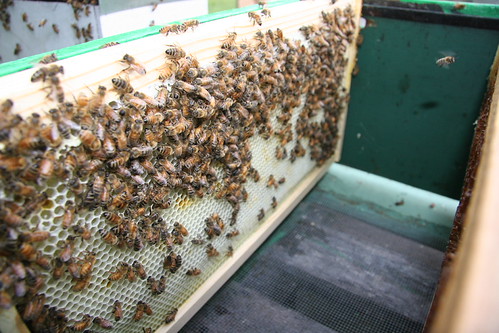
This is what frames look like installed in the hive. There are ten frames in each section of the hive. We mixed the five frames full of honey and brood (developing bees) in with 5 clean frames.
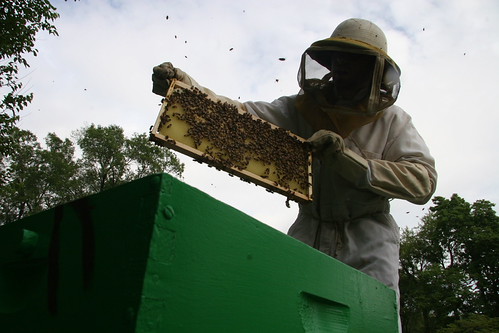

Most of the frames are installed. Just a few more to squeeze in.
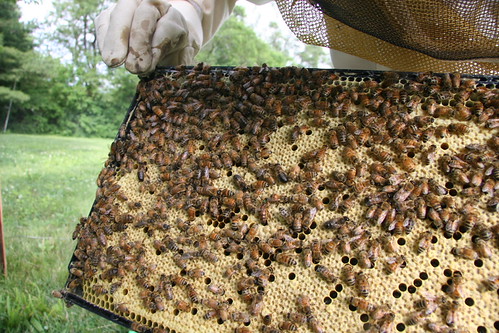
You can see the queen crawling around in this photo. There’s a little green dot on her back. Try this hi-res version if you want to see her up close. She has a longer body and smaller wings.
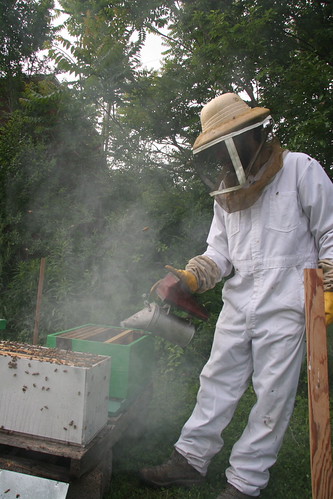
I suited up and moved the second set of frames while Robby took photos. This time we tried the smoker instead of sugar water. The smoke calms them down and confuses their communication.
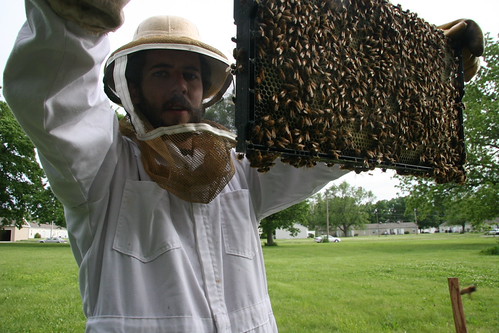
Robby snapped this nice photo.

Calming them with more smoke. Only two frames left to move.
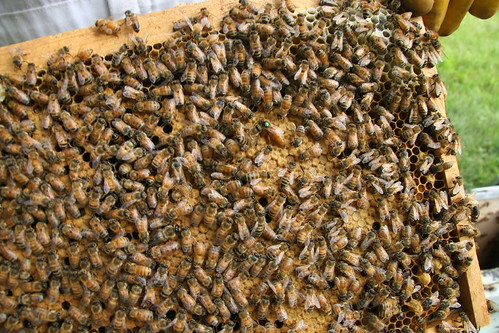
The other queen. Look for the green dot. Hi-res.

All put back together. Bees installed. The next move is to put more boxes with clean frames on top. The hives are designed to be modular, building up from the bottom box. Two big boxes at the base are where the queen builds up her colony. Then at some point smaller boxes are placed on top with a screen that lets only the workers past. Since only the worker can access the top boxes, no eggs are laid and they become full of honey. Since we’re starting this hive pretty late in the season, we might not get much honey this year. But its still a worthwhile project and if the hives survive the winter, we’ll have plenty of honey next year. -
house concert – This Must Be The Place
Last Wednesday, May 13, we put on House Concert VII (seventh in “recent memory”), the final act of which was all of us La Casans covering the Talking Heads, This Must Be The Place. Heather got the whole thing on her point-and-shoot; thanks Heather!
More videos from Heather’s youtube:
A New Inspired Poem, by Snow Leopard.
This is the Title of the Story, read by Michael Phelps.
Hoprock, by Jacob Barton.
5 songs of fish (but in this instance, four), by Nodal Nim. -
now for something totally different
have you guys heard of this? i had heard about it awhile back and it sounded cool, but the description left me wondering what it looked like. now there’s this video out. i just watched it and it blew my mind … the future, now? will it [gasp] change the world? its based on this guys ideas put down in this book about seven years ago. whaddya know, they’re located in Champaign, IL. we are at the center of the universe.
its supposed to go live to the public tonight
-
after the flood
We got soaked yesterday and most of the garden is now underwater. yikes.

from some news article… “In Illinois, a range of windy storms dumped as much as 3 inches of rain within 50 minutes. National Weather Service meteorologist Ed Shimon called the accumulation “unbelievable,” comparing it to heavy rainfall in the tropics.”today – dry
tomorrow – more rainlet’s hope this dries up soon.
update: went out and snapped some photos with my “good” camera. click thumbs below to see ’em.


