Author: JP

  • Satellite Images Updated for Urbana

    Up until yesterday, every time I checked out our town on Google Maps or Google Earth, I was frustrated by the low-res images that were in the database.  Well thats changed and now there are great images for Urbana, although they’re a year or two old.  (You can see the veggie-diesel truck in the yard from a former housemate)

    Satellite view of our yard, with labels
    Satellite view of our yard, with labels

    There are a lot of sweet GIS tools that Google offers through Earth and Maps that allow you to play with the images and add your own content layers.   I drew a path that shows my bike route to work everyday. Then I made a screen capture.

    My bike route to work
    My bike route to work

    GIS (geographic information systems) is an exciting field that has many possible community applications. La Casa member, Jacob, made this map last year that shows where all the fruit trees are growing in town. This is a form of community asset mapping. Pretty sweet.  What else can we do?

  • an urbana community garden

    My great friend Drew, an environmental philosopher, has been working hard on getting more community gardens started in Champaign-Urbana.  Over the weekend I helped out at one of the locations for an eco-ecumenical group that formed this year.  Here’s some phoneCAM photos that I snapped to document the day.
    Mulching watering

    Raspberries were planted along the wall.  A generous amount of straw mulch was put down.

    Planting

    Peas, and flowers were planted along the front rows.

    Planting tomatoes

    A variety of tomatoes were planted in the middle of the plot.

    Mulching approved

    Nice mulch, Gretchen approves.

    Drew and Brian

    Drew and Brian, the site organizers.

    Workdays are Saturday mornings from 9-12 at different sites around town.

    To learn about how to get involved visit:  http://www.ecoecumenical.org/

  • neighborhood pancake breakfast

    Block By Block, a group of neighbors, organized a potluck style pancake breakfast this morning.  Before our house meeting, a few of us made it over for some delicious food, complete with maple syrup that was tapped from maple trees in the area.  I forgot to bring my nice camera, but I brought my phoneCAM.

    Community pancake breakfast

    It was great to meet and chat with so many neighbors at once.  I had some really great conversations, and we went home with a cucumber plant!
    Local syrup

    Block By Block Cooperation is a group of neighbors in unhistoric east urbana (the historic part starts north of Washington).  They are organizing people and raising awareness of local food issues.  Its really exciting to see such things happening only 2 blocks from La Casa.  There are so many projects that we can work together on.

    neighbor Sam tapped the local maple trees to make syrup for the pancake breakfast, thanks Sam!
    neighbor Sam tapped the local maple trees to make syrup for the pancake breakfast, how f-ing cool! It came out really delicious. what a treat, thanks Sam!
  • Across the street from the “center of the universe”

    As the Spring gets on, it seems like a lot of strange coincidences keep happening.  The other day while we were making eggs and potatoes for breakfast, we heard a gathering across the street.  We walked out in PJs, coffee in hand to see about 50 or so people gathered at the corner to see Roger Ebert’s childhood home dedicated with a plaque.  Mr Ebert himself was in town for his annual Roger Ebert Film Festival, and was there for the occasion.
    Roger ebert grew up across the street woah

    He walked around and greeted all those who attended, and several local notables spoke a few words.  I later heard that the woman who taught Mr Ebert how to read and write was there to congratulate him, but that may have been a rumor.  All in all it was a good start to the day, and our housemates were eager to tell friends about the event.  We like our neighborhood very much so learning that Mr Ebert was once very much a part of it is cool.  Growing up, my parents watched Siskel and Ebert a lot and would sometimes let me lay between them and watch too.

    I snapped the above photo with my cell phone and put it on my flickr page almost as a habit, and a friend commented.  She said, “Sweet! You’re living at the center of the universe: blogs.suntimes.com/ebert/2009/04/410_east_was hington_stre…”  I didn’t know until this morning but Roger Ebert keeps a blog.  And its a great blog (as to be expected from someone who won a Pulitzer for his writing).  He recently wrote a very lucid post about growing up in his Urbana home, which is just two houses away from where we currently live at La Casa.  His post begins, “I was born at the center of the universe, and have had good fortune for all of my days. The center was located at the corner of Washington and Maple streets in Urbana, Illinois…”  Wow, tell me more.

    I’m sure a lot has changed in C-U since then, but many of the places he reminisces about also exist in my memories of this town.  I spent time on photography projects in the cemetery, snuck around Altgeld at night, the powerplant, the railroad tracks, cobblestone streets whose tree canopies must be at least 50 ft taller than they were back then.  His descriptions of the Urbana of 50 years ago are fascinating, and very much worth reading if you’re familiar with the area.

    Ebert was a writer for the Daily Illini, the same student newspaper where I worked during my undergrad years.  Although I didn’t write, I took photos.  I probably learned more taking photos for the paper than I did sitting through photography classes, mainly because it was an applied learning environment.  You really figure out the relationship between aperture and depth-of-field when you come back from an assignment and all your photos are blurry.  I can only hope that some day I will earn a Pulitzer with the skillz I picked up from the DI!  Ahh but with the digital age its hard to make a living as a photojournalist (not to mention a regular journalist).

    My housemates and I keep talking about connecting with the history of our Coop and our community in general.  Urbana has a very rich history of social justice and political activism.  We are finding that the interconnectedness of the online world is helping us do that, as we find old coop members through facebook and by way of blog comments.  Its really a fascinating process to witness, and knowing that there are people like Mr Ebert who keep a blog and seem to have a photographic memory makes me hopefully that there are many connections to still be made.

    Here’s a bit about our Center of the Universe.  We are surrounded on one side by the “Historic Neighborhood of East Urbana” and on the other side by a somewhat new grouping of condominiums.  Our yard, which is just shy of 3 acres, seems to be the biggest undeveloped lot in the area (and the largest patch of turf after the high school).  We are constantly wondering what used to be here and why no one built anything out there.  About a month ago, a permaculturist named Peter Bane visited us.  He grew up in Urbana like Mr Ebert and his grandparents used to grow a bit of food in their yard as well.  He had many stories to share about the neighborhood as it was.  He told us that our lot was the lowest point in the area, and the reason it was never developed was because it was probably too water-logged.  Now it seems to be the only substantial greenspace close by that isn’t a park.  Mr Bane taught permaculture to Rob who then designed and planted the garden that exists today.  We also heard from the owners of our house that a large community garden existed along the dirt drive the edges the property, but that was a long time ago.

    We’ve dug a few holes recently to put up a clothes line and the excavation shed some light on the history.  We dug through a layer of bubbly looking cinders from the coal that used to heat the house, probably from when Ebert lived across the street.  There is actually still a pile of coal in our basement and the foundation has the hatch that it was shoveled through.  These little things remind me of what was here before I moved in and the collective experience of a changing neighborhood in the middle of America.  I wonder if as a boy, Mr Ebert spent time in our yard as a lot of neighborhood kids still do.  Were there raspberries growing along the fence back then?

    The great thing about the internet (and Web 2.0 if you’re into that lingo) is that its conversational.  There are feedback tools like commenting and rating (often a thumbs up or down 😉 that allow for two way communication.  In reading Ebert’s post I noticed that he replies to many of the comments that readers leave, and so I can only assume that he is excited as well about the potential connections to be made through online participation.  In that spirit I’m going to comment on his post with a hyperlink to this one.  Thanks for your compelling stories from Washington and Maple Mr Ebert.
  • OPEN FORUM ON BROADBAND IN C-U

    There was a very inspiring event this weekend where a group of community members got together to talk about getting broadband to the entire C-U community. YES!  I believe internet access is an important factor for inclusion in the emerging 21st century culture, especially a sustainable culture.  The forum was built off of a project already underway by CITES (the campus technology department) to apply for stimulus money (read: Obama money).  The stimulus package included 9 billion for getting broadband to rural and low-income communities and CITES is writing a proposal that will ask for $25-30 million.  Here’s the current draft of the map that was passed around by Mike, the project lead and panel member for the forum.
    Urbana Champaign Big Broadband version 7

    The yellow, blue, and pink areas north of campus are the low-income neighborhoods that the plan is specifically targeting. Although much of the talk during the forum focused on creating access models that include some sort of FREE access (as in beer) Mike was very clear that the proposal that he is writing won’t be FREE because the stimulus money stipulates that the plan must be “sustainable”. This is where the meaning of sustainable means different things to different people. It is still unclear what the final proposal will look like. A lot of the community members, church leaders, teachers, etc, were very clear that the digital divide is stopping many sectors from fully embracing online resources. For example, a teacher couldn’t assign online homework if they couldn’t be sure all students could get online. The librarian from Urbana Free also got up and lamented that her public access stations were constantly backed up; a sign of the times…

    Open Access Forum
    From left: Danielle (from UCIMC), Mike, (CITES), Anne Bishop, (GSLIS community informatics), Abdul (GSLIS), and a church organizer (can't remember her name, sry)

    I can envision a compromise being a network of free wireless nodes that reach every home. The wireless would have some bandwidth limit if needed. If you want your own wired connection, you’d have to pay a certain amount. This would enable everyone to have some sort of access, and also allow people to have the super-sexy-mega-bandwidth. The mega-access really makes the whole project enticing to a lot of the more affluent parts of town already getting screwed by Comcast, but don’t realize it.  Mike was saying he wanted 100 MBPS… damn.

    There is a website up to coordinate the whole effort.  (Champaign Urbana Open Access Coalition) Anyone interested in OpenAccess for Urbana-Champaign should think about signing up.

  • don’t mind me, just a little mushroom in with the plants

    mushroom in with the seedlings

    A couple tiny mushrooms popped up among our seedlings the other day. I was unable to accurately identify them using our field guides, and I’m still wondering if mushrooms are some sort of indicator that we’re doing something wrong. Either way, I thought they were interesting.

  • perennial emergence

    Would anyone like to trade some images for some words? How many words are these pictures worth? ~JP

    I meet your five pictures with five poems.  Brownie points to those who guess th constraint. ~AndR

    bamboo shoots
    Bamboo Shoots

    blasting aggressively, my bamboo oozes out,
    striking hard only once: three shoots


    hops coming up
    Cascade Hops

    “climb! a skyhigh clamor! away, dread earth!”
    (how ordinary: pursuing sun)


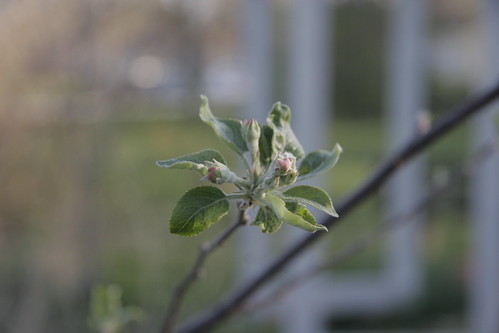
    Apple buds blossom
    Apple bud blossoms

    a plump pink leafy existence
    but under drunk
    billowing laughter of some smiling ovary: my spectacle


    older asparagus bed
    Asparagus

    aerodynamic sunfed plant, arousing rustic “awwww’s”: give us splendor


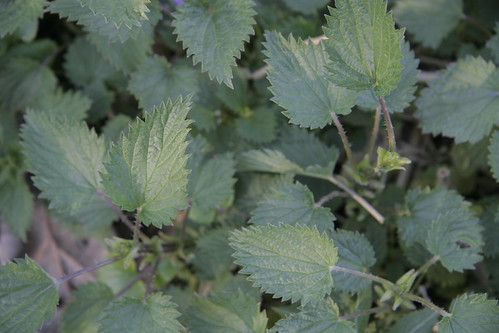
    stinging nettle
    Stinging Nettles

    spines touch. i never go in nighttime gowns
    never ever tattle try like embers: sigh

  • Jacob, white bread

    Jacob told me yesterday that he was going to bake bread everyday this week.  Pictured below is day 2.
    Jacob baked bread

    Tired of so many a bread machine failure loaf this year, I decided to take failure into my own hands.  Bread, like mayonnaise and kombucha, is something La Casa knows is way way waaaay better when you make it yourself, unquestionably worth the extra effort. This half-whole-wheat loaf was hand-formed with my trademark ineptitude™ and includes sunflower seeds and rosemary.  Maria (my protégé) has assisted greatly with kneading and baking.

  • Grafted Golden Delicious

    My friend and band-mate Sam generously gifted me this piece of M-7 rootstock with three golden delicious apple buds grafted onto it.  Sam’s horticulture class at Parkland College was doing a unit on grafting and he wanted to share what he was learning with me and La Casa.  We grafted on two dormant buds in Sam’s kitchen Friday afternoon and I biked home with it all smiles.  I’m keeping it in the sunny room with the seed starts until its ready to move outside.

    The golden delicious graft with the seedlings in the background.  Three buds were grafted onto the rootstock.  I did the top bud and Sam the middle.  After the buds grow the green on top will be cut off.
    The golden delicious graft with the seedlings in the background. Three buds were grafted onto the rootstock. I did the top bud and Sam the middle. After the buds grow the green on top will be cut off.
  • Make Mountains

    Last Friday I made it to the U of I quad during an event by local artist Bonnie Fortune called Make Mountains. Participants were instructed to assume a stance similar to downward facing dog.  I participated as long as my wrists would let me, and then went on my way after snapping this photo.
    Make mountains

    We don’t have any mountains here, and the flat land seems boring and barren sometimes. This performance gesture was a nod to those communities suffering from mountaintop removal practices.

  • Domebook 2, Geodesics: futuristic design meme of the past

    A geodesic dome made of glass
    A geodesic dome made of glass

    The Library of Radiant Optimism is a project by Let’s Remake, a group of local artists/activist that live in our hood. They write: “The Library was begun to catalog a groundswell of optimistic and visionary activities in the late 1960s and early 1970s. We gathered a handful of books that embrace grass roots exchange of information and themes of self and community empowerment.” They put up a PDF of a book titled Domebook 2 and I’ve been fascinated with it the last couple days.

    Domebook 2 was published in 1971 by Lloyd Kahn, at the height of geodesic dome excitement within the counterculture.   Geodesic domes were evangelized by Buckminster Fuller as being cheap, easy to construct, and structurally superior.  Sounds super-cool, right?  After spending some time reading through the book I did a bit of background research on domes, this book, and the author.

    It turns out that Domebook 2 was taken out of print by Kahn a few years after publication after continued frustrations with dome building.  After building some 19 domes, Kahn abandoned domes altogether and shifted his inquiry towards elegantly built homes made from local material.  This new work was published in the books Shelter (1973) and Shelter II (1978).  However, he had created so much hype about domes that he continued to be asked about their construction for years and years.  He finally wrote up this piece, Refried Domes, along with a comparison of dome/rectangle construction.  His arguments against domebuilding are many and seem to have been earned through the pain of experience.

    Reading Kahn’s later words killed some of the excitement I had upon discovering the book.  Over a hundred pages of beautiful people trying new and exciting ways of living resonated with my current view of the world.  Domes might make bad homes, but they certainly seem appealing when the rest of the world is so square.  I also love the idea of starting with a stack of triangles and a group of friends and building an object of wonder together.

    Kahn, now 72, lives outside SF, CA.  He has a blog and wrote a new book, Builder’s of the Pacific Coast.

  • modeling the La Casa permaculture garden in 3D

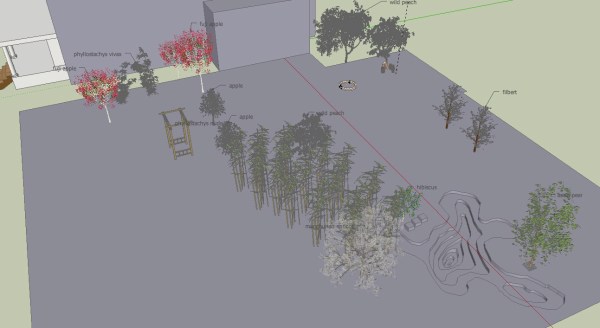
    Here’s a 3D model in that I’m in the process of building to document our permaculture garden. It includes a mock-up design for the pond that attempts to maximize the amount of perimeter. I’m still learning how to use Google Sketchup so I haven’t added too many bells and whistles.

    Garden Model

    I sense an interesting utility in 3D modeling software when building permaculture designs.  I’m already comfortable using photoshop but it was a conceptual leap to start working in the third dimension. Google made Sketchup very user friendly and they have online tutorials to explain each tool. Here’s a good place to start if your interested. The killer feature that google implemented is the ability to download and add models to the 3D Model Warehouse. That is where all the trees in my model came from. Other users have already started adding their own permaculture designs.